
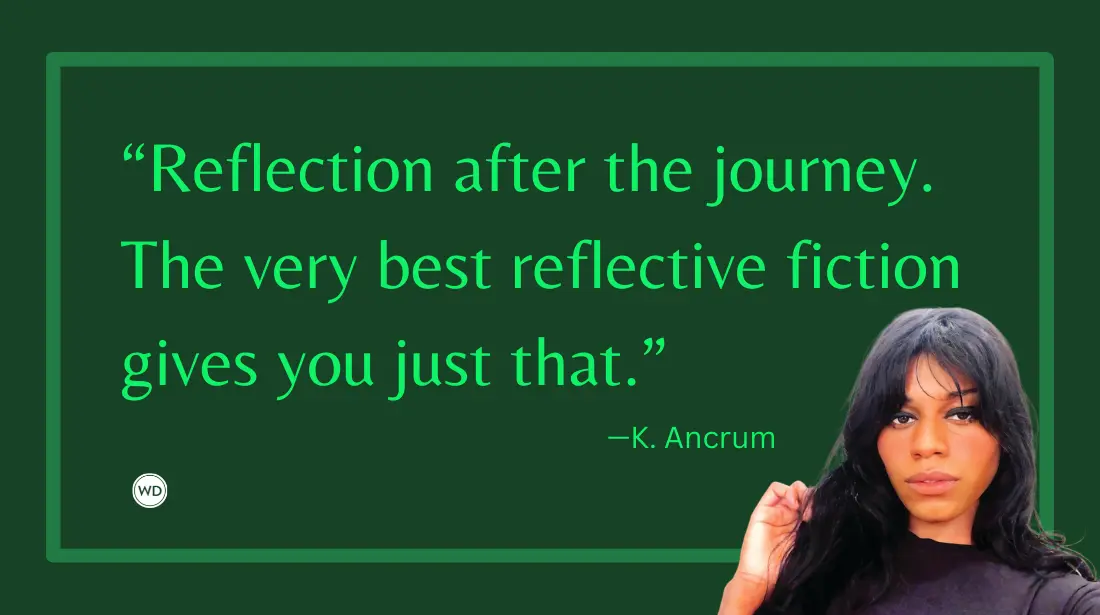
Executive Overview
In the realm of creative writing, prescriptive advice is often treated as a rigid architectural blueprint: pour the foundation, raise the load-bearing walls, and do not deviate from the plan under penalty of structural collapse. However, award-winning young adult (YA) author K. Ancrum offers a radically different, delightfully tactile paradigm. Approaching the composition of reflective fiction not as an engineering feat, but as the intimate, intuitive art of making a family lasagna, Ancrum demystifies the craft.
By drawing a parallel between layering pasta, cheese, and sauce and developing character arcs, philosophical themes, and narrative resolutions, Ancrum provides writers with an accessible yet sophisticated framework. Her core premise is straightforward: writing advice is like someone else’s family lasagna recipe. It supplies a sequence of steps and ingredients that ultimately yields a finished dish, but the creator retains full autonomy. Whether a writer chooses to add extra garlic, omit the boiling phase, or experiment with alternative layers, the final product remains uniquely their own.
This investigative look into Ancrum’s methodology—anchored by insights from her latest release, Adam, Mine.—explores how structural non-negotiables, internal character development, contrasting personalities, and satisfying thematic payoffs converge to create unforgettable reflective fiction, particularly for young readers.
Read Also
Detailed Chronology: The Four-Step Culinary Blueprint of Storytelling
To understand Ancrum’s approach to structuring a reflective narrative, one must trace the sequential methodology she outlines for authors. Far from a chaotic kitchen experiment, her process follows a deliberate trajectory designed to ensure that thematic weight and emotional resonance are baked into every layer of the manuscript.
Step One: The Non-Negotiables (Laying the Pasta)
Every culinary creation requires a structural base, and in Italian cuisine, that base is the noodle. Without it, you simply have a bowl of sauce and melted cheese. In reflective fiction, the "noodle" represents the central thesis or the primary point of reflection chosen by the author.
Ancrum stresses that this must be established first. Before diving into the nuanced interplay of sugar versus acid (plot mechanics versus character depth), an author must decide what conversation they are opening within the cultural zeitgeist. When readers close the back cover, what concept do they need to have reflected upon?
Once this thematic anchor is secured, writers face the classic culinary dilemma: to boil or not to boil.
- The Traditional Boiler Approach: Selecting a protagonist who directly embodies the author’s philosophical projection. Janet Finch’s White Oleander serves as a prime example, where characters act as clear avatars for the underlying philosophy of the work.
- The No-Boil, Foil-Covered Method: The riskier, more modern approach. Here, an author selects a protagonist who seems entirely antithetical to the book’s core message, then subjects them to the crucible of the plot until they soften and transform. Jeannette Walls’ The Glass Castle exemplifies this dynamic, proving that unconventional protagonists can yield profoundly satisfying narrative resolutions.
No matter the method chosen, the structural foundation—the thematic core—is non-negotiable.
Step Two: The Internal Cheeses (Character-Focused Growth)
Moving past the foundational pasta, a lasagna requires layers of creamy dairy: béchamel, ricotta, mascarpone, or parmesan. In Ancrum’s narrative kitchen, these cheeses represent the internal architecture of character-focused work.
This phase relies on flexibility, but the ultimate goal is rich, textured emotional development. Character-driven narratives demand a limited articulation of personal growth. Protagonists cannot begin the story with a complete, enlightened understanding of the world; otherwise, narrative tension evaporates.
Instead, characters must initiate their journeys in a state of deficit—not knowing, stuck, confused, or operating from the innocent limitations of youth. This deficit prepares them to undergo transformative experiences or face forces that irrevocably alter their worldview. Without an initial lack of understanding, stories lose the runway necessary for profound change, as seen in literary milestones like Alexandre Dumas’ The Count of Monte Cristo, Stephanie Land’s Maid, and Marjane Satrapi’s Persepolis.
Step Three: The Sauce (Personality, Conflict, and Contrast)
The sauce offers the greatest potential for individual expression. Whether an author opts for a hearty meat sauce, a chunky vegetable blend, or a silky smooth purée, the sauce dictates the overarching flavor profile of the dish.
In storytelling, the sauce translates to the personality of the protagonist and how they react to external circumstances. An author must balance the character’s reaction speed against the escalating problems introduced by the plot. Crucially, Ancrum notes that a protagonist’s personality does not need to mechanically mirror the book’s broader philosophical goals.
Ancrum illustrates this principle through her own work, Adam, Mine., a narrative love letter to Mary Shelley’s Frankenstein. In her novel, the monster-figure is embodied by a man driven by incredible bloodthirst in his pursuit of vengeance. Yet, his internal personality is gentle, mournful, and burdened by a sense of external duty. He weeps frequently—even before committing acts of extreme violence.
By juxtaposing a gentle, grieving interiority with a violent, plot-driven exterior, Ancrum creates a distinct, unusual flavor profile. She could have chosen to write a cold, virulent sociopath; instead, she chose a more complex dynamic suitable for a young audience exploring the true meaning of atonement.
Step Four: The Closer (The Melty Mozzarella of Reflection)
Every great lasagna culminates in a layer of mozzarella that bubbles, browns, and provides a final, savory stretch of salt. In storytelling, this is the resolution—the structural element that delivers post-journey reflection.
The finest reflective fiction provides readers with a moment to lean back, process self-analysis, and recognize that they have arrived at a destination entirely different from where they began. Whether executed through a striking monologue, as in Albert Camus’ The Stranger, or a cathartic graphic rumination, as in Alison Bechdel’s Fun Home, the narrative must look directly at the audience and signal transformation. It must articulate clearly: Here is where we are now; this is what has changed, and this is what will be.
Supporting Context & Metrics: The Mechanics of YA Reflective Fiction
Writing for young adults and children presents unique structural challenges that elevate the importance of Ancrum’s metaphor. Unlike adult literary fiction, which often revels in unresolved ambiguity, YA reflective fiction operates under a social contract to guide readers toward emotional clarity without sacrificing nuance.
The Demographics of Reflection
Publishing data indicates that YA readership continues to demand character-driven narratives that tackle complex philosophical questions—such as morality, identity, and systemic justice—packaged within accessible frameworks. When authors like K. Ancrum utilize genre tropes (such as the gothic echoes of Frankenstein in Adam, Mine.), they leverage familiar narrative signposts to smuggle profound moral inquiries past the gatekeepers of juvenile cynicism.
Balancing Simplicity and Depth
The "gluten-free easy bake noodle" approach—writing accessible stories for younger audiences—requires rigorous authorial discipline. As metrics in youth literacy and engagement show, young readers are uniquely receptive to stories that treat their emotional intelligence with respect. By presenting complex ethical dilemmas through empathetic antiheroes, authors create a safe psychological distance that allows readers to evaluate their own value systems.
Official Statements & Authorial Philosophy
To further illuminate the philosophy driving Ancrum’s work, her approach underscores the symbiotic relationship between writer and audience. Writing is not a surveillance operation; it is an act of trust.
"It’s MY family recipe, but I am not in your home watching you make it," Ancrum notes regarding the malleability of writing advice. "Feel free to add extra basil or completely skip boiling the noodles, you’ll still end up with a lasagna (probably)."
This philosophy liberates emerging writers from the paralysis of perfectionism. By viewing craft books and structural guides as flexible culinary traditions rather than immutable laws, authors can focus on what truly matters: the emotional truth of the characters and the resonance of the closing reflection.
Furthermore, Ancrum emphasizes the intentionality required when shaping antiheroes for younger demographics. Addressing the ideological framework of Adam, Mine., she explains her choice to ground a violent narrative arc in a tender, sorrowful protagonist:
"My noodles, my conversation for the zeitgeist, is a story for children about a slow and philosophical journey between two teenagers who are deciding what kind of adults they would like to become… positioning them appropriately to confront the question ‘what does atonement truly mean?’ by presenting these quandaries from the perspective of well-balanced empathetic antiheroes."
Future Outlook: The Evolution of Craft Metaphors in Publishing
As the literary landscape continues to diversify, traditional, rigid rules of narrative structure are increasingly giving way to fluid, cross-disciplinary pedagogical tools. Authors are finding that culinary, musical, and somatic metaphors resonate more deeply with modern creators than dry academic jargon.
K. Ancrum’s lasagna metaphor points toward a future where writing advice is taught not through prohibitions and warnings, but through sensory engagement, experimentation, and emotional honesty. By breaking down complex narrative theory into digestible, kitchen-table steps—pasta, cheese, sauce, and cheese pull—Ancrum equips a new generation of writers to step into the kitchen of their own imaginations with confidence.
Ultimately, whether an author’s recipe calls for extra garlic, gluten-free noodles, or a daringly unconventional protagonist, the objective remains the same: to pull the dish from the oven of the creative process, slice it with care, and invite readers to sit at the table.





Comments
Facebook App ID not configured. Please add it in the Customizer.