
Executive Overview
The landscape of historical fiction has long wrestled with a fundamental tension: the dichotomy between macro-level historical accuracy and micro-level emotional truth. For readers and writers alike, the challenge is not merely documenting dates, troop movements, and legislative acts, but capturing the atmospheric and psychological reality of human beings navigating catastrophic events.
In this literary landscape, bestselling author Sharon Cameron has carved out a distinct and rigorous methodology. Best known for her meticulously researched works—including The Light in Hidden Places, which chronicled the harrowing true story of Stefania Podgorska, and her more recent release, Up From the Ashes, detailing the miraculous survival and romance of Chaim and Selma Engel at the Sobibor death camp—Cameron bypasses traditional archival boundaries. Instead, she forms deep, collaborative relationships with the living descendants of her subjects.
This investigative profile explores Cameron’s literary philosophy, the profound methodological risks of inviting living trauma into the creative writing process, and the structural framework she has developed for working directly with families. By wedding rigorous public-record research with the intimate, unvarnished oral histories held by descendants, Cameron’s work achieves a form of "dramatized reality." This approach bridges the gap between textbook history and visceral empathy, redefining how authors can responsibly bring twentieth-century atrocities to life on the page.
Read Also
Detailed Chronology: From Middle-Grade Escapism to Holocaust Realism
The Formative Years of Literary Discovery
Cameron’s fascination with the emotional weight of history began in childhood, devouring middle-grade and young adult historical fiction. Long before she encountered the dry recitation of dates in standard history curricula, she understood that well-researched fiction possesses a unique capacity to illuminate the collective human experience. By centering narratives on the emotional truth of individuals, these early reads laid the foundation for her eventual career as a novelist.
Transitioning to Speculative and Historical Worlds
When Cameron transitioned to writing professionally, her initial output spanned steampunk, dystopian societies, and light science fiction. Yet, her creative process remained anchored in historical rigor. She researched speculative settings with the same obsessive dedication she would later apply to the Holocaust, discovering that grounding fantastical elements in real, profound human emotional weight provided a realism that pure imagination could never achieve.
The Paradigm Shift: Confronting the Holocaust
The pivot to writing about the Holocaust demanded a complete reinvention of her research paradigm. When Cameron chose to chronicle the life of Stefania Podgorska—a 16-year-old Polish Catholic girl who hid 13 Jewish individuals in an attic while four Nazi officers lived downstairs—she realized that traditional authorial license was ethically untenable. To re-imagine suffering or invent atrocities out of whole cloth would constitute a profound disservice to the historical record and the survivors.
Rather than writing a work of traditional nonfiction, Cameron sought to construct a piece of "dramatized reality." This required an unprecedented level of hyper-accuracy, both historically and emotionally, driving her to bypass standard secondary sources and approach Podgorska’s surviving family directly.
Deepening the Narrative: The Light in Hidden Places
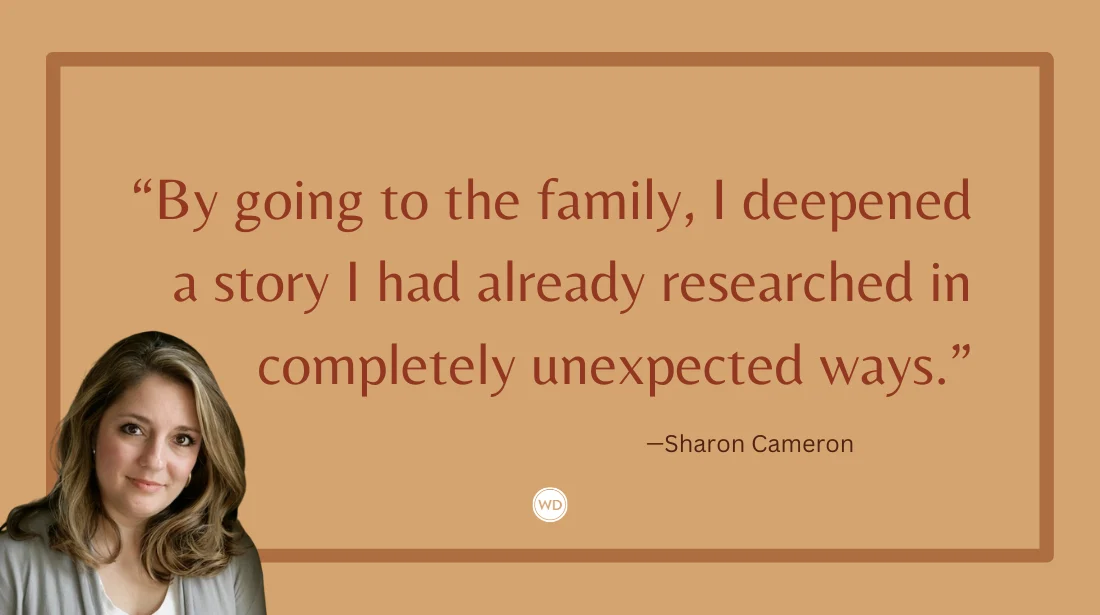
Against the warnings of publishing professionals, peers, and friends who cautioned against the unpredictable friction of working with non-literary families dealing with generational trauma, Cameron forged ahead. The resulting collaboration yielded extraordinary access:
- The Memoir: Cameron gained access to Stefania Podgorska’s unpublished, unedited personal memoir.
- Visual Records: She reviewed private photographs and video footage, analyzing speech patterns and body language.
- Oral Histories: Through the trust established with the family, she interviewed Helena, Stefania’s younger sister and an unsung hero of the rescue, uncovering previously unspoken stories.
- Immersive Geography: Cameron walked the streets of Podgorska’s Polish hometown and stood inside the very house where 13 lives were saved.
Expanding the Methodology: Up From the Ashes
Building upon the success of her methodology, Cameron applied these same principles four years later to the story of Chaim and Selma Engel in Up From the Ashes. Approaching the children and grandchildren of the Polish boy and Dutch girl who fell in love and escaped from the Sobibor death camp, Cameron transformed what could have been an exclusively brutal account of survival into a testament of resilience, hope, and enduring love.
Supporting Context & Metrics: The Mechanics of Descendant-Led Research
Collaborating with families who carry the living legacy of trauma requires a delicate, highly structured methodology. Cameron’s framework offers a blueprint for authors navigating the ethical minefield of historical dramatization:
1. Rigorous Prior Research
An author must never approach a subject’s family as a substitute for basic homework. Archival documents, historical texts, and digital research must be exhausted beforehand. Descendants should be engaged to enhance and humanize existing knowledge, not to serve as basic educators on the historical timeline.
2. Trauma-Informed Engagement
Trauma does not die with the direct victim; it cascades through generations. Writers delving into recent historical atrocities must educate themselves on how to interact with trauma survivors and their descendants. Knowing how to phrase questions sensitively—and, equally important, recognizing when to step back and withhold questioning—is paramount for maintaining ethical boundaries and gathering accurate interpretations.
3. Sensitive Outreach Protocols
When families have deliberately chosen a private life rather than a public profile, direct cold-calling can be intrusive. Cameron emphasizes utilizing institutional intermediaries:
- Museum curators holding donated artifacts.
- Archivists managing historical documents.
- Hometown librarians, local historical societies, and non-fiction authors who have pre-established rapport with the community.
4. Establishing a Shared Vision
The bedrock of any collaboration involving generational trauma is a unified vision. Because books form a permanent legacy, alignment on the target audience, the desired age level, the strictness of historical accuracy, and the thematic framing of the ancestor is essential. A shared goal prevents downstream conflicts and fosters a climate of mutual respect.
Official Statements and Industry Perspectives
The intersection of historical fiction and living memory raises critical questions regarding authorship, creative license, and ethical stewardship. Publishing and historical experts have increasingly debated the boundaries of creative non-fiction and biographical novels.
While literary traditionalists often caution that integrating living family members into the novel-writing process risks compromising artistic independence, authors who champion this approach argue that the ethical imperative lies in honoring emotional fidelity. As Cameron notes regarding editorial boundaries:
"Establish boundaries for what a family’s help looks like, for when a draft can be read by the family, how long they have to read it, and leaving the last word editorially with the author and editor is paramount."
At the same time, Cameron emphasizes the necessity of humility in the face of ancestral memory:
"However, when I have worked with a family, I have always compromised on language or scenes where a family member is uncomfortable. Respect for their feelings—and their ultimate support of the book—is more important than how a sentence is phrased or a certain scene is framed. If the family is uncomfortable, then I, as the author, am probably wrong."
This philosophy challenges the traditional autonomous auteur model of writing, suggesting that when dealing with living history, co-creation with descendants acts as an essential ethical anchor against sensationalism.
Future Outlook: The Evolution of Historical Fiction
As the living generation of World War II and Holocaust survivors steadily diminishes, the literary world faces a profound transition. The era of direct, first-person oral history is drawing to a close, placing an unprecedented burden on second- and third-generation descendants to preserve and transmit the emotional weight of these historical events.
Cameron’s work points toward a new paradigm in historical storytelling—one where novelists do not merely consult archives, but actively partner with descendant networks to function as custodians of memory. This collaborative model counters the risk of historical amnesia and combat-fatigue surrounding well-documented atrocities by re-infusing dry historical events with raw, intimate, and rigorously verified human truth.
In the future, the success of historical novels depicting twentieth-century conflicts may well be judged not only by their fidelity to tactical timelines and wartime documents, but by the depth of trust established between authors and the families whose legacies they steward. By demonstrating that trauma and heroism can be rendered with both literary power and deep communal respect, Sharon Cameron’s work establishes a rigorous standard for the next generation of historical storytellers.


Comments
Facebook App ID not configured. Please add it in the Customizer.