
Executive Overview
The international fine art market, institutional galleries, and cultural heritage networks find themselves grappling with a turbulent cycle of high-stakes crimes, record-shattering fossil auctions, and profound historical revisions. In the heart of France, a brazen overnight museum heist has stripped the nation of an irreplaceable, multi-artist surrealist masterpiece, prompting local officials to mourn what they term an "assassination" of French cultural heritage. Simultaneously, the commercialization of prehistoric paleontology continues unabated, with Sotheby’s gearing up for another multi-million-dollar dinosaur skeleton auction that highlights the evolving nature of scientific classification.
Beyond headline-grabbing thefts and prehistoric sales, the cultural landscape is shifting across institutional and geographic boundaries. From major gallery realignments involving acclaimed painters like Denzil Forrester to transformative philanthropic investments in South Asian art galleries, the art ecosystem is experiencing a period of intense financial and structural recalibration. Meanwhile, in the realm of antiquities and medieval studies, foundational assumptions about the world’s most mysterious historical documents are being rewritten. This report provides a comprehensive, investigative breakdown of these critical developments, offering structural depth, contextual analysis, and forward-looking projections for the global art market.
Detailed Chronology & Investigative Breakdown
1. The Surrealist Heist: The Disappearance of the Livre de l’Apocalypse
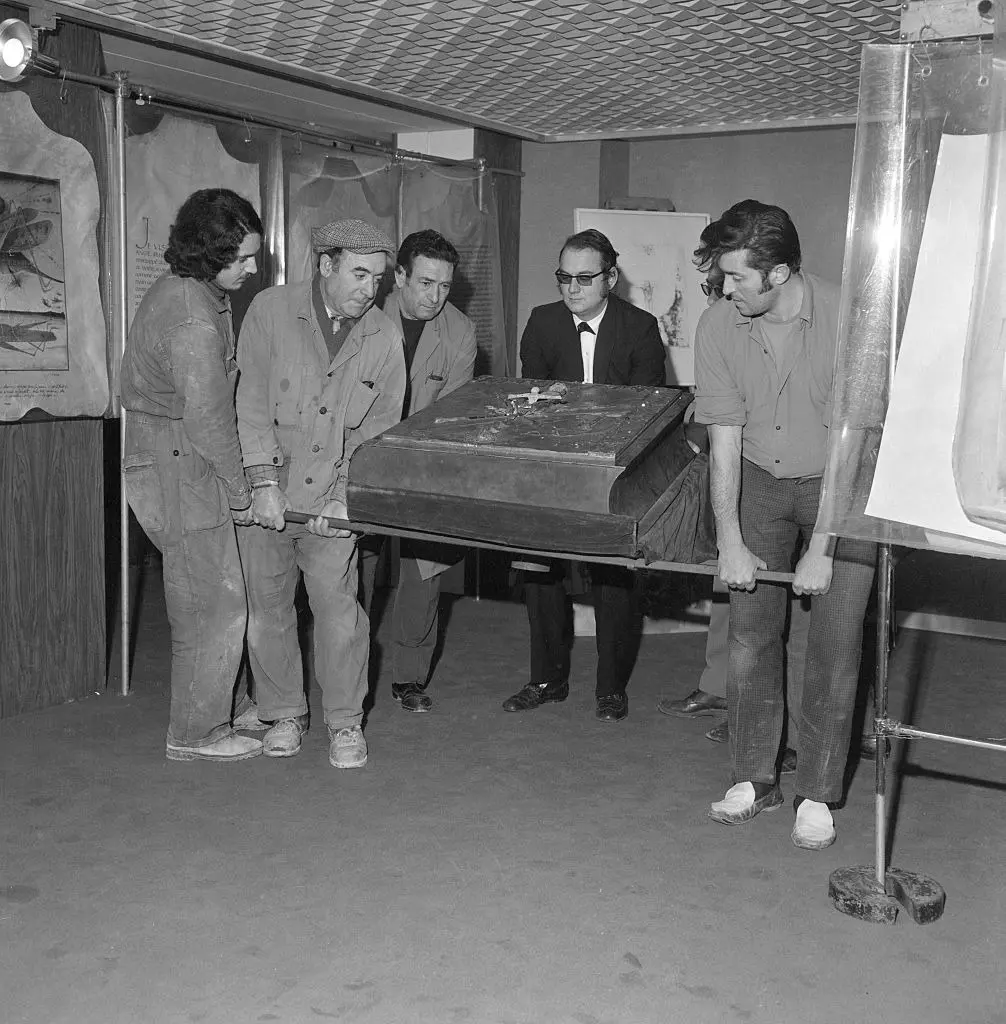
Between the hours of Sunday night and Monday morning, a small, private contemporary art museum in Issoire—a picturesque commune in central France—became the latest target in a troubling wave of European cultural property thefts. The object of the crime was nothing short of monumental: a 330-pound book cover conceived for the collective masterpiece known as the Livre de l’Apocalypse (The Book of Revelation).
Read Also
Commissioned in 1958 by visionary French art publisher Joseph Foret, the project was designed as a sprawling, collaborative testament to modern artistic output, bringing together fourteen preeminent figures of twentieth-century art and literature. While the core of the publication consisted of 150 large sheets of parchment, it was the monumental protective housing that commanded legendary status. Designed by Salvador Dalí, the bronze-cast cover was heavily encrusted with precious stones, rare seashells, and signature Dalinian flourishes, including actual cutlery welded into the composition.
Law enforcement agencies in France have launched a multi-jurisdictional investigation, though early reports indicate a frustrating lack of forensic evidence regarding how perpetrators managed to extract a 330-pound metal-and-jewel armature from a secure exhibition space without immediate detection. Fortunately, the 150 parchment leaves containing the textual and graphic contributions of other luminaries—including Jean Cocteau, Bernard Buffet, and Jean Giono—had been stored separately and remain safely accounted for.
However, the loss of the physical binding has sent shockwaves through the French heritage community. Christian Karoutzos, the private owner of the masterwork, delivered a scathing indictment of the security lapses plaguing regional institutions, telling local radio broadcasts that "they assassinated France last night; they assassinated French heritage." Issoire Mayor Bertrand Barraud echoed this sentiment, categorizing the cover as a "work of a lifetime" whose intrinsic and cultural value remains entirely "inestimable."
2. Paleontological Commerce: Jodi the Nanotyrannus Heads to Sotheby’s
In an entirely different arena of high-value asset exchange, Sotheby’s New York is preparing for its upcoming October 27 auction, which will feature the commercial sale of "Jodi"—a remarkably well-preserved, fossilized Nanotyrannus skeleton. Estimated to fetch between $6 million and $9 million, Jodi’s impending auction block appearance underscores the booming, albeit controversial, intersection of commercial auction houses and high-end paleontology.
Jodi is no stranger to the global exhibition circuit. The specimen previously made waves at Frieze London in 2023, where it was initially marketed as a juvenile Tyrannosaurus rex and attached to an ambitious $20 million price tag. However, rigorous anatomical re-evaluation over the past year led paleontologists to reclassify Jodi as a distinct, valid species—a smaller cousin to the undisputed king of the dinosaurs.
This valuation pivot arrives on the heels of Sotheby’s blockbuster July sale of "Gus," a full-grown T. rex that commanded an astonishing $50.1 million at auction. While commercializing natural history specimens routinely draws fierce debate from academic paleontologists concerned about the privatization of scientific data, auction houses defend the practice by framing it as a vital bridge between private wealth and public awareness.
Supporting Context & Metrics
To fully understand the current pressures facing museums, galleries, and auction houses, one must examine the broader metrics governing institutional funding, real estate maneuvers, and global biennials:
- Institutional Funding and Regional Grants: The San Francisco Arts Commission (SFAC) recently injected a staggering $25.26 million into the local creative ecosystem. Distributed across 465 individual grants, this capital aims to sustain local artists, community-based nonprofits, and cultural institutions weathering economic shifts.
- Architectural and Philanthropic Investments: Philanthropist Sukumar Nagendran has committed a transformative $5 million gift to the Phoenix Art Museum. The capital is earmarked specifically for expanding the museum’s Sri Lankan and South Asian art galleries, fueling new acquisitions, supporting scholarly research, and underwriting public engagement programs.
- High-End Real Estate Shifts: The intersection of wealth and art collecting was further highlighted as prominent collector Beth Rudin De Woody listed her expansive, 5,000-square-foot Upper East Side cooperative apartment for $12 million—marking her second attempt to sell the 1929 property since 2018.
- Global Biennial Expansion: The 2026 Lagos Biennial officially released its preliminary roster of participating artists for its upcoming exhibition, "The Museum of Things Unseen." Curators have assembled a cross-disciplinary group of talents—including Ade Adekola, Ala Praxis, Caitlyn Min-ji Au, CAMP, Ha Bik Chuen, Jacob Höfle, the Lagos Studio Archives, and Olukemi Lijadu—signaling a continued shift toward decentralized, archival, and post-colonial institutional critique.
Official Statements & Industry Reactions
The professional art world has responded to these developments through varied channels, highlighting systemic vulnerabilities and paradigm shifts:
On the Issoire Museum Heist:
"They assassinated France last night; they assassinated French heritage. This is a tragedy from which physical recovery may prove entirely impossible."
— Christian Karoutzos, Owner of the Livre de l’Apocalypse binding.Mayor Bertrand Barraud on the Inestimable Loss:
"It is the work of a lifetime. The physical weight of the object is 330 pounds, but its cultural and artistic weight to our region and to French history is completely inestimable."On the Reclassification of Jodi the Dinosaur:
"It’s a really good example of how paleontology is an evolving science and how specimens like this can answer fundamental questions about how prehistoric ecosystems worked."
— Cassandra Hatton, Head of Science and Natural History at Sotheby’s.
Future Outlook & Market Projections
As the global art market navigates the remainder of the fiscal year, several critical trajectories are emerging from these events:
1. Heightened Security Audits for Regional European Museums
The brazen theft in Issoire exposes a critical vulnerability: while major metropolitan institutions—such as the Louvre or the Musée d’Orsay—deploy fortress-level security infrastructure, regional and municipal museums housing high-value masterworks remain dangerously underequipped. Over the next 12 to 24 months, European cultural ministries are expected to mandate stricter baseline security protocols for regional lenders, potentially accelerating insurance premiums and forcing smaller institutions to temporarily repatriate or place high-risk items into secure state-run vaults.
2. The Maturation of the Commercial Fossil Market
With Jodi’s reclassification as a Nanotyrannus and its adjusted $6 million to $9 million estimate, the market for prehistoric specimens is maturing past the speculative gold rush that once plagued juvenile T. rex valuations. Institutional buyers, private collectors, and auction houses are developing a more nuanced taxonomy for natural history assets. However, friction between academic researchers and commercial auction houses will likely intensify, necessitating new hybrid models of fractional public-private ownership or right-of-first-refusal agreements for museum acquisition committees.
3. Gallery Consolidation and Talent Migration
The structural realignment of blue-chip galleries continues unabated, evidenced by Grenada-born painter Denzil Forrester’s recent transition to Thaddaeus Ropac following the closure of Stephen Friedman Gallery. As mid-sized galleries face rising operational overhead, rent spikes in global art capitals, and increased competition from mega-galleries, top-tier artists are consolidating their representation with operations capable of providing international institutional placement and robust market stabilization.
4. Technological and Archival Interrogation of Historical Textures
As demonstrated by recent revelations surrounding the Voynich manuscript—where digital medievalists proved that centuries of scholarship were derailed by improperly bound, jumbled pages—the digital humanities are aggressively upending traditional art history and codicology. The dismantling of the "lone genius in an attic" myth in favor of communal, generationally passed-down codices signals a broader methodological shift. Future scholarship will increasingly rely on computational manuscript analysis, material science, and collaborative archival reconstruction rather than romanticized attribution narratives.




Comments
Facebook App ID not configured. Please add it in the Customizer.