
Executive Overview
In the historic heart of the Spanish city of Valladolid, a quiet and profound crisis has shaken local religious communities. Over the course of a few days in September, three works of sacred art vanished from two distinct churches, triggering a wave of alarm that extends far beyond the Castilian plateau. These incidents are far from isolated; they represent the sharp end of an escalating continental trend targeting the fragile, often under-protected repositories of European cultural and religious heritage.
From the gilded Baroque altarpieces of provincial Spanish towns to the high-security display cases of major continental museums, art theft has experienced a troubling resurgence. Law enforcement agencies, led by the European Union Agency for Law Enforcement Cooperation (Europol), are confronting an organized and opportunistic wave of property crime fueled by high market demand for precious metals, antiquities, and religious artifacts.
In Valladolid, the losses include a delicate 17th-century devotional painting, a silver-relief Station of the Cross, and a polychrome wooden sculpture of a torch-bearing angel. While the financial value of these pieces may pale in comparison to crown jewels or multi-million-dollar museum heists, their cultural, historical, and spiritual worth is immeasurable. The thefts have exposed structural vulnerabilities in how historical churches operate—balancing their missions as open, welcoming houses of worship with the harsh modern reality that their treasures are prime targets for illicit traffickers.
Read Also
As ecclesiastical authorities scramble to implement emergency security protocols, the burglaries in Valladolid serve as a cautionary tale for preservationists, law enforcement, and religious leaders across Spain and the wider European Union.
Detailed Chronology: The Valladolid Heists
The sequence of events that rattled the Archbishopric of Valladolid unfolded in mid-September, highlighting a brazenness that has left both parishioners and investigators searching for answers. The thefts targeted two notable sites within the city: the Church of San Pablo and the nearby Church of Vera Cruz.
The Disappearances at the Church of San Pablo
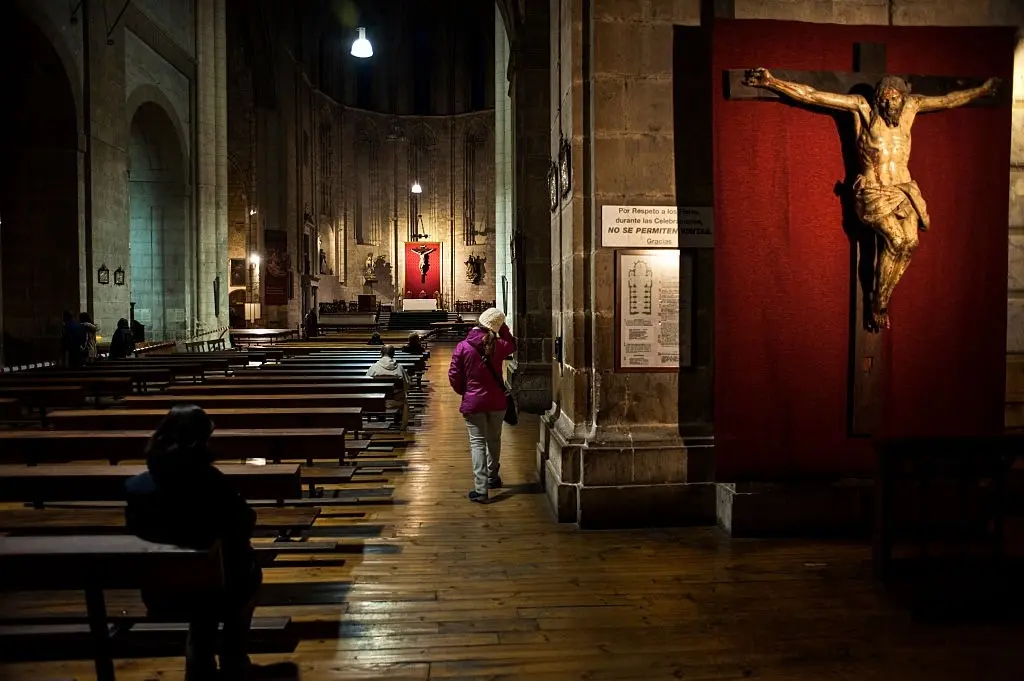
The primary focus of the investigation centers on the Church of San Pablo, a masterpiece of Isabelline Gothic architecture renowned for its ornate, richly sculpted facade. According to the church’s prior, two distinct religious artifacts were spirited away during the evening hours of September 10.
The first item identified as missing was a small Station of the Cross, a devotional plaque depicting Jesus falling for the second time during his journey to Calvary. The piece was distinguished by intricate silver relief work. The second item was a 17th-century canvas: a copy of an Ecce Homo originally painted by the renowned Spanish Renaissance master Luis de Morales.
The theft occurred during an active evening Mass. Investigators believe the timing was meticulously chosen. While parishioners sat or knelt facing the high altar, their backs turned to the side chapels and architectural details lining the nave, the perpetrator exploited the distraction of the liturgy.
Eyewitness accounts corroborate this tactical window. A sacristan told the local newspaper El Diario de Valladolid that several individuals recalled seeing an unidentified man leaving the church premises carrying a suspiciously large plastic bag. At the time, the significance of the bag went unquestioned amid the regular flow of visitors and churchgoers.
Compounding the confusion, the church administration did not immediately realize the full extent of the loss. Officials initially discovered that the Morales-style Ecce Homo had vanished and promptly reported its disappearance to local authorities. It was only during subsequent security reviews and checks of the interior that custodians realized the silver-embellished Station of the Cross was also gone.
The Loss at the Church of Vera Cruz
Shortly after the San Pablo thefts came to light, officials at the neighboring Church of Vera Cruz reported a parallel loss. Known for housing precious floats used in Spain’s elaborate Holy Week (Semana Santa) processions, the church discovered that a historic wooden sculpture was missing.
The stolen artifact is a roughly two-foot-tall polychrome wooden carving depicting an angel carrying a torch. Crafted with the expressive realism characteristic of Spanish polychrome sculpture, the piece held both artistic and devotional significance for the local brotherhood.
According to reports published in the Spanish daily El País, investigators are actively examining whether the thefts at San Pablo and Vera Cruz are connected. The geographic proximity of the two churches, combined with the short timeframe and the specialized nature of the items taken, points toward either a single itinerant art thief or a coordinated local ring operating with prior knowledge of the churches’ layouts and security blind spots.
Supporting Context & Metrics: A Continent-Wide Wave of Heritage Crime
The incidents in Valladolid do not occur in a vacuum. They are part of a broader, deeply concerning escalation in property crimes targeting cultural institutions, museums, and religious sites across Spain and the wider European continent.
Spain’s Summer of Heritage Thefts
Spain’s cultural heritage sector has endured a bruising string of high-profile thefts over recent months, raising questions about the security preparedness of regional museums and archival centers.
- Albacete: During the summer months, thieves struck the Provincial Museum of Albacete, making off with 220 rare 19th-century gold coins. The precision of the break-in suggested targeted intelligence regarding the museum’s storage and display vulnerabilities.
- Badajoz: In April, the Provincial Archaeological Museum of Badajoz fell victim to a heist involving 149 coins belonging to the historically significant Villanueva Treasure.
- Alicante: More recently, archaeological artifacts from the Bronze Age Treasure of Villena were targeted, with pieces stolen directly from a municipal museum showcase.
International Echoes: From Germany to France
The phenomenon extends well beyond the Iberian Peninsula, characterized by both opportunistic thefts of precious metals and professional, high-value museum break-ins:
- Manching, Germany: Thieves executed a brazen daylight-adjacent raid on the Celtic Roman Museum, making off with a hoard of ancient Celtic gold coins valued in the millions.
- France: The decorative arts sector was rocked by a $4.5 million jewelry heist at a French museum dedicated to the works of René Lalique, where expertly executed security bypasses left staff stunned.
- Paris, France: Most famously, the cultural world reeled from a high-stakes smash-and-grab at the Louvre, where royal jewels valued at upwards of $100 million were targeted in a flash heist that exposed the perpetual tension between public accessibility and asset protection in mega-museums.
Europol’s Assessment
Law enforcement agencies at the highest levels have taken notice. Europol, the European Union’s law enforcement agency, has tracked these incidents with mounting concern. Jean-Yves Goriou, head of the European Union’s organized crime unit, highlighted the trend in statements to El País, noting that the agency has observed "a clear and pronounced increase in the number of museum robberies" reported by national authorities across member states.
Goriou pointed to a primary economic driver behind the trend: the soaring global market price of precious metals, particularly gold. Gold artifacts, coins, and silver-adorned religious items are uniquely vulnerable because they can be easily melted down, stripping them of their historical and provenance context and converting them into untraceable bullion. Once reduced to raw metal, stolen heritage items become nearly impossible to recover or repatriate, representing a permanent loss to human history.
Official Statements & Institutional Response
The cascading thefts in Valladolid have prompted swift, urgent reactions from ecclesiastical authorities, who realize that churches are facing an unprecedented security deficit.
The Archbishopric’s Directive
In response to the thefts at San Pablo and Vera Cruz, the Archbishopric of Valladolid issued a formal directive to all parishes and religious communities within the archdiocese. The communication urged church administrators to adopt "extreme precautions and surveillance" moving forward.
Recognizing that many parishes lack the financial resources for sophisticated electronic security systems, closed-circuit television (CCTV), or professional guards, the Archbishopric focused on practical, administrative safeguards:
- Comprehensive Inventories: Parishes have been instructed to maintain rigorously updated, digital inventories of all sacred art, liturgical vessels, paintings, and sculptures housed within their walls.
- Photographic Documentation: Church officials were strongly encouraged to capture high-resolution photographs of every valuable item from multiple angles, creating a vital record for law enforcement and international databases in the event of theft.
- Rapid Reporting Protocols: Emphasizing that time is of the essence in art recovery, the archdiocese urged clergy and sacristans to report any suspected thefts or suspicious behavior immediately, bypassing bureaucratic delays that can allow thieves to cross international borders.
The Vulnerability of Sacred Spaces
Security experts and criminologists point out that churches present a uniquely challenging security paradox. By definition, houses of worship are designed to be open, welcoming sanctuaries accessible to the public, the faithful, and the curious alike.
Unlike secured museums that charge admission, enforce bag checks, and monitor foot traffic through strict bottlenecks, churches often sit nearly empty for hours at a time, guarded only by a handful of volunteers or staff. Furthermore, during active religious services, the congregation’s attention is—by design—focused inward toward the altar, the liturgy, and prayer. This creates a natural blind spot, leaving side chapels, ambulatory artworks, and altarpieces unobserved.
"Churches are a particularly easy target," notes security analysts studying European heritage crime. "During services, the people who are there tend, quite reasonably, to be looking at the altar rather than keeping watch over the art. In Valladolid, that may have been all the opening the thief needed."
Future Outlook: Protecting Europe’s Open Sanctuaries
The events in Valladolid and across Europe raise difficult questions for the future of cultural heritage management. As organized crime syndicates and opportunistic thieves increasingly eye the unsecured corners of history, communities face a sobering dilemma: how to protect priceless artifacts without transforming open houses of worship into fortress-like museums.
The Path Forward: Technology Meets Tradition
Balancing openness with security will require a multi-layered approach combining modern technology with traditional vigilance:
- Discreet Surveillance: Modern micro-cameras and motion sensors can be installed in historic churches without disrupting the aesthetic or sacred atmosphere of the space.
- Securing Movable Artifacts: Many stolen items—such as the Station of the Cross and the wooden angel—are inherently portable. Bolstering display cases, securing paintings with specialized anti-theft brackets, and locking down smaller valuables when services are not taking place will become standard practice.
- Community Engagement: Parishioners and local communities must be enlisted as active stewards of their heritage. Training volunteers to recognize suspicious behavior and maintaining open lines of communication with local law enforcement can deter would-be thieves.
- Cross-Border Cooperation: With stolen art frequently moving across national borders within hours of a heist, strengthened intelligence sharing between local police, national heritage units, and agencies like Europol remains vital.
The loss of the Ecce Homo copy, the silver-relief Station, and the polychrome angel is a local tragedy for Valladolid, but it serves as a continental warning bell. Unless European churches and cultural institutions receive the support, resources, and strategic guidance necessary to fortify their collections, the continent risks seeing more of its irreplaceable artistic and spiritual heritage quietly vanish into the shadows of the illicit art market.





Comments
Facebook App ID not configured. Please add it in the Customizer.