
Executive Overview
In March 1945, Operation Meetinghouse—the American B-29 Superfortress firebombing raid on Tokyo—reduced the Japanese capital to an expanse of ash and crushed brick. The attack claimed approximately 100,000 lives, displaced a million residents, and transformed a bustling metropolis into what journalist Mark Gayn described as "a man-made desert, ugly and desolate and hazy in the dust." For decades, monster cinema relied on pristine urban backdrops designed specifically to be flattened by giant creatures (kaiju). Yet director Takashi Yamazaki inverted this paradigm in his critically acclaimed 2023 masterpiece, Godzilla Minus One, by setting a colossal monster attack against a city already completely devastated by war.
The decision paid off artistically and commercially. Godzilla Minus One earned widespread international praise for its blend of grounded human trauma, rigorous historical texture, and innovative visual effects. In March 2024, the film achieved a historic milestone by becoming the first entry in the 70-year-old franchise to win an Academy Award for Best Visual Effects. Produced for an extraordinarily lean budget estimated at $15 million—a fraction of the $160 million-plus budgets typical of Hollywood monster blockbusters—the film demonstrated that meticulous, integrated visual effects pipelines can rival western studio output.
Now, with the release of its sequel, Godzilla Minus Zero, Yamazaki faces the daunting task of topping his own Oscar-winning benchmark while expanding his creative footprint into Hollywood through major projects with Sony and Scott Free Productions.
Read Also
Detailed Chronology
+-----------------------------------------------------------------------------------+
| 1945: Allied firebombing reduces Tokyo to rubble; 100,000 dead, 1M homeless       |
| 1954: Ishirō Honda directs original 'Gojira' as a response to US nuclear testing |
| 1964: Takashi Yamazaki born in Matsumoto, Nagano Prefecture                       |
| 1971: Yamazaki sees 'Ghidorah' at age 7; spark of the "Second Kaiju Boom"        |
| 1984: Yamazaki joins visual effects house Shirogumi while an art student          |
| 1995: Co-creates digital effects for 'Eko Eko Azarak' using early Adobe tools     |
| 2000: Makes directorial feature debut with 'Juvenile'                             |
| 2005: Releases breakthrough nostalgic drama 'Always: Sunset on Third Street'      |
| 2016: 'Shin Godzilla' debuts, setting box office records and resetting standards  |
| 2023: 'Godzilla Minus One' released to global critical acclaim                    |
| 2024: Wins Academy Award for Best Visual Effects; production begins on sequel     |
+-----------------------------------------------------------------------------------+
1945–1954: Ashes of War and the Birth of a Cinematic Mythos
Following the end of World War II, strict censorship under the Allied occupation suppressed direct journalistic coverage and cinematic depictions of the atomic bombings of Hiroshima and Nagasaki. In 1954, director Ishirō Honda and Toho Studios bypassed these restrictions by creating Gojira (Godzilla). Inspired in part by the Daigo Fukuryū Maru (Lucky Dragon No. 5) incident—in which a Japanese fishing vessel was irradiated by an American hydrogen bomb test at Bikini Atoll—the film encoded national nuclear trauma into a giant, radioactive reptile. While contemporary critics initially dismissed it as lowbrow entertainment, audiences embraced the creature as a profound metaphor for nuclear horror.
1964–1984: The Making of an Effects Visionary
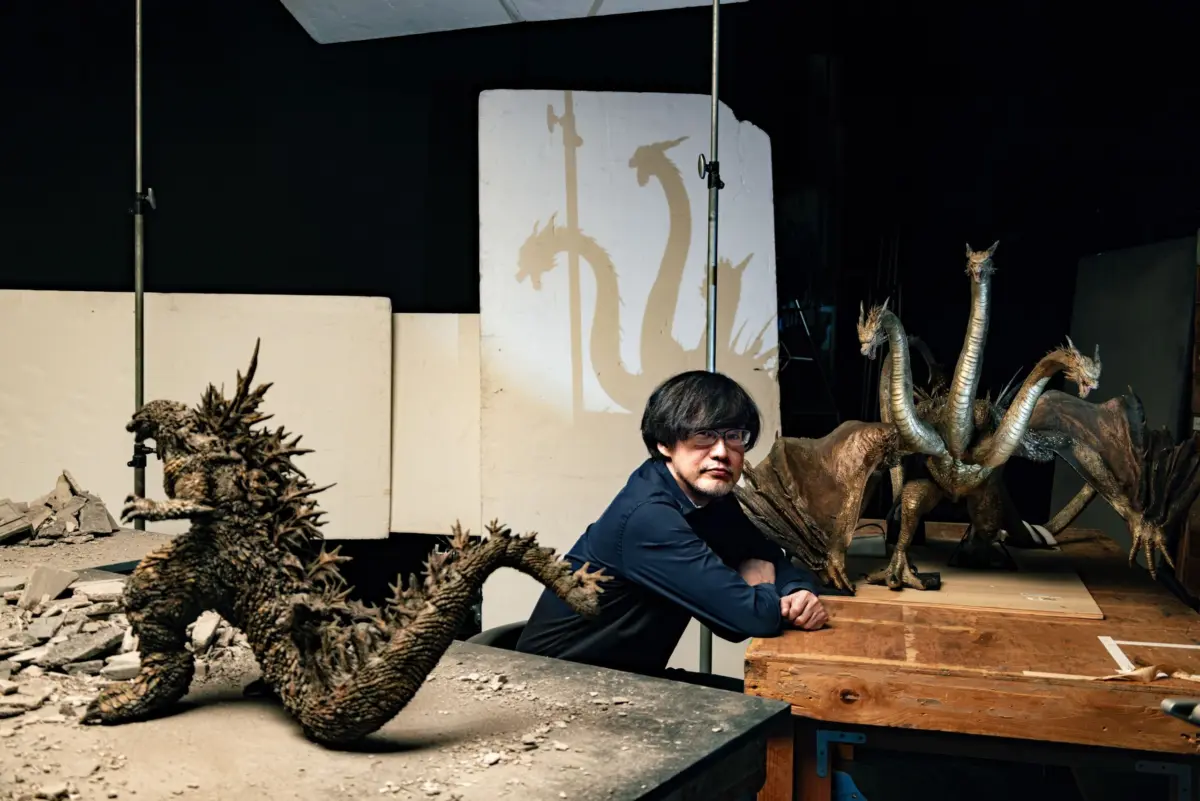
Takashi Yamazaki was born in 1964 in Matsumoto, a city nestled at the base of the Japanese Alps. Raised by a father who worked in industrial bakery supplies and a kindergarten teacher mother, Yamazaki developed a passion for customizing plastic model kits and drawing. In 1971, at age seven, he convinced his father to take him to a revival screening of 1964’s Ghidorah, the Three-Headed Monster. The experience coincided with Japan’s "Second Kaiju Boom"—an era dominated by monster television shows like Ultraman and Kamen Rider.
During junior high, an article revealing that adult actors wore latex monster suits inspired Yamazaki to make an 8mm sci-fi short titled Glory, featuring a six-foot plywood spaceship decorated with model parts. After high school, he attended the Asagaya College of Art and Design in Tokyo and, in 1984, joined Shirogumi, a specialized visual effects studio founded by animator Tatsuo Shimamura.
                  [Yamazaki's Career Progression]
                                |
       (1984) Joined Shirogumi as Model Maker & Cameraman
                                |
       (1995) Early Digital Effects pioneer on 'Eko Eko Azarak'
                                |
       (2000) Directorial Debut: 'Juvenile'
                                |
       (2005) Domestic Breakthrough: 'Always: Sunset on Third Street'
                                |
       (2023) International Triumph: 'Godzilla Minus One'
1995–2005: Digital Breakthroughs and Directorial Ascendance
In the mid-1990s, Yamazaki teamed up with director Shimako Satō (whom he later married in 2012) and artist Kiyoko Shibuya to create digital visual effects for the low-budget horror film Eko Eko Azarak: Wizard of Darkness (1995). Utilizing desktop software like Adobe After Effects, Yamazaki and Shibuya delivered striking visuals on a shoestring budget. The film’s critical success at the Yubari International Fantastic Film Festival motivated Yamazaki to step behind the camera himself.
After pitching an ambitious, unproduced folklore feature titled Nue, Yamazaki directed his first feature, Juvenile, in 2000. He followed it with the 2005 box-office smash Always: Sunset on Third Street, a nostalgic drama set in late-1950s Tokyo that cemented his reputation as a master of artfully engineered special effects and historical recreations.
2016–2024: From Shin Godzilla to Oscar History
When Yamazaki began early planning for a Godzilla film, he operated under the shadow of 2016’s Shin Godzilla, directed by Hideaki Anno and Shinji Higuchi. That film had re-energized the franchise by reimagining Godzilla as a satirical critique of bureaucratic paralysis following the 2011 Fukushima Daiichi nuclear disaster.
Rather than copying Anno’s socio-political satire, Yamazaki anchored Godzilla Minus One in the immediate post-WWII era (1945–1947), centering the narrative on broken veterans suffering from survivor’s guilt. The approach resonated globally. After winning the Academy Award for Best Visual Effects in March 2024, Toho immediately greenlit the sequel, Godzilla Minus Zero, setting its narrative in 1949 and introducing the iconic three-headed dragon Ghidorah.
Supporting Context & Metrics
The Micro-Budget Revolution: $15 Million vs. Hollywood’s Megabudgets
Godzilla Minus One captured industry attention not only for its narrative power, but also for its extreme operational efficiency. While contemporary American visual-effects heavyweights regularly exceed production costs of $150 to $200 million, Yamazaki achieved Oscar-winning visuals for roughly $15 million.
PRODUCTION BUDGET COMPARISON (USD)
+-------------------------------------------------------------+
| Godzilla Minus One (2023)       | $15M                      |
+-------------------------------------------------------------+
| Godzilla (Hollywood Reboot 2014)| $160M                     |
+-------------------------------------------------------------+
| Godzilla x Kong (2024)          | $135M                     |
+-------------------------------------------------------------+
Yamazaki attributes this cost efficiency to Shirogumi’s streamlined production model:
- Task Integration: Unlike Hollywood FX studios, which distribute tasks across highly specialized pipelines (riggers, lighters, animators, compositors), Shirogumi trains individual artists to handle multiple stages of a single shot. This structure eliminates inter-departmental delays and handoff friction.
- In-House Synergy: As a director who double-functions as visual effects supervisor, Yamazaki makes precise decisions on set, eliminating the costly re-work cycles common in western productions driven by post-production studio notes.
Modern On-Set Technology: Augmented Reality Framing
To abandon the traditional "suitmation" technique—where an actor performs inside a heavy rubber suit within miniature city sets—Yamazaki fully digitized Godzilla. This allowed for variable bodily proportions to emphasize scale, hyper-realistic water displacement physics, and dynamic camera movement.
To overcome the challenges of directing actors against invisible CGI monsters, Yamazaki introduced custom Augmented Reality (AR) tools on soundstages like Toho’s historic Stage 31 in Setagaya, Tokyo:
[AR Directorial Workflow on Stage 31]

  (Physical Stage)                     (Digital Overlay via Tablet)
+------------------------+           +---------------------------------+
| Physical Set Pieces    |           | Rendered 1949 Tokyo Architecture|
| (Ginza Clock Tower)    |  ======>  | + CGI Godzilla Model Position   |
| Real Actors & Lighting |           | + Real-time Camera Tracking     |
+------------------------+           +---------------------------------+
                                                     ||
                                                     /
(Precision Sightlines & Framing)- AR Tablet Monitoring: Yamazaki uses a tablet loaded with a real-time digital model of 1940s Tokyo and the CGI monster mapped onto the studio floor. Pointing the screen anywhere on set reveals the precise position and scale of Godzilla relative to physical props.
- Physical Marker Alignment: Stagehands use targeted sightline poles featuring color printouts of the monster’s face, positioned via AR coordinates, ensuring actors look at the exact eye level of the virtual beast.
- Dynamic Sound Amplification: For Godzilla Minus Zero, sound designer Natsuko Inoue and Yamazaki re-recorded the creature’s signature roar—originally created in 1954 by rubbing tar-coated leather gloves down a double bass E-string—by blasting it through massive speakers against a concrete dam wall to capture natural reverberation.
Official Statements
The global impact of Yamazaki’s work has drawn praise from major film directors, while Yamazaki himself has addressed both his technical philosophy and the political undercurrents of his work.
Steven Spielberg reportedly watched Godzilla Minus One three times, while Christopher Nolan publicly hailed the film as "tremendous." During a press tour in Tokyo, Tom Cruise praised Yamazaki directly, stating:
"You’ve entertained me for hours."Reflecting on the film’s unexpected Oscar victory, Takashi Yamazaki recalled his initial reaction to the nomination:
"I had no idea it had even been submitted. Toho put the film up for consideration right before the deadline… When I saw Hideaki Anno’s ‘Shin Godzilla,’ I thought, ‘How am I going to make something that stands up in the face of that?’ Now, making ‘Minus Zero,’ my rival is ‘Godzilla Minus One.’"Addressing criticisms regarding his frequent cinematic focus on World War II military hardware (such as 2013’s The Eternal Zero and 2019’s The Great War of Archimedes), Yamazaki clarified his anti-war stance:
"Some people mistake me for being pro-war because I put weapons in my films. I hate war. I think most who watch ‘Godzilla Minus Zero’ will come away disgusted by war. I want world leaders to watch it. I want them to see what happens when they press the button—that even if your side wins, this is what is happening under that mushroom cloud."Director Gareth Edwards (Godzilla 2014) contextualized the historical brilliance of the franchise’s origins:
"The original 1954 movie was one of the greatest Trojan horses in the history of cinema. The fact that monster ‘B movies’ were held in such low regard worked in its favor—bypassing censors and studio executives, tapping directly into the hearts and minds of the younger generation."
Future Outlook
The success of Godzilla Minus One has repositioned Japanese visual effects on the global stage and elevated Yamazaki into an internationally sought-after filmmaker.
+------------------------------------------------------------------------------------+
|                         YAMAZAKI'S UPCOMING SLATE                                  |
+------------------------------------+-----------------------------------------------+
| Project Title                      | Partnering Studios / Key Collaborators        |
+------------------------------------+-----------------------------------------------+
| Godzilla Minus Zero                | Toho Studios (Writer / Director / VFX)        |
| Grandgear                          | Bad Robot / J.J. Abrams / Sony Pictures       |
| Nue                                | Scott Free Productions / Ridley Scott         |
+------------------------------------+-----------------------------------------------+
Yamazaki’s immediate focus remains completing post-production on Godzilla Minus Zero, which pits Godzilla against Ghidorah in a post-WWII Japan still recovering from war. Following its release, Yamazaki will transition to two major Hollywood studio productions:
- Grandgear: An original, high-concept sci-fi epic centered on giant robots, produced by J.J. Abrams’ Bad Robot banner and distributed worldwide by Sony Pictures.
- Nue: A revival of the dark Japanese mythological fantasy project Yamazaki was forced to abandon early in his career due to lack of funding. The project is now fully backed by Scott Free Productions, the company co-founded by Ridley Scott—one of the directors whose films (Alien, Blade Runner) originally inspired Yamazaki to enter the industry.
By combining low-cost visual effects methods with deeply human storytelling, Takashi Yamazaki has updated the monster movie genre while building a bridge between Japanese pop culture and major Hollywood cinema.





Comments
Facebook App ID not configured. Please add it in the Customizer.