
Executive Overview
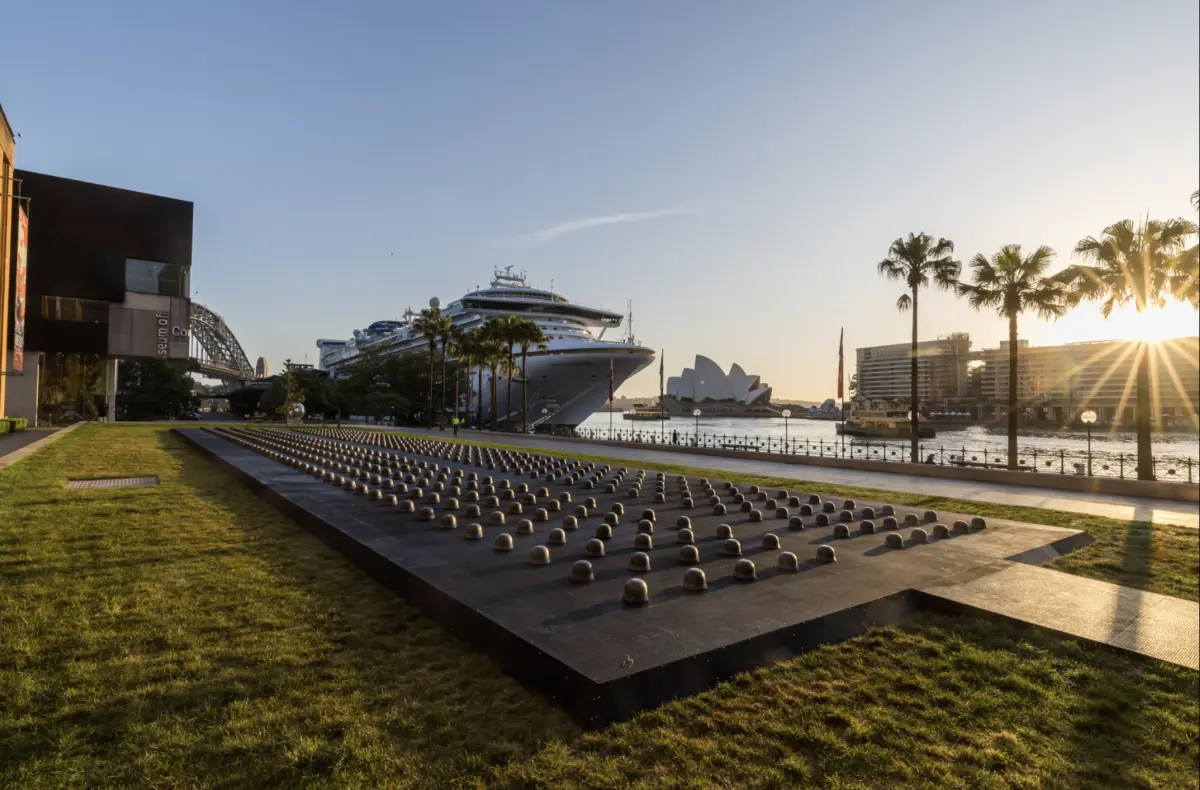
Renowned Chinese dissident and contemporary artist Ai Weiwei has once again turned public space into an arena for political and philosophical interrogation. On Friday, the artist unveiled his latest monumental commission outside the Museum of Contemporary Art Australia (MCA) in Sydney. Titled Mushrooms, the installation comprises 500 meticulously cast-iron combat helmets arranged in ten razor-sharp, orderly lines across Tallawoladah Lawn—one of the city’s most heavily trafficked green spaces, framed by the iconic backdrop of the Sydney Opera House and the Harbour Bridge.
Stretching 131 feet in length, the installation is mounted on an elevated platform directly bisected by a high-footfall pedestrian walkway. The design ensures that commuters, tourists, and art lovers alike cannot bypass the sobering visual experience. The helmets, complete with historically accurate inner padding and distinct flared brims, evoke the specter of 20th-century warfare. Yet, the work’s conceptual weight extends far beyond historical reenactment.
According to Ai, the title Mushrooms serves as a multivalent metaphor. It references biological growth in subterranean darkness, the apocalyptic geometry of nuclear mushroom clouds, and, in a linguistic nod to Chinese idiom, a concept suggesting endless, bureaucratic delays and systemic paralysis.
Read Also
The installation forms the second iteration of the prestigious Neil Balnaves Tallawoladah Lawn Commission, an annual public art initiative established in honor of the late Australian philanthropist and businessman Neil Balnaves. Scheduled to remain on view for seven months, Mushrooms challenges contemporary complacency. It forces an affluent, peaceful society to reckon with the fragile dichotomy of global security, the superficiality of modern geopolitical posturing, and the enduring threat of armed conflict in an increasingly volatile world.
Detailed Chronology & Unveiling
The genesis of Mushrooms dates back to early conceptual discussions between Ai Weiwei and the curatorial team at the Museum of Contemporary Art Australia. Situated in the historic Rocks district of Sydney, the MCA serves as a primary cultural anchor for the city, drawing millions of visitors annually. Tallawoladah Lawn, which rolls out from the museum’s art-deco facade toward the shimmering waters of Sydney Harbor, has traditionally hosted welcoming, contemplative, and community-oriented public sculptures. Ai’s commission radically subverts this pastoral tradition.
The Construction and Layout
Installation crews worked through the night under tight security to construct the 131-foot-long elevated wooden platform that serves as the plinth for the iron army. Upon this stage, 500 heavy, cast-iron combat helmets were meticulously aligned. The grid-like arrangement—ten rows deep—creates an unsettling sense of regimentation, echoing both military parades and mass graves.
Crucially, the platform is cleaved down the middle by a pedestrian corridor. This spatial choice forces thousands of daily commuters and harbor-front strollers to walk directly through the heart of the installation. Pedestrians find themselves flanked on either side by an unyielding sea of dark, cold metal, effectively turning every passerby into an accidental participant in a solemn procession.
The Unveiling Ceremony
On Friday morning, amid a gathering of international media, local art patrons, and curious onlookers, the installation was officially opened to the public. While Ai Weiwei did not physically attend the Sydney unveiling in person—managing the project remotely from his European base—his curatorial presence loomed large over the proceedings. Speeches delivered by MCA representatives and arts administrators emphasized the courage required to bring such a confrontational work into a sun-drenched, leisure-oriented urban environment.
As the morning sun hit the cast-iron surfaces, the helmets caught the harsh Australian light, casting long, geometric shadows across the wooden decking. Visitors immediately began documenting the piece, posting photographs to social media against the contrasting backdrop of Sydney’s sparkling blue harbor—a juxtaposition that underscored the core tension of Ai’s artistic vision: the fragile veneer of peace masking an underlying global trauma.
Supporting Context & Metrics: From Berlin to Sydney
To fully understand the gravity of Mushrooms, one must trace its conceptual roots back to a specific geopolitical flashpoint in early 2022. Following Russia’s full-scale invasion of Ukraine, the international community scrambled to provide defensive and offensive military aid to Kyiv. Amid this global crisis, the German government initially demurred on sending heavy weaponry, offering instead a symbolic shipment of 5,000 military helmets.
The gesture was met with swift, biting derision. Ukrainian officials and international commentators mocked the offer as "an absolute joke," pointing out the lethal disparity between helmets and artillery in a modern, mechanized war.
However, in interviews surrounding the Sydney launch—including a revealing discussion with The Art Newspaper—Ai Weiwei clarified that Mushrooms is not intended as a mere "political joke" or a satirical jab at German bureaucracy. Instead, the artist views the incident as a symptom of a much deeper, more dangerous malady within modern governance.
The Anatomy of the Commission
- Mushrooms
- Artist: Ai Weiwei
- Location: Tallawoladah Lawn, Museum of Contemporary Art Australia, Sydney
- Scale: 131 feet (40 meters) in length
- Materials: 500 cast-iron combat helmets complete with historical inner padding
- Duration: On view for seven months
- Sponsorship: The Neil Balnaves Tallawoladah Lawn Commission
The Balnaves Legacy
Mushrooms is the second commission under the Neil Balnaves Tallawoladah Lawn banner. The program was established to honor Neil Balnaves, a towering figure in Australian philanthropy, media, and business, who tragically died in a boating accident near Tahiti in 2022 at the age of 77. Balnaves was known for his staunch support of the arts, education, and social welfare, believing deeply in the power of public art to provoke critical thinking and democratic debate.
The inaugural commission, launched last year, was awarded to acclaimed British sculptor Thomas J. Price. Price’s monumental creation, Ancient Feelings, featured a golden-bronze head of a Black woman standing over 10 feet tall. Gazing serenely out toward Sydney Harbor, Ancient Feelings invited viewers to reflect on universal human emotions, representation, and shared empathy.
In stark contrast, Ai Weiwei’s Mushrooms pivots from internal emotional resonance to external geopolitical anxiety. Where Price offered a monument to individual dignity and connection, Ai offers a monument to collective vulnerability and historical repetition.
Official Statements & Critical Analysis
The thematic weight of Mushrooms relies heavily on the tension between nature, technology, and political shortsightedness. In an official artist statement released by the MCA, Ai elaborated on the philosophical underpinnings of the work:
"We continue to exist in a time where war and peace interchangeably assume each other’s roles, shaping the identity of our age. I hope this work prompts people to reflect on war and peace."
The artist further unpacked the multilayered symbolism embedded in the
"The title—like the curved lip of the helmet—alludes to growth in darkness, nuclear mushroom clouds, and in Chinese, the term also suggests endless delays."
By linking the physical shape of a military helmet to the biological form of a mushroom—an organism that thrives in damp, hidden decay—Ai draws a direct line between the hidden machinations of state power and the sudden, explosive devastation of modern warfare. Furthermore, the Chinese linguistic connotation of endless delays speaks to the frustrating inertia of international diplomacy, where bureaucratic stagnation often paves the way for catastrophic escalation.
Challenging State Leadership
Art critics and political analysts have been quick to note that Mushrooms serves as an indictment of contemporary political leadership. In his interview with The Art Newspaper, Ai emphasized that the 500 iron helmets symbolize the intellectual and moral poverty of those who hold the levers of power:
"It aims to demonstrate how shallow an understanding today’s national leadership can have of the human condition and of what may happen in the future."
This critique resonates globally at a time when defense budgets are ballooning, diplomatic channels are fraying, and the specter of nuclear conflict—once largely relegated to Cold War history books—has re-entered mainstream political discourse. By placing these symbols of mechanized violence in a peaceful, sun-soaked harbor city thousands of miles from active European and Middle Eastern warzones, Ai reminds Australian audiences that geographical isolation is no defense against global interconnectedness.
Future Outlook: Public Engagement and the Legacy of Mushrooms
As Mushrooms settles into its seven-month residency on Tallawoladah Lawn, its long-term impact on Sydney’s cultural landscape is already generating intense discussion. Public art in high-traffic tourist zones frequently walks a tightrope between aesthetic integration and jarring disruption. Ai Weiwei’s installation deliberately chooses disruption.
Educational Programming and Public Dialogue
The Museum of Contemporary Art Australia has announced a comprehensive series of public programs, panel discussions, and educational workshops tied to the exhibition. These initiatives will explore themes of freedom of speech, human rights, the ethics of public monuments, and the role of artists as geopolitical whistleblowers. University art history departments and political science faculties across Sydney are incorporating site visits to Mushrooms into their syllabi, ensuring that the installation functions as an active classroom rather than a passive monument.
Preservation and Post-Exhibition Trajectory
Given the heavy industrial materials used—500 solid cast-iron helmets exposed to the coastal elements of Sydney Harbor—maintenance and weathering will be closely monitored by MCA conservators over the seven-month period. The gradual interaction of salt air and iron will likely induce patination and surface rusting, adding another layer of conceptual depth to the work: the slow, corrosive decay of militarism exposed to the open air.
Once the exhibition concludes, the future placement of the 500 helmets remains unconfirmed, though international museum directors and private collectors have already expressed keen interest in acquiring iterations of the installation for global tour circuits.
Ultimately, Mushrooms cements Ai Weiwei’s status as one of the most vital, unyielding voices in contemporary art. By transforming 500 symbols of defensive inadequacy and martial readiness into an inescapable urban forest of iron, Ai forces the public to look down at the instruments of war while gazing out at the horizon of peace—a sobering, necessary meditation for an unsettled world.


Comments
Facebook App ID not configured. Please add it in the Customizer.