
Executive Overview
While consumers meticulously check expiration dates, freshness seals, and nutritional labels to determine whether a packaged food item is safe to eat, a silent hazard routinely goes unnoticed. No warning label indicates whether toxic pesticides, industrial plasticizers, hormone-disrupting phthalates, or persistent per- and polyfluoroalkyl substances (PFAS) are actively migrating from cardboard boxes, plastic tubs, metal cans, and juice pouches directly into our meals.
A groundbreaking peer-reviewed study published in the journal Environmental Science & Technology has laid bare an alarming reality of the modern global food system. Out of more than 15,000 distinct chemicals known to come into contact with food during processing, transport, and packaging, researchers identified 1,222 substances that pose severe, documented health risks, including cancer, reproductive harm, and the dangerous ability to bioaccumulate within human tissues.
Even more disturbing than the hazardous chemicals already identified is the vast expanse of the unknown. An astounding 87 percent—over 13,200 chemicals—lack sufficient publicly accessible data for independent scientists and regulatory bodies to even begin estimating their safety profiles.
Read Also
This comprehensive investigation examines the methodology of this landmark research, the structural failures of global chemical regulation, the specific risks posed to vulnerable populations like infants and children, and the urgent calls from scientists to overhaul how materials touching our food supply are evaluated and controlled.
Detailed Chronology: Unpacking the Research and Regulatory Blind Spots
The journey toward this eye-opening publication has been years in the making, spearheaded by international teams of environmental scientists, toxicologists, and public health advocates dedicated to lifting the veil of corporate secrecy surrounding food-contact materials (FCMs).
Phase 1: Mapping the Universe of Food-Contact Chemicals
In previous foundational research, an international team led by managing director Jane Muncke at the nonprofit Food Packaging Forum Foundation undertook the monumental task of cataloging chemicals used globally in food processing and packaging. By scouring authorized lists from regulatory agencies in the United States, China, Japan, countries across Europe, and South America—alongside peer-reviewed scientific literature—the researchers identified an astonishing universe of more than 15,000 chemicals.
Described by researchers as a "jaw-dropping" number, this inventory proved that the chemical footprint of our daily diet is far more complex than previously acknowledged by the public.
Phase 2: Filtering for Hazard and Exposure (The New Study)
In their latest paper, published Tuesday in Environmental Science & Technology, Muncke and co-author Helene Wiesinger, a chemist and scientific officer at the Food Packaging Forum, analyzed this expansive chemical catalog to isolate the most problematic substances.
To ensure maximum credibility and utility, the research team relied exclusively on data obtained from official governmental and regulatory bodies linking specific chemicals to concrete human health hazards, such as carcinogenicity, reproductive toxicity, or systemic bioaccumulation.
This rigorous screening yielded a priority list of 1,222 chemicals, which the researchers systematically categorized into four distinct tiers based on the strength of evidence regarding human exposure through food-contact materials:
- Tier 1 (The Highest Priority): Comprising 94 chemicals that have not only been proven to leach into food but have also been directly detected in human biomonitoring studies—including samples of human blood, urine, and breast milk.
- Tier 2: Encompassing an additional 264 hazardous chemicals confirmed to leach into food products, though they have not yet been detected in human tissue samples (at least, not yet).
- Tiers 3 and 4: Grouping remaining substances with varying degrees of toxicological concern and documented presence in the supply chain.
Phase 3: The Danger of "Non-Intentionally Added Substances" (NIAS)
Beyond intentional additives, the research underscores a pervasive category known as Non-Intentionally Added Substances (NIAS). These are chemical impurities, reaction byproducts, and breakdown components generated during the manufacturing of plastics and packaging materials.
Because manufacturers frequently keep their exact proprietary formulas confidential, and because standard analytical instruments often cannot identify every chemical present without knowing what to look for, millions of consumers ingest NIAS daily without any regulatory oversight.
Supporting Context & Metrics: What Is Lurking in Our Pantries?
The implications of the Food Packaging Forum’s findings stretch across virtually every aisle of the modern supermarket. Studies cited alongside the research demonstrate that these migrating chemicals do not remain trapped within packaging matrices. Instead, they partition readily into diverse food and beverage matrices, including drinking water, infant formula, orange juice, ice cream, yogurt, cream, edible oils, baked goods, and fatty foods.
The Tier 1 Culprits: Forever Chemicals, Plasticizers, and Carcinogens
The 94 chemicals placed into Tier 1 represent a roster of notorious industrial pollutants:
- PFAS ("Forever Chemicals"): Widely utilized to make fast-food wrappers, microwave popcorn bags, and bakery boxes grease- and water-resistant. These synthetic compounds are linked to severe liver damage, immune system suppression, and reduced vaccine efficacy in children.
- Styrene: A classified likely human carcinogen utilized extensively in the manufacturing of takeout food containers and refrigerated dairy packaging.
- Phthalates: Ubiquitous hormone-disrupting compounds added to plastics to increase flexibility, commonly found in tubing, conveyor belts, and plastic wraps used to seal vegetable oils and dairy.
- Bisphenol A (BPA): A textbook endocrine disruptor utilized in hard plastics and metal can linings. BPA is known to mimic human hormones, impairing developmental processes even at exceptionally low doses.
The Data Void: The "Elephant in the Room"
The most profound systemic flaw highlighted by the study is not merely the presence of known toxins, but the complete absence of data for the vast majority of food-contact chemicals.
When 87 percent of chemicals touching our food lack sufficient public safety data, regulators are effectively operating blind. Independent scientists cannot assess risks, public health officials cannot establish safe exposure thresholds, and consumers are left unprotected.
Furthermore, the study revealed that 70 percent of more than 4,200 chemicals classified across 38 priority structural groups—including classes like organophosphates (used as flame retardants and pesticides) and various phthalates—suffer from a severe lack of baseline safety data. This highlights a dangerous regulatory game of "whack-a-mole," where banned toxic chemicals are routinely replaced by structurally similar alternatives that often exhibit identical toxicity profiles.
Official Statements and Industry Reactions
The release of the study has ignited intense debate within the scientific and regulatory communities, sharply contrasting independent health experts with trade representatives.
Independent Perspectives
Jane Muncke did not mince words when discussing the disconnect between public perception and regulatory reality:
"Consumers trust that when regulators allow chemicals in products like food packaging, it’s because it’s been through rigorous safety testing. But that’s not the case. And it doesn’t make sense."
Emphasizing the undeniable link between packaging, food, and human biology, Muncke added regarding Tier 1 substances:
"The chemicals are in people, they’re in food, and they’re in food-contact materials. What more proof do you want?"
Maricel Maffini, an independent chemical safety and regulation expert who was not involved in the study, praised the research team for highlighting systemic blind spots:
"They’ve done a very, very good job highlighting how little is known about the risks of substances that affect everyone."
However, Maffini cautioned that because the study focused strictly on lists that industry and regulators already regard as reliable, it represents "looking under the proverbial lamppost"—meaning the true scope of chemical contamination is likely even broader than reported.
Sara Lupolt, an exposure assessment expert at the Johns Hopkins Bloomberg School of Public Health, noted that the paper provides a practical, transparent roadmap for prioritizing regulatory action. She emphasized, however, that future research must drill down into specific food-chemical combinations to understand precisely which pairings accelerate chemical migration.
Industry Silence and Defenses
Inside Climate News reached out to the American Chemistry Council and the Food Packaging Coalition—major trade associations representing the chemical manufacturing and packaging industries—inviting them to commit to releasing comprehensive hazard data for their chemicals and voluntarily phasing out known toxins.
Neither organization provided a direct response. However, the Food Packaging Coalition maintains a general stance that modern packaging is meticulously engineered to prevent the transfer of chemical components to food, ensuring that all materials remain safe and suitable for their intended commercial applications.
Special Focus: Plastic Chemicals in Baby Food and Infant Exposure
While chemical exposure poses risks across all age groups, the scientific community is raising red flags regarding the heightened vulnerability of infants and young children.
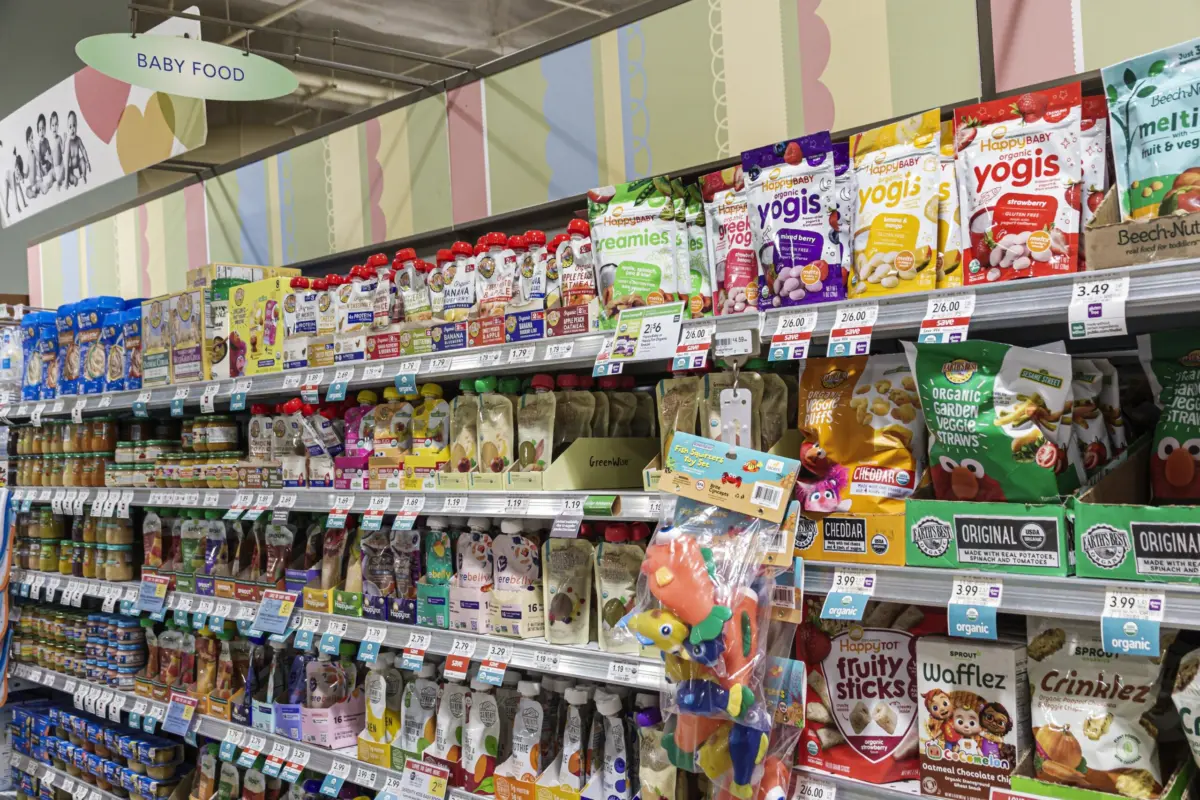
Jane Muncke has expressed acute concern regarding infant exposure to plastic chemicals migrating from squeezable pouches used for fruit juices and pureed baby foods. Earlier this year, her research team presented alarming data at an event in the United Kingdom’s House of Lords, revealing that more than 330 distinct chemicals leach from baby food pouches, nearly 80 of which are known to be hazardous.
Why Baby Food Pouches Pose Unique Risks
- High Surface-Area-to-Volume Ratio: Small serving sizes packaged in flexible pouches mean that the ratio of packaging material to actual food is exceptionally high, resulting in greater concentrations of migrating compounds relative to the infant’s body weight.
- Thermal Stress: Pouches are frequently subjected to high-temperature industrial sterilization processes. Heat accelerates the breakdown of polymers, driving chemical migration and generating microplastics directly within the food matrix.
- Cumulative NIAS Exposure: Supporting peer-reviewed findings, including a 2013 study published in Chemosphere, have consistently detected unknown NIAS impurities derived from plastic manufacturing raw materials in pouched baby foods, warning that infants may experience chronic, uninterrupted chemical exposure during critical developmental windows.
Future Outlook: Recommendations for Reform
To safeguard public health and restore integrity to the food supply chain, the authors of the study and affiliated public health experts advocate for immediate, structural changes in chemical policy.
1. Shift Away from Single-Chemical Risk Assessments
Regulatory agencies—such as the U.S. Food and Drug Administration (FDA) and the European Food Safety Authority (EFSA)—must abandon their traditional practice of evaluating chemicals in isolation. Because humans are exposed to complex mixtures of chemicals simultaneously, regulatory frameworks must account for cumulative, synergistic toxicity.
2. Implement the "No Data, No Market" Principle
Helene Wiesinger and her co-authors argue for a precautionary regulatory philosophy: no chemical or food-contact material should be permitted on the market until the manufacturing entity provides robust, publicly verifiable proof of its safety.
Furthermore, regulators should immediately prioritize restricting entire classes of chemicals based on structural similarities. If a chemical shares molecular traits with a known carcinogen or endocrine disruptor, it should be preemptively flagged rather than waiting years for epidemiological proof of harm.
3. Greater Transparency and Corporate Accountability
Chemical manufacturers and packaging companies must be mandated to disclose full formulations to independent scientific bodies. Eliminating the shroud of "proprietary business information" regarding substances that inevitably ingest into the human body is a fundamental prerequisite for modern public health protection.
As independent science continues to peel back the layers of our industrial food system, the message to regulators is clear: the era of assuming packaging is inert must come to an end. Protecting consumers requires acknowledging that what holds our food is just as critical as the food itself.





Comments
Facebook App ID not configured. Please add it in the Customizer.