
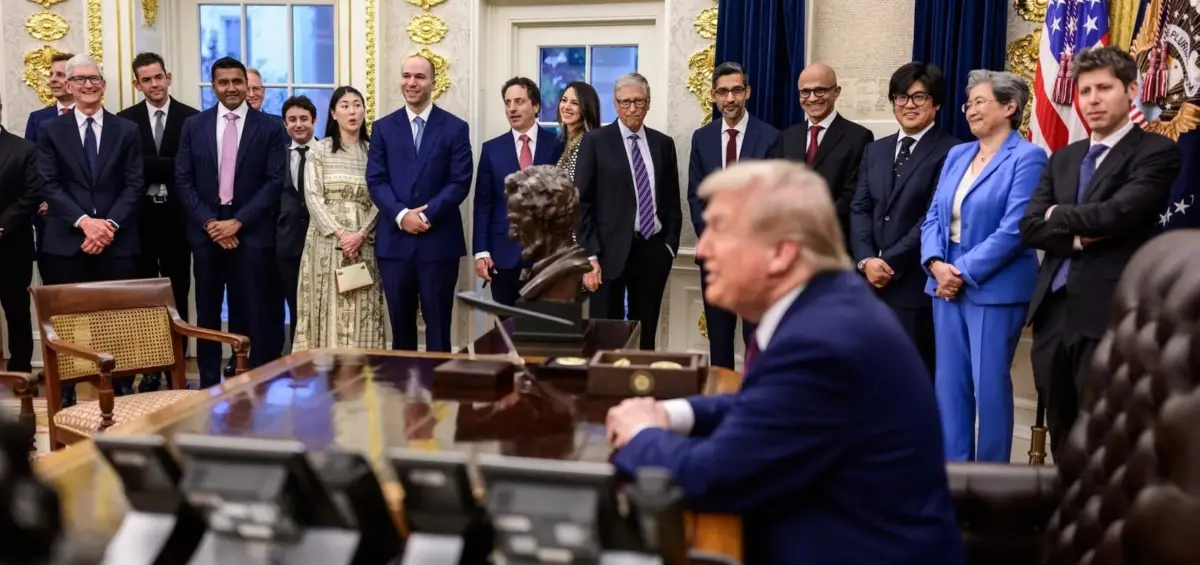
Executive Overview
Two years after returning to the Oval Office on a wave of populist fervor and a decisive popular mandate, Donald Trump’s second presidential term has encountered a dramatic political reckoning. The historic losses suffered by the Republican Party in the 2026 midterm elections—widely characterized by political scientists and pollsters alike as a sweeping national referendum on the administration’s legislative agenda and executive overreach—have left the White House politically vulnerable. Once buoyed by a coalition of working-class voters and an influential vanguard of Silicon Valley technologists, the administration now faces unprecedented disapproval ratings, signaling a profound rupture in the populist movement that defined the mid-2020s.
To understand how the political landscape shifted so dramatically, one must examine the intersection of populist governance and the meteoric rise of the “Tech Right.” This insurgent coalition of venture capitalists, tech executives, and dissident intellectuals provided both the ideological scaffolding and the financial muscle for Trump’s 2024 resurgence. Yet, the rapid institutionalization of this movement exposed deep fissures between the libertarian-technocratic ambitions of Silicon Valley elites and the economic security demands of the traditional working-class base.
In this comprehensive investigative report, we analyze the trajectory of the second Trump administration, the anatomy of the 2026 legislative and electoral backlash, and the ascent of the Tech Right. Featuring critical insights from cultural critic and Compact managing editor Geoff Shullenberger—author of the landmark new book Strange New Thoughts: The Origins and Rise of the Tech Right—this article explores how the alliance between Washington populism and Silicon Valley techno-optimism fractured, permanently altering the trajectory of American power.
Read Also
Detailed Chronology: From the 2024 Triumph to the 2026 Midterm Debacle
The 2024 Mandate and the Populist Coalition
When Donald Trump secured his historic return to the presidency in November 2024, his victory was hailed by supporters as the permanent consolidation of a new American majority. Running on a platform combining economic nationalism, border security, and a sharp critique of federal institutional overreach, Trump achieved what no modern Republican had managed in two decades: winning the national popular vote.
Crucially, this victory was forged through an unlikely alliance. Beyond the traditional rural and Rust Belt base, the 2024 campaign successfully courted a new demographic of young, male, economically anxious voters, alongside a vocal faction of high-profile technology leaders disillusioned with the progressive consensus of the Biden-Harris years. Figures who had once dismissed traditional partisan politics poured resources, platforms, and intellectual validation into the populist movement, convincing millions that a second Trump term would usher in a techno-populist renaissance characterized by deregulation, domestic manufacturing revitalization, and aggressive state capacity building driven by cutting-edge innovation.
The Honeymoon Phase and Legislative Impasse (2025)
The early months of the second administration were defined by aggressive executive actions. True to campaign promises, the White House moved swiftly to overhaul federal agencies, implement sweeping trade tariffs, and dismantle legacy bureaucratic structures.
However, structural economic realities quickly complicated the administration’s sweeping agenda. Inflationary pressures, exacerbated by sudden trade realignments and labor market adjustments, began to squeeze middle-class households. Concurrently, the administration’s attempts to harmonize populist economic protectionism with the free-market deregulatory priorities of its Silicon Valley allies created legislative gridlock. While tech elites championed artificial intelligence deregulation, federal research funding, and high-skilled immigration reforms, working-class voters looked for immediate relief from the rising cost of living and housing shortages.
By late 2025, the internal contradictions of the "populist-technocratic" coalition began to surface. Congressional Republicans found themselves torn between traditional corporate conservatism, populist demands for wealth redistribution and industrial protection, and the radical restructuring envisioned by Silicon Valley insiders.
The 2026 Referendum: A Historic Midterm Landslide
The accumulation of economic anxieties, legislative compromises, and cultural fatigue culminated in the November 2026 midterm elections. Punctuated by record voter turnout, the midterms delivered a historic repudiation of the ruling party.
The Republican Party suffered devastating losses in both chambers of Congress, losing its majority in the House of Representatives by a comfortable margin and ceding critical Senate seats in traditional swing states and historical strongholds alike. Exit polls and post-election data confirmed that the electorate viewed the midterms as a direct referendum on the second Trump administration. Independent voters, suburban moderates, and disillusioned working-class constituencies broke overwhelmingly for the opposition, signaling that the electoral coalition of 2024 had effectively shattered.
Supporting Context & Metrics: The Anatomy of a Political Reversal
To grasp the magnitude of the 2026 political shift, one must examine the quantitative indicators that trace the administration’s descent from historic popularity to record disapproval.
Polling Trajectory and Voter Realignment
In the immediate aftermath of the 2024 inauguration, Trump’s job approval ratings hovered near a second-term high of 52%, buoyed by optimism surrounding economic reform and government efficiency initiatives. By the end of 2025, however, compounding economic pressures had dragged approval numbers down into the low 40s.
Following the legislative battles over federal spending and healthcare in mid-2026, the administration’s approval plummeted to historical lows, bottoming out at 37% weeks before the midterm elections. Most alarmingly for Republican strategists, the erosion was not confined to traditional swing demographics. Key subsets of the working-class coalition—particularly non-college-educated voters in suburban counties—exhibited a double-digit swing away from Republican candidates, citing unfulfilled promises regarding economic stabilization.
The Rise, Fall, and Legacy of the "Tech Right"
At the heart of the administration’s ideological experiment was the "Tech Right"—a movement that sought to merge the computational prowess and market dynamism of Silicon Valley with the nationalist statecraft of populist politics.
In his upcoming book, Strange New Thoughts: The Origins and Rise of the Tech Right, Geoff Shullenberger provides the first comprehensive intellectual history of this phenomenon. According to Shullenberger, the movement did not emerge in a vacuum; rather, it was the culmination of decades of disillusionment among tech entrepreneurs with legacy institutions, mainstream media, and progressive cultural hegemony.
"What we witnessed in the lead-up to 2024 was a profound philosophical realignment," Shullenberger notes in his analysis. "For years, Silicon Valley operated under a technocratic-liberal consensus. But as the cultural and regulatory pressures from the federal administrative state intensified during the early 2020s, a critical mass of tech elites realized their interests aligned much more closely with populist critiques of institutional corruption."
The Tech Right promised a new synthesis: using breakthrough technologies—ranging from decentralized finance and cryptographic tools to artificial intelligence and national defense innovation—to break up entrenched monopolies and revitalize American power. Yet, as Shullenberger argues, this marriage of convenience was inherently unstable.
"The fundamental paradox of the Tech Right is that its proponents advocated for radical, disruptive innovation while simultaneously seeking the protective backing of a populist state," Shullenberger explains. "When the rubber met the road, the libertarian impulses of Silicon Valley—such as demands for unfettered global labor pools and hyper-capitalist acceleration—clashed violently with the economic nationalism and protectionism demanded by Trump’s core working-class base."
By 2026, as the legislative agenda bogged down and economic indicators turned sour, the public perception of the Tech Right shifted from that of visionary liberators to an insulated elite class dictating policy from Silicon Valley boardrooms at the expense of Main Street America.
Official Statements and Political Reactions
The fallout from the 2026 midterm landslide prompted immediate, combative reactions from Washington, sparking internal warfare within the Republican Party and defiant defenses from the White House.
In a televised address following the certification of the midterm results, President Trump attributed the party’s losses not to the administration’s policy direction, but to legislative obstructionism in Congress and a coordinated media campaign designed to undermine executive authority.
"We achieved historic things in our first two years—securing our borders, fighting inflation-causing regulations, and bringing cutting-edge innovation back to American shores," the President declared from the Roosevelt Room. "The establishment fought us every step of the way, and the establishment media distorted our message. But our movement is bigger than any single election. We are going to recalibrate, refocus, and continue fighting for the forgotten men and women of this country."
Congressional leadership, however, struck a starkly different tone. Facing an incoming opposition-controlled House, Republican congressional leaders signaled an immediate pivot away from executive-led initiatives toward legislative compromise and fiscal restraint.
Meanwhile, prominent figures within the Tech Right offered varying assessments of the electoral disaster. While some venture capitalists doubled down on their commitment to decentralized infrastructure and state-level political organizing, others distanced themselves from the administration’s populist messaging, arguing that the movement had failed to execute a coherent economic modernization strategy.
Opposition leaders seized on the election results as a definitive rejection of what they termed "techno-authoritarian populism." Democratic congressional leaders announced plans to launch immediate investigations into executive overreach, regulatory rollbacks, and the influence of technology executives on federal policymaking during the first two years of the term.
Future Outlook: Where American Politics Goes From Here
As Washington prepares for a divided government and a paralyzed legislative calendar, the American political landscape stands at a critical juncture. The events of 2024 through 2026 have upended traditional party alignments, leaving both major political parties grappling with internal identity crises.
The Future of Populism Without Unchallenged Executive Power
With the loss of congressional majorities, the second Trump administration faces a diminished capacity to enact sweeping structural reforms through executive-legislative coordination. The primary challenge for populist strategists will be maintaining coalition cohesion in the absence of legislative victories.
If the populist movement is to survive the post-2026 political wilderness, it must reconcile its economic nationalist promises with a realistic program for addressing cost-of-living pressures, housing affordability, and infrastructural modernization. Failure to do so risks alienating the working-class voters whose electoral mobilization made the populist resurgence possible in the first place.
The Evolution of the Tech Right
As Geoff Shullenberger details in Strange New Thoughts, the Tech Right was never a monolithic voting bloc, nor was its political lifespan dependent entirely on the fortunes of a single presidential administration. While the direct influence of Silicon Valley elites on federal policymaking has undoubtedly waned in the wake of the 2026 backlash, the movement’s underlying philosophical tenets—technological sovereignty, institutional skepticism, and the pursuit of parallel systems of governance—are poised to endure.
"The Tech Right exposed cracks in the American political architecture that are not going to be papered over simply because of an election cycle," Shullenberger concludes. "Whether through decentralized technology, alternative media ecosystems, or state-level innovation hubs, the institutional critique pioneered by these thinkers has permanently altered how a new generation views political power. The political actors may change, but the intellectual framework has been established for the long haul."
Conclusion: A Turning Point for the Republic
The trajectory from the triumphalism of 2024 to the sobering reality of the 2026 midterms demonstrates the volatile nature of contemporary American politics. The marriage of working-class populism and Silicon Valley techno-optimism proved potent enough to capture the White House, yet fragile enough to fracture under the weight of governance, economic friction, and ideological contradiction.
As the nation looks toward the latter half of the decade, the lessons of the second Trump administration and the rise and fall of the Tech Right will serve as a defining case study in the perils and possibilities of insurgent political movements attempting to reshape a superpower from within.





Comments
Facebook App ID not configured. Please add it in the Customizer.