
Executive Overview
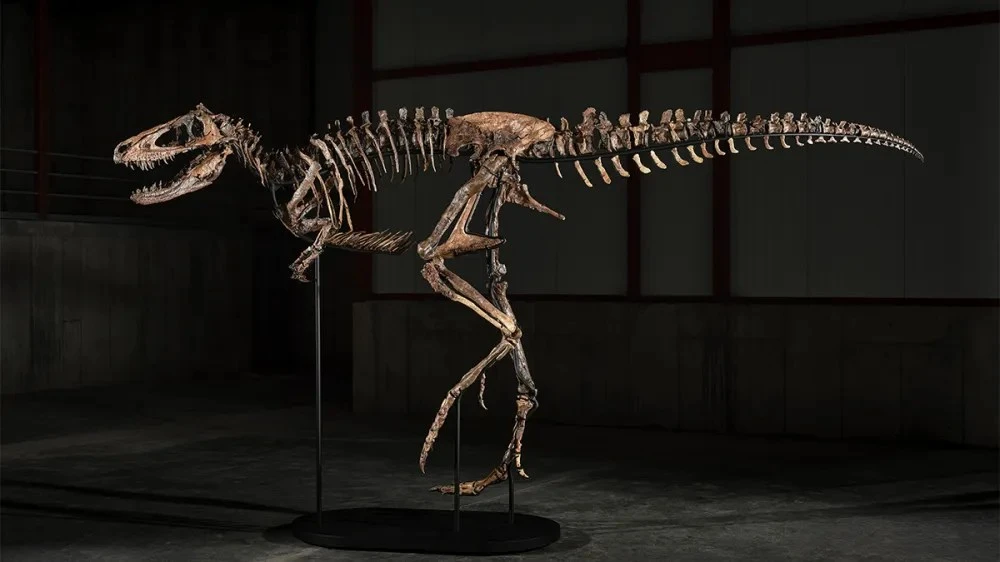
The commercial market for prehistoric fossils has reached unprecedented, stratospheric heights, cementing dinosaur skeletons as the ultimate luxury trophy assets for the global ultra-wealthy. In a stunning display of high-stakes bidding at Sotheby’s New York, a remarkably preserved, 67-million-year-old Nanotyrannus skeleton affectionately known as "Jodi" obliterated market projections on Tuesday. Fetching a jaw-dropping $47.3 million inclusive of fees, Jodi hammered down at $40.5 million—surpassing its ambitious $9 million high estimate by more than five times.
This monumental sale is far from an isolated market anomaly. Instead, it serves as the latest chapter in a surging, multi-year gold rush that has seen fossil valuations skyrocket past those of blue-chip contemporary artworks, rare horology, and elite sports memorabilia. Coming a mere three months after Sotheby’s sold a Tyrannosaurus rex named "Gus" for a record-shattering $50.1 million, the Jodi auction underscores an insatiable global appetite among billionaires for tangible pieces of Earth’s deep history.
Yet, this astronomical financial boom casts a long and contentious shadow over the scientific community. As commercial auction houses transform paleontology into a playground for private collectors, leading researchers warn that priceless, scientifically vital specimens are slipping behind closed doors, permanently obscured from public museums and academic study. Conversely, market advocates argue that private capital fuels the arduous, high-cost endeavors of excavation and preservation. As the battle lines between commercial interests and scientific stewardship harden, the historic sale of Jodi offers a clear lens into the evolving, highly lucrative—and deeply polarizing—intersection of elite art markets and paleontology.
Read Also
Detailed Chronology: From the Badlands of Montana to the Auction Podium
The extraordinary journey of Jodi spans millions of years of geological preservation, recent remote excavations, a shifting scientific identity, and a clever repositioning within the high-end art market.
Discovery and Excavation in the Hell Creek Formation
The story of Jodi begins in 2019 within the rugged, fossil-rich terrain of Montana’s Hell Creek Formation—a geological treasure trove renowned for yielding some of the world’s most significant Late Cretaceous dinosaur specimens. It was here that rancher Jodi Pierson made the discovery of a lifetime, unearthing the remains of a slender, agile predator that would eventually bear her first name.
Unlike many fragmentary finds, Jodi emerged from the rock as an exceptionally complete specimen. The nearly 20-foot-long skeleton comprises 191 distinct fossil bone elements, anchored by a remarkably well-preserved, nearly complete skull. This anatomical integrity is what immediately captured the attention of commercial handlers and academic paleontologists alike, as pristine cranial material is the ultimate key to unlocking taxonomic debates.
A Taxonomic Identity Crisis
For decades, the very existence of Nanotyrannus as a distinct genus was a subject of fierce, unresolved academic warfare. Generations of paleontologists debated whether these smaller, swift-footed carnivorous predators were truly an independent genus or merely juvenile specimens of the lumbering, apex predator Tyrannosaurus rex.
The ambiguity surrounding Jodi’s classification directly impacted its initial commercial trajectory. In 2023, when the specimen was circulated under the moniker "Chomper" and still broadly marketed as a juvenile T. rex, London-based antiquities and fossil dealer David Aaron brought the skeleton to Frieze Masters with an asking price of $20 million. At the time, the market was hesitant, and the specimen failed to secure a buyer—partly because of the lingering academic uncertainty regarding its taxonomic status and partly due to its evolving provenance (the current consignor having acquired it in 2021).
The Scientific Breakthrough and the Rebranding
The fortunes of the skeleton shifted dramatically following a watershed moment in paleontology. A landmark study published in the journal Nature provided robust, compelling morphological evidence settling the long-standing debate. The study definitively identified Nanotyrannus as a distinct, valid genus that coexisted in the same ecosystems alongside its vastly larger cousin, the T. rex.
Armed with a validated, distinct scientific identity and a fresh, marketable name ("Jodi"), the skeleton returned to the commercial spotlight with a renewed aura of rarity. Sotheby’s positioned the lot as one of only three known Nanotyrannus skeletons in existence. When the hammer finally fell on Tuesday at $40.5 million ($47.3 million with fees), Jodi had more than doubled the $20 million price tag it carried during its unsold stint at Frieze Masters just three years prior.
Supporting Context & Metrics: The Dinosaur Market Boom
To fully grasp the magnitude of Jodi’s $47.3 million sale, one must examine the meteoric financial trajectory of the dinosaur fossil market over the past half-decade. What was once a niche academic pursuit supported by institutional grants has transformed into a high-octane luxury sector.
The Escalation of Fossil Valuations
Prehistoric fossils have systematically broken records, routinely outperforming pre-sale auction expectations by exponential margins. Consider the following milestones that have defined the modern fossil market:
- 2020 (Christie’s, New York): The trend toward institutional-grade private collecting gained major momentum when Stan, a remarkably complete T. rex skeleton, sold for $31.8 million—shattering its modest $6 million to $8 million estimate.
- 2024 (Sotheby’s, New York): A massive Stegosaurus skeleton named "Apex" sold for an astonishing $44.6 million, setting a high-water mark that signaled dinosaurs were competing directly with masterworks of modern art.
- Late 2024 (Sotheby’s, New York): A juvenile Ceratosaurus stunned market observers by fetching $30.5 million against an original pre-sale estimate of just $4 million to $6 million.
- Mid-2025 (Sotheby’s, New York): "Gus," a colossal T. rex skeleton, reset the all-time record for any prehistoric fossil at auction by commanding a staggering $50.1 million, comfortably eclipsing its $20 million to $30 million estimate.
- Early 2026 (Sotheby’s, New York): Jodi steps onto the podium, nearly matching the all-time T. rex record despite being smaller and carrying less widespread public brand recognition than its larger tyrannosaurid relative.
| Specimen Name | Species | Sale Year | Auction House | Hammer / Total Price | Pre-Sale High Estimate |
|---|---|---|---|---|---|
| Gus | Tyrannosaurus rex | 2025 | Sotheby’s | $50.1 million | $30 million |
| Jodi | Nanotyrannus | 2026 | Sotheby’s | $47.3 million (with fees) | $9 million |
| Apex | Stegosaurus | 2024 | Sotheby’s | $44.6 million | $6 million |
| Stan | Tyrannosaurus rex | 2020 | Christie’s | $31.8 million | $8 million |
| Unnamed | Juvenile Ceratosaurus | 2024 | Sotheby’s | $30.5 million | $6 million |
Dinosaurs as Blue-Chip "Trophy Objects"
The demographic driving these astronomical figures comprises ultra-high-net-worth individuals, tech billionaires, hedge fund managers, and international family offices. For these collectors, owning a multi-million-dollar dinosaur skeleton offers a unique synthesis of cultural capital, intellectual curiosity, and visceral display power. Much like a canvas by Jean-Michel Basquiat or a rare Ferrari 250 GTO, a mounted prehistoric apex predator serves as an ultimate conversational centerpiece for private estates, corporate headquarters, and private museums.
Market analysts point out that dinosaur fossils possess inherent advantages over traditional fine art: they are universally understood, visually arresting, biologically unique, and limited in absolute supply by the laws of geology. As traditional luxury asset classes experience saturation, tangible artifacts of deep time have emerged as the definitive alternative asset class of the 2020s.
Official Statements and Industry Perspectives
The rapid commercialization of paleontology has generated intense public discourse, pitting auction houses and private prospectors against academic researchers and museum curators.
The Auction House Defense: Funding Discovery and Preservation
Representatives for premier auction houses like Sotheby’s and Christie’s vigorously defend the private market, arguing that commercial enterprise is an essential engine for paleontological discovery. Excavating a major dinosaur skeleton from remote badlands requires immense financial capital, heavy machinery, specialized engineering, years of meticulous laboratory preparation, and adherence to complex legal frameworks regarding private land rights.
"Private collectors and commercial excavators shoulder financial risks that cash-strapped academic institutions simply cannot afford to take," notes an industry consultant familiar with major fossil transactions. Auction houses emphasize that many commercially recovered specimens are subjected to rigorous scientific study, 3D scanning, and academic publishing before they ever cross an auction block. Furthermore, auction houses frequently coordinate with anonymous buyers who ultimately loan their multimillion-dollar acquisitions to public museums, ensuring that the specimens remain accessible to future generations of scientists and school children.
The Academic Backlash: The Commodification of Prehistoric Heritage
Conversely, the academic and scientific communities view the multi-million-dollar fossil boom with alarm and profound frustration. Paleontologists argue that pricing specimens in the tens of millions of dollars effectively prices public, university-backed museums out of the market entirely.
When a fossil like Jodi sells for $47.3 million, it enters a closed ecosystem of private wealth where access is dictated by the whims of private owners rather than peer-reviewed research priorities. Scientists have raised persistent concerns regarding:
- Loss of Reproducibility: If a private collector stores a holotype or rare specimen in an inaccessible private vault, researchers cannot re-examine the physical bones to verify published studies, violating a foundational tenet of the scientific method.
- Destruction of Context: Commercial prospectors focused on high-value, complete skulls or skeletons may inadvertently or intentionally disturb the surrounding geological matrix, destroying micro-fossils, paleobotanical data, and stratigraphic context that hold immense value for understanding ancient ecosystems.
- Commercial Incentivization of Poaching: High auction payouts risk incentivizing unregulated, destructive digging on public or private lands, leading to the loss of specimens to the illicit black market before they can be properly documented.
Future Outlook: Where Does the Prehistoric Market Go From Here?
As the dust settles on Sotheby’s historic $47.3 million sale of Jodi, industry watchers and scientists alike are left pondering the long-term trajectory of the dinosaur market.
Will the Bubble Burst or Expand?
From an economic standpoint, demand shows no immediate signs of cooling. The psychological barrier of the $50 million ceiling—broken by Gus in 2025—has opened the floodgates for valuations that were once considered unimaginable. As long as ultra-wealthy collectors continue to view prehistoric fossils as peerless expressions of status and permanence, auction houses will actively scour private lands in Montana, Wyoming, the Dakotas, and international fossil hotspots for the next great titan.
However, the market faces looming structural challenges. The supply of large, exceptionally well-preserved, and scientifically complete dinosaur skeletons is strictly finite. Unlike manufactured luxury goods or even contemporary art, nature does not manufacture new editions of a T. rex or a Nanotyrannus. As prime specimens become increasingly scarce, market volatility could rise, or alternatively, prices could continue to climb into unprecedented nine-figure territories.
Bridging the Gap Between Commerce and Science
Looking ahead, industry stakeholders suggest that the best path forward lies in proactive collaboration rather than antagonistic division. Innovative partnerships—where commercial collectors fund the expensive fieldwork and retain ownership while partnering with academic institutions for exhaustive study, open-access digital archiving, and rotational public museum displays—may offer a sustainable compromise.
Until such frameworks become standard practice, however, the commercial dinosaur market will remain a lightning rod for controversy. The sale of Jodi proves that while the bones belong to deep geological time, their current economic valuation belongs firmly to the hyper-capitalist present—leaving scientists to marvel at the creatures that once ruled the Earth, even as they watch them march past museum doors and into the private fortresses of the global elite.





Comments
Facebook App ID not configured. Please add it in the Customizer.