
Executive Overview
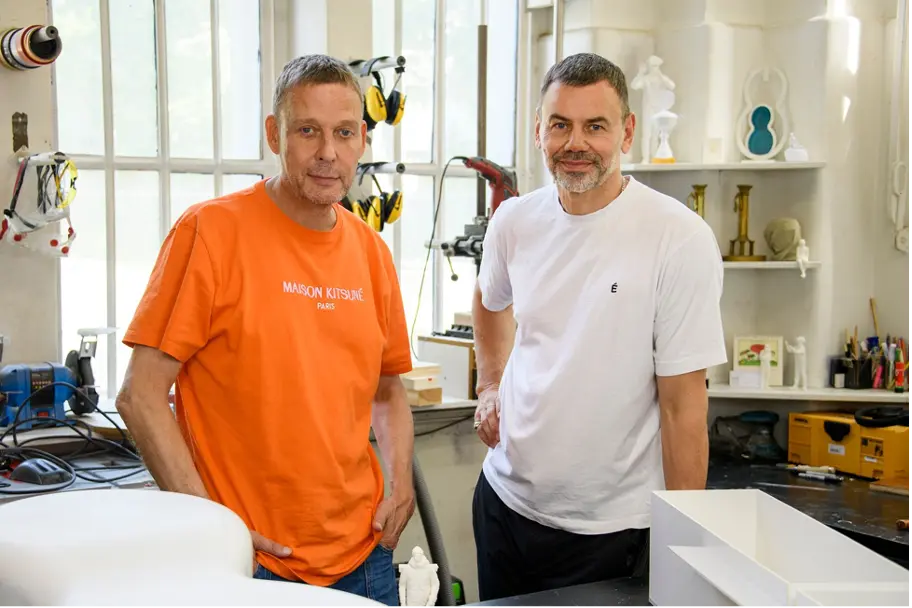
When the Smithsonian Institution’s Hirshhorn Museum and Sculpture Garden reopens its gates to the public on October 31, visitors strolling the National Mall in Washington, D.C., will encounter a striking and disorienting architectural anomaly: a pristine, 28-foot-tall stainless-steel swimming pool standing entirely on end. Titled Eight, this monumental sculpture is the creation of the internationally acclaimed, Berlin-based Scandinavian artist duo Michael Elmgreen and Ingar Dragset.
Representing the centerpiece acquisition of the museum’s newly revitalized outdoor grounds, the sculpture arrives as the crowning visual paradox of a massive, four-year, $68 million redesign executed by renowned Japanese artist and architect Hiroshi Sugimoto. The installation marks a high-water mark for Elmgreen & Dragset, whose career has long been defined by subverting the familiar, questioning institutional spaces, and placing uncanny objects in unexpected public topographies.
Measuring nearly three stories high, Eight features a brilliant lacquered cyan interior complete with all the standard accoutrements of modern leisure—a diving board, a stainless-steel ladder, and recessed pool lighting. Yet, because it is mounted vertically against gravity, the basin is permanently drained, empty, and eternally unswimmable. The sculpture serves as a physical manifestation of the artists’ signature technique of displacement, wrenching a quotidian object of communal recreation out of its utilitarian context and transforming it into a monument of surrealism and silent contemplation.
Read Also
Behind this captivating visual prank lies a deeply thoughtful meditation on public access, community, and institutional architecture. As the Hirshhorn prepares to unveil both Sugimoto’s masterclass in landscape architecture and Elmgreen & Dragset’s towering monument, the art world is watching closely. The installation promises to redefine how visitors experience contemporary sculpture in the nation’s capital, bridging the gap between playful absurdity and profound institutional critique.
Detailed Chronology: From Concept to the National Mall
The Evolution of the Hirshhorn Sculpture Garden Revitalization
The arrival of Eight is inextricably linked to the broader, highly anticipated reopening of the Hirshhorn Sculpture Garden, a project that has been years in the making. Originally designed by Gordon Bunshaft and opened in 1974, the subterranean and ground-level sculpture garden historically struggled with urban integration, deteriorating infrastructure, and a spatial layout that failed to meet the evolving demands of contemporary large-scale sculpture.
In 2019, the Hirshhorn Museum announced that architect and artist Hiroshi Sugimoto had been commissioned to spearhead a comprehensive master plan for the garden. The multi-million-dollar revitalization project aimed to honor Bunshaft’s original brutalist aesthetic while introducing dynamic, flexible spaces capable of accommodating twenty-first-century artistic practices.
Key phases of the Sugimoto-led overhaul included:
- Infrastructure Upgrades: Complete overhaul of drainage, lighting, and security systems across the sunken plaza and surrounding green spaces.
- Geometrical Restructuring: Introduction of new stonework, tiered seating, and minimalist reflecting pools that harmonize historical brutalism with Japanese minimalist landscaping principles.
- Enhanced Accessibility: Reworking paths and entryways to ensure seamless compliance with modern accessibility standards, opening the garden more fluidly to the millions of annual visitors touring the National Mall.
Originally slated for completion sooner, the project faced complex logistical hurdles, supply chain interruptions, and the meticulous stonework required to realize Sugimoto’s exacting vision. The total investment climbed to $68 million, largely supported by private philanthropy and federal allocations. By setting the reopening date for October 31, the institution has positioned the unveiling as the premier cultural event of the capital’s autumn season.
The Genesis of Eight
While Sugimoto reshaped the physical topography of the garden, the search was on for a "crowning installation" that could capture the spirit of contemporary art while engaging in a dynamic dialogue with the historic architecture of Washington, D.C. The choice fell naturally upon Eight, the fourth iteration of a conceptual swimming pool series by Elmgreen & Dragset that has captivated audiences across the globe.
The creative lineage of Eight traces back to the duo’s ongoing fascination with civic spaces and modern architecture. Previous versions of the swimming pool series have been strategically deployed in diverse global contexts, including coastal Miami and bustling New York City. Each iteration adapts to its local environment while maintaining the core conceptual shock of an inverted, unusable aquatic basin.
When the Hirshhorn’s curatorial team initiated discussions with the artists regarding the newly redesigned garden, the vision for Eight quickly crystallized. Unlike previous installations that sat flush with the earth or were integrated into gallery walls, the D.C. version would rise a staggering 28 feet into the sky, demanding the attention of pedestrians blocks away and establishing an unmissable vertical anchor within Sugimoto’s newly terraced landscape.
Supporting Context & Metrics: The Art and Architecture of Elmgreen & Dragset
Masters of Spatial Subversion
Michael Elmgreen (born in Denmark, 1961) and Ingar Dragset (born in Norway, 1969) have collaborated as a conceptual art duo since 1995. Based in Berlin, their artistic practice frequently explores the intersections of art, architecture, and social design. They are widely celebrated for transforming standard white-cube gallery spaces into immersive, narrative-driven environments, as well as planting surreal architectural interventions in starkly contrasting public landscapes.
To fully understand the gravity of Eight, one must examine the duo’s most celebrated public art interventions over the last three decades:
- Prada Marfa (2005): Situated along a desolate stretch of U.S. Highway 90 in West Texas, this permanent sculpture mimics a luxury Prada boutique. Stocked with genuine, non-functional designer shoes and handbags from the 2005 collection, the building was designed to slowly decay and return to the desert landscape, offering a scathing critique of consumerism, luxury culture, and corporate intervention in nature.
- The Memorial to the Persecuted Homosexuals under National Socialism (2008): Located in Berlin’s Tiergarten, this stark, concrete block features a recessed viewing window. Passersby look inside to see a continuous loop of a short film depicting two men kissing. The work transformed a historically neglected victimhood into a living, poignant public monument.
- Powerless Structures, Fig. 101 (2012): Installed on the empty fourth plinth in London’s Trafalgar Square, the duo presented a bronze sculpture of a boy on a rocking horse, subverting the traditional military equestrian statues that typically populate European public squares.
Technical Specifications of Eight
- Height: 28 feet (approx. 8.5 meters) towering vertically.
- Materials: Marine-grade stainless steel exterior with a highly polished, reflective finish; interior coated in a vibrant, lacquered cyan paint.
- Furnishings: Outfitted with a regulation aluminum diving board, a safety ladder, and waterproof recessed lighting fixtures that illuminate the empty basin at night.
- Engineering: Rigorously engineered to withstand severe D.C. weather conditions, including high winds and heavy snow loads, utilizing hidden internal steel trusses anchored deep within reinforced concrete footings beneath Sugimoto’s new garden layout.
Official Statements and Curatorial Perspectives
The acquisition and placement of Eight have generated considerable excitement within the global contemporary art community, reflected in statements released by the museum and the artists themselves.
In their joint artist statement, Elmgreen & Dragset elaborated on the metaphorical weight of the sculpture within a civic context:
"For us, swimming pools can be synonymous with public access, togetherness, and community—like the Hirshhorn. Eight appears empty, yes, but ready to be filled by the imaginations of visitors. By rendering the pool vertical, we remove its functional purpose, turning a site of physical leisure into a monument for psychological reflection."
Hirshhorn curator Anne Reeve emphasized the duo’s unique ability to shift perceptions of public space:
"Elmgreen & Dragset are true virtuosos of transformations within both the traditional confines of galleries and outside in the public sphere. Their ability to take familiar, highly social urban infrastructure and tilt it just enough to reveal its underlying absurdity—and its poetry—makes Eight the ultimate dialogue partner for Hiroshi Sugimoto’s architectural vision."
Museum directors note that the sculpture aligns perfectly with the Hirshhorn’s historic mission: to bring the most provocative, boundary-pushing contemporary art of our time directly to the American public, free of charge, in the heart of the federal capital.
Future Outlook: A New Era for the Hirshhorn
As the final construction barriers come down and the landscaping matures, the October 31 reopening of the Hirshhorn Sculpture Garden is poised to redraw the cultural map of Washington, D.C. The synthesis of Hiroshi Sugimoto’s timeless, meditative architectural framing and Elmgreen & Dragset’s irreverent, soaring sculpture establishes a compelling tension between the past and the present.
For visitors approaching the National Mall this autumn, Eight will serve as an immediate visual beacon—a gleaming, azure-lined monolith defying gravity and logic alike. It challenges museum-goers to look past the literal function of everyday objects and consider how public spaces foster community, imagination, and shared humanity.
In an era where public monuments are increasingly scrutinized for their relevance and meaning, Elmgreen & Dragset’s vacant swimming pool offers a refreshing alternative: a monument dedicated to nothing less than human potential and the boundless expanse of the collective imagination. When the gates unlock on Halloween, the waters may be missing, but the depth of experience promises to run very deep indeed.





Comments
Facebook App ID not configured. Please add it in the Customizer.