At Berlin’s prestigious Alte Nationalgalerie, a landmark new exhibition, "Cassirer: Breakthrough of Impressionism," sets out to dismantle the artificial barrier traditionally erected between the pristine walls of the art museum and the pragmatic mechanics of the art market. Visitors are greeted immediately by an evocative triptych of human portraiture: Edgar Degas’s dynamic Miss La La (1879), Pierre-Auguste Renoir’s luminous Lise with a Parasol (1867), and Max Slevogt’s tender 1901 portrait of the dealer’s own daughter, Suzanne Aimée Cassirer.
Though comprising two French works and one German, these three paintings are bound together by a single, formidable historical figure: Paul Cassirer. Around the turn of the twentieth century, Cassirer operated as the preeminent Berlin-based dealer responsible for single-handedly importing French Impressionism into the heart of Germany. His aggressive commercial strategy, sophisticated eye, and relentless advocacy for the European avant-garde fundamentally reshaped the nation’s cultural landscape.
For decades, art historical scholarship has often attempted to sanitize canonical museum collections, treating masterpieces as though they manifested through pure aesthetic destiny rather than private capital, speculative risk, and cross-border negotiations. This exhibition, paired with its comprehensive catalog, boldly restores transparency to that history. It lays bare the mechanisms by which art crossed borders, exchanged hands, and transformed taste.
By shifting the locus of cultural authority away from conservative state academies and toward private gallerists and critics, Cassirer proved that the success of a modern art movement relies as much on savvy commercial enterprise as it does on canvas and pigment. While his French contemporary Paul Durand-Ruel is a household name in art history circles, Cassirer’s monumental influence across the Rhine is only now receiving its long-overdue institutional reckoning.
Detailed Chronology: The Rise, Reign, and Ruin of a Cultural Kingmaker
1898–1901: The Genesis of the Kunstsalon and the Tiergarten Revolution
The foundational chapter of Paul Cassirer’s ascension began in 1898 when he and his cousin Bruno established the Kunstsalon in Berlin. Operating in an era when official cultural policy was strictly dictated by the state—which favored a conservative, heroic German national style—the Cassirer cousins injected radical foreign aesthetics directly into the imperial capital. By 1901, the cousins parted ways, leaving Paul as the sole director of operations.
Relocating to a luxurious gallery in the fashionable Tiergarten district, Cassirer enlisted the celebrated Art Nouveau architect Henry van de Velde to design a sumptuous, ultra-modern interior. Eschewing the dense, floor-to-ceiling, salon-style hangs that were standard practice at the time, Cassirer opted for relatively sparse, single-row arrangements. This curatorial restraint allowed individual canvases to breathe, forcing viewers to engage with the works on their own formal terms rather than as mere decorative wallpaper.
1901–1914: Expanding the Canon and the "Money" Punchline
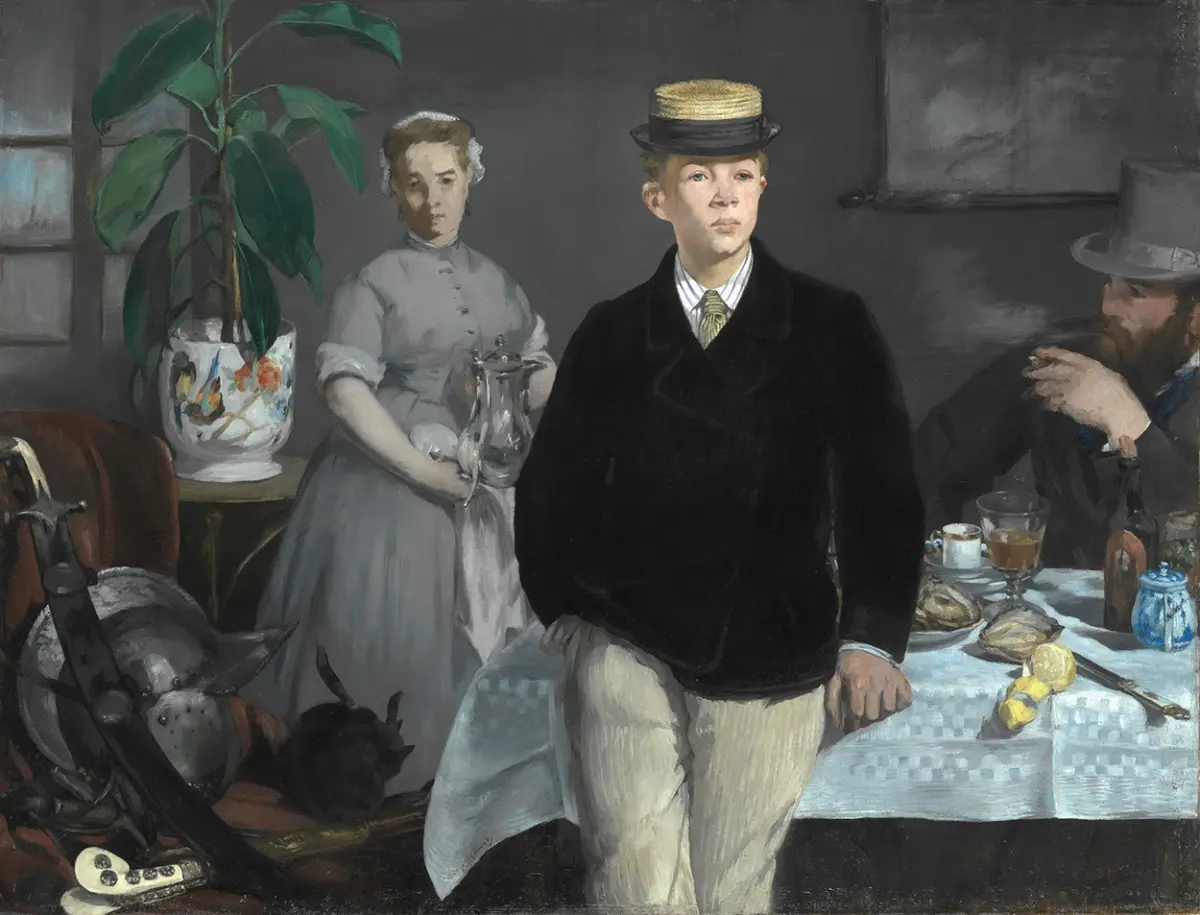
Cassirer’s stable quickly expanded beyond Degas and Renoir to encompass the heavy hitters of French and European modernism: Claude Monet, Édouard Manet, Paul Cézanne, Vincent van Gogh, and even non-French visionaries like Edvard Munch. This transnational curation was driven by a genuine passion for modernism, but it was anchored by a sharp commercial instinct. A biting contemporary caricature of the gallerist famously quipped a summary of his business model: "From Monet and Manet to money."
Cassirer understood that educating a resistant public required patience and repetition. When a work failed to sell, he did not banish it to the back room; instead, he exhibited it again and again until the eye of the Berlin bourgeoisie caught up with the vision of the avant-garde. This persistent methodology culminated in 1914 with what was then the largest-ever retrospective of Vincent van Gogh, featuring an astonishing 151 works.
Yet, this relentless commercial promotion of foreign art inevitably set the dealer on a collision course with the conservative Prussian state and nationalist artists who viewed the influx of French modernism as a direct threat to German cultural identity.
1911–Present: The Nationalist Backlash, Political Purges, and Tragic Downfall
The tension between international modernism and nationalist preservation boiled over in 1911. Landscape painter Carl Vinnen published the reactionary manifesto "Protest by German Artists," gathering 140 signatures from artists hostile to the French cultural invasion. Cassirer swiftly fired back, participating in a counter-manifesto organized by more internationalist-leaning artists, including Wassily Kandinsky and Franz Marc.
The cultural battlefield had real political casualties. Three years prior to the Vinnen protest, Hugo von Tschudi, the progressive director of the Nationalgalerie, was unceremoniously ousted from his post. His crime? Acquiring French modernist masterpieces via Cassirer at a time when Kaiser Wilhelm II demanded that national collections serve patriotic, state-sanctioned ends.
Cassirer’s life ultimately ended in tragedy, marked by suicide amidst stressful divorce proceedings. Yet, his structural legacy endures. The Alte Nationalgalerie’s current exhibition proves that understanding the merit of historical museum collections requires absolute transparency regarding the motivations—both noble and pecuniary—that shaped them.
Supporting Context & Metrics: The Anatomy of an Exhibition
To fully appreciate the scope of "Cassirer: Breakthrough of Impressionism," one must examine the curatorial choices and quantitative realities underpinning the installation at the Alte Nationalgalerie.
The Contrast of Collections: Cassirer’s Vision vs. State Acquisitions
A striking metric within the current exhibition highlights the divergence between what Cassirer championed and what the Prussian state was ultimately willing to absorb into its public holdings:
Van Gogh Representation: While Cassirer’s historic 1914 gallery show featured 151 works by the Dutch master, the current Alte Nationalgalerie exhibition features a mere 2 works by van Gogh. This stark contrast underscores the historic friction between private market taste and institutional reluctance.
The Power of Repetition: Cassirer’s strategy of re-exhibiting unsold inventories is reflected in pairings like van Gogh’s Boulevard de Clichy (1887)—which Cassirer exhibited in both 1905 and 1908—hung directly alongside German Impressionist Curt Hermann’s Snow-Covered Roofs (1908/09). This juxtaposition provides a compelling visual argument for the direct lineage and influence of French techniques upon domestic German painters.
Economic Realities and Institutional Pressures
The exhibition goes to great lengths to contextualize early masterpieces that initially shocked the market. Among them is Monet’s 1866 Jar of Peaches, exhibited alongside the radical 1872 Impression, Sunrise. By placing early still lifes next to groundbreaking plein-air landscapes, Cassirer systematically constructed an evolutionary art-historical lineage that his nervous patrons could comfortably digest.
Even Manet’s monumental 1863 scandal, Le déjeuner sur l’herbe, made its way to the Kunstsalon under Cassirer’s watch—though, notably, it still failed to find a buyer at the time, proving that even the master dealer occasionally outpaced the risk tolerance of his clientele.
Official Statements and Curatorial Insights
Exhibition organizers and contemporary critics have pointed out the uncomfortable parallels between the nationalist pressures faced by Cassirer and modern political interference in the arts.
Curatorial notes in the exhibition catalog emphasize:
"Too often, we try to separate the art market from the museum, as if esteemed collections of now-canonical art could be held apart from the money with which they were bought and the circumstances in which they were sold. This exhibition and the accompanying catalog openly trace the mechanisms by which art crossed borders and exchanged hands."
Furthermore, cultural historians observing the exhibition have drawn explicit parallels to contemporary political climates:
"The attempt to constrain museums to patriotic and nationalist ends during the reign of Kaiser Wilhelm II finds an uncomfortable echo in the United States today, where museum exhibitions and educational programs are increasingly placed under direct pressure from state-level political priorities."
Paul Durand-Ruel, Cassirer’s esteemed French counterpart, once remarked that Cassirer was "exclusively responsible" for successfully carrying the banner of Impressionism across the Rhine—an accolade that validates the German dealer’s unique, transnational bridge-building capabilities.
Future Outlook: Transparency in the Modern Museum
As "Cassirer: Breakthrough of Impressionism" welcomes international visitors to Berlin, its broader implications extend far beyond 19th-century art history. The exhibition serves as a timely reminder of the complex ecosystem that sustains the art world.
In an era where modern museums face renewed scrutiny regarding corporate sponsorship, deaccessioning ethics, provenance research, and political interference, Cassirer’s legacy offers a valuable lesson. It demonstrates that denying the commercial and economic underpinnings of art collections creates a false narrative.
By embracing transparency—revealing the profit motives, the failed sales, the nationalist pushback, and the private-dealer networks—institutions like the Alte Nationalgalerie empower viewers to understand art not as an isolated miracle of aesthetic genius, but as a vibrant, highly negotiated human enterprise shaped by courage, commerce, and cultural exchange.





Comments
Facebook App ID not configured. Please add it in the Customizer.