
Executive Overview
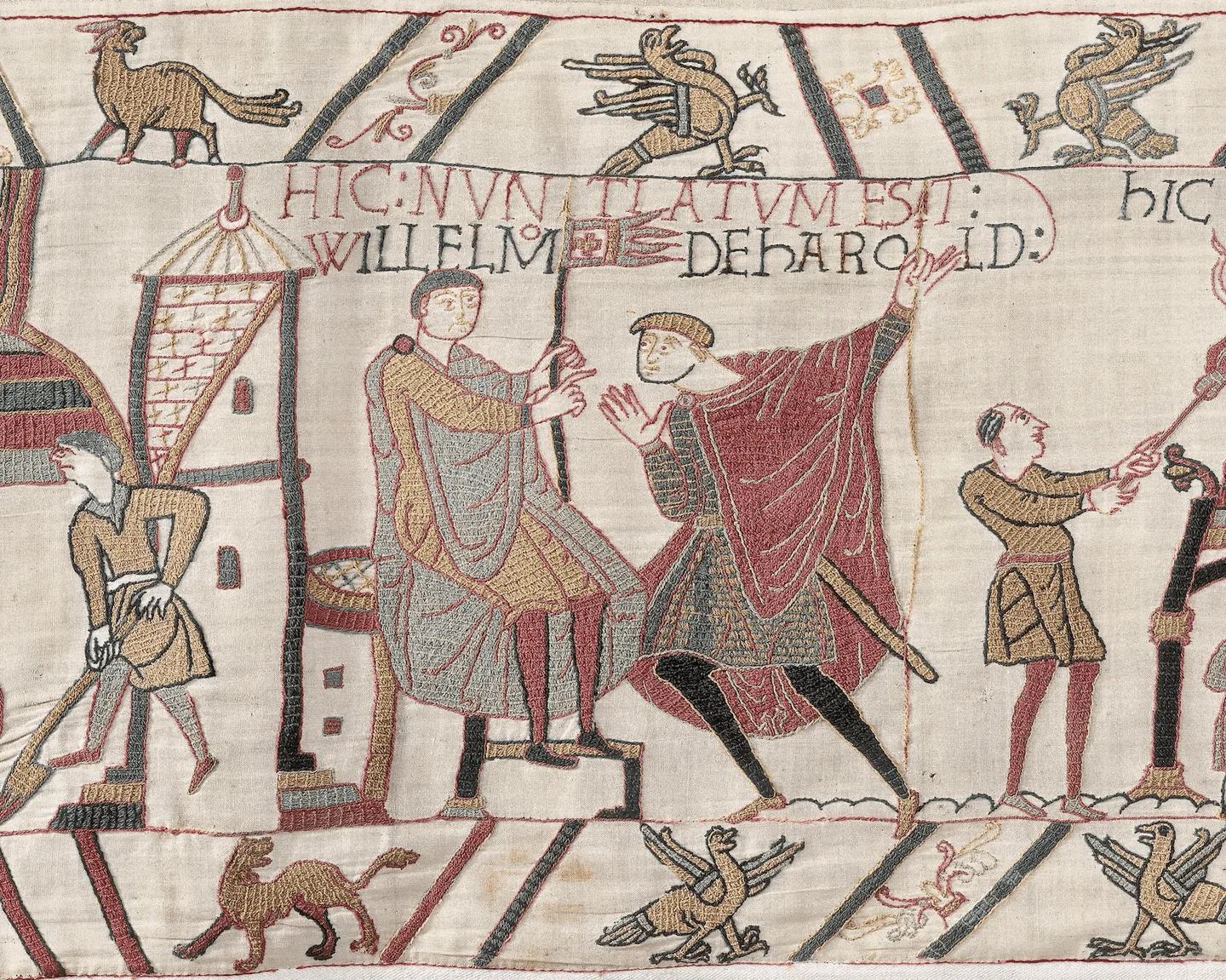
In an extraordinary convergence of medieval heritage, diplomatic maneuvering, and cutting-edge conservation engineering, the Bayeux Tapestry—a 220-foot-long embroidered masterpiece chronicling the 1066 Norman Conquest of England—has embarked on a historical cross-Channel journey. Transported from its long-held sanctuary in Normandy to the British Museum in London, the ancient artifact is being displayed in the United Kingdom for what is widely recognized as the first time in its nearly 1,000-year history.
The transfer represents far more than a standard museum loan; it is an unprecedented logistical gamble involving a $1 billion state-backed insurance indemnity, complex diplomatic overtures between Paris and London, and an engineering solution designed to protect one of the world’s most fragile textiles. Suspended within a custom-built, multi-layered protective cage (le paravent) and escorted by heavily armed police convoys, the tapestry’s move across the English Channel marks a pivotal moment in contemporary Anglo-French relations.
While British cultural authorities celebrate the arrival of what they consider a foundational document of their national story, the loan has sparked profound anxiety across France. Critics, conservators, and heritage activists have voiced sharp opposition, questioning the wisdom of subjecting an irreplaceable, fraying 11th-century masterpiece to the physical stresses of international transit. Amid persistent post-Brexit friction and maritime border debates, the tapestry’s relocation stands as a high-stakes test of cultural diplomacy and art preservation physics.
Read Also
Detailed Chronology
+-----------------------------------------------------------------------------------+
| CHRONOLOGY OF THE BAYEUX TAPESTRY                                                 |
+-----------------------------------------------------------------------------------+
| c. 1070s     | Crafted, likely in Anglo-Saxon England, for Bishop Odo of Bayeux.  |
| 1720s        | Rediscovered by antiquarians after centuries of local obscurity.  |
| 1803         | Hung in the Louvre by Napoleon Bonaparte as invasion propaganda.  |
| 1944         | Retains cultural resonance during WWII; inspires Allied imagery.  |
| Jan 2018     | French President Emmanuel Macron revives the concept of a UK loan.|
| Sept 2022    | Prefectural & conservation concerns voiced via regional petition.|
| Feb 2023     | Dry-run vibration testing reveals mechanical amplification risk.  |
| Sept 2023    | 7-hour extraction operation executed by 90 conservation staff.   |
| Summer 2024  | Police-escorted transit from Normandy to the British Museum.      |
+-----------------------------------------------------------------------------------+
The Origins and Early History
Crafted in the decades following the Battle of Hastings—most likely by Anglo-Saxon embroiderers working under the commission of Odo, Bishop of Bayeux and half-brother to William the Conqueror—the tapestry served as an ideological and visual record of the Conquest. Despite its English creation, the artifact remained in Normandy for centuries, largely unseen by the broader public and housed within Bayeux Cathedral.
Rediscovery and Political Weaponization
It was not until the early 18th century that antiquarians brought the embroidery to international prominence. As its fame grew, both nations claimed ownership of its narrative. In 1803, Napoleon Bonaparte ordered the tapestry transferred to Paris and displayed at the Louvre to whip up public enthusiasm for his planned invasion of Britain. During World War II, following the Allied landings in Normandy, the tapestry’s distinctive visual iconography was famously echoed in contemporary culture, cementing its status as an enduring emblem of cross-Channel conflict and convergence.
The Diplomatic Turn (2018–2023)
For decades, official inquiries by British institutions regarding a potential loan were politely rejected by French authorities citing the extreme fragility of the textile. However, in January 2018, French President Emmanuel Macron formally revived the proposition during a bilateral summit with the British government. Macron envisioned the gesture as a cultural bridge capable of transcending post-Brexit political tensions.
Despite opposition from conservationists—including a petition launched by French art journalist Didier Rykner that garnered over 70,000 signatures—the French state exercised its legal authority as the owner of the object to approve the loan.
Operation Extraction (September 2023)
The physical removal of the tapestry from the Bayeux Museum demanded absolute precision. Over decades, the textile had been displayed on a U-shaped rail, secured to a heavy linen backing that exerted continuous downward strain. To dismantle the display:
- A specialized team of 90 conservators and engineers wearing protective latex gloves was assembled.
- Executing rhythmic, synchronized movements dictated by a lead instructor ("un, deux, tac tac, stop"), the team spent seven continuous hours transferring the tapestry inch by inch into a newly engineered folding apparatus.
- The tapestry was safely packed, sealed within a climate-controlled container, and secured aboard a specialized transport vehicle for its police-escorted crossing to the United Kingdom.
Supporting Context & Metrics
Key Exhibition & Artifact Metrics
| Metric | Detail / Value |
|---|---|
| Physical Dimensions | 220 feet (68.8 meters) long; approx. 20 inches tall |
| Estimated Valuation / Indemnity | $1,000,000,000 USD (£800M+ UK Indemnity Scheme) |
| Projected Exhibition Visitors | 700,000+ over a 10-month display window |
| Ticket Demand Peak | 9-hour digital queue upon initial public release |
| Transit Vibration Threshold | Strict limit of < 2.0 mm/s peak particle velocity |
| Extraction Team Size | 90 specialized conservators working in unison |
Engineering Le Paravent and Transport Logistics
Because the tapestry could neither be rolled tightly without cracking its ancient wool thread nor handled directly by human hands during transport, French engineering firm SMACH designed le paravent ("the folding screen").
   [ Zigzag Screen Frame (Le Paravent) ]
   +---+---+---+---+---+---+---+---+
   |   |   |   |   |   |   |   |   |  <-- Tapestry layered between padding
   +---+---+---+---+---+---+---+---+
                   |
                   v
   [ Sealed Inner Crate ]
   +-------------------------------+
   | [===========================] |  <-- Wire-rope shock isolators
   +-------------------------------+
                   |
                   v
[ Heavy Aluminum Cage / Transport Vehicle ]- The Mechanism: A multi-hinged, zigzag aluminum support structure that allows the tapestry to be laid flat between protective padding and folded into a compact cuboid without applying pressure to the stitches.
- The Transit Crate: Built by Dutch art-shipping firm Hizkia, the folded screen was suspended within an aluminum frame floating on wire-rope shock absorbers designed to dampen kinetic energy during transport.
The Physics of Transit: Resolving the Vibration Paradox
During a preliminary trial in February 2023, transport engineers detected a critical flaw: the mechanical structure of le paravent was actually amplifying road vibration, pushing parameters past the mandatory 2.0 mm/s limit.
German vibration technology specialist Dr. Kerstin Kracht was brought in to analyze the system’s behavioral physics. Kracht identified that the strict metric—velocity measured in millimeters per second—was inherently misleading when evaluated without frequency parameters:
$$textVibration Severity = f(textAmplitude, textFrequency)$$
Dr. Kracht demonstrated that low-frequency movement with higher amplitude (akin to the long, slow sway of a cradle) posed no threat to the structural integrity of historical linen fibers, whereas high-frequency, low-amplitude micro-shocks (rapid jerks) cause structural shear. By recalibrating the dampening systems to eliminate high-frequency resonance while permitting soft, low-frequency movement, the engineering team cleared the tapestry for safe transport across the Channel.
Vibration Dynamics Comparison:

High-Frequency Jerks (HAZARDOUS TO FIBERS)
  /  /  /  /  /  -> Causes friction shear & micro-tears in ancient thread
 /  /  /  /  /

Low-Frequency Sway (SAFE FOR TEXTILES)
   /'''''     /'''''
  /          /         -> Gentle kinetic displacement managed by padding
 /         _/
Artistic and Material Significance
The Bayeux Tapestry is not a woven tapestry, but an embroidery executed in crewel wool yarn on a plain-weave linen background. It features:
- Visual Narrative: 58 distinct scenes depicting political diplomacy, military preparations, naval logistics, and the Battle of Hastings.
- Marginalia: Top and bottom borders populated by real and mythical beasts, fables, and uncensored observational vignettes—including satirical and explicitly anatomical figures that reflect medieval popular culture.
- Individual Workmanship: Microscopic analysis confirms that while the overarching composition was conceived by a master designer, the stitching was carried out by dozens of distinct artisans simultaneously. No two drawn elements—including hundreds of horses, ships, and structures—are identical.
   +-------------------------------------------------------------------+
   | TOP BORDER: Fables, Mythical Beasts, Tail-Chasing Dogs            |
   +-------------------------------------------------------------------+
   | MAIN NARRATIVE: Epic scenes of Harold, William, Armies & Ships     |
   | [Edward Speaks] -> [Fleet Sails] -> [Cavalry Charge at Hastings]  |
   +-------------------------------------------------------------------+
   | BOTTOM BORDER: Fallen Soldiers, Satirical Figures, Eel & Fish Trim|
   +-------------------------------------------------------------------+
Official Statements
The loan has provoked sharp debate among political leaders, conservators, and cultural commentators, highlighting contrasting national perspectives on heritage and conservation risks.
The Diplomatic Imperative
Lord Peter Ricketts, former British Ambassador to France and the U.K. government’s special envoy for the loan, underscored the political and historical resonance of the gesture:
"In his clever, instinctive way, President Macron understood that this tapestry would have far greater impact in the U.K. than it has had in France. It’s a foundational part of our national story. Everybody knows 1066, even if they don’t know the detail. Why not lend it to the British?"
The Conservationist Pushback
Conversely, Didier Rykner, prominent French art journalist and founder of La Tribune de l’Art, launched a fierce public campaign opposing the move:
"The tapestry is more culturally important for the English than for the French. But that’s no excuse. The more important it is for you, the less O.K. you should be with it being moved. It is an ancient, fragile textile—moving it for political gestures sets a dangerous precedent."
The Engineering Reality
Addressing the intense technical scrutiny surrounding the operation, Cécilia Gauvin, co-founder of the engineering firm SMACH, recalled the tension when learning the destination had shifted from local storage to an international journey:
"We designed the system thinking it was going to travel around three hundred meters to a temporary facility in Bayeux. When we learned it was traveling three hundred miles to London, the mood was not great. We were all terrified about the outcome. But the command came from above, so we had to solve it."
Dr. Kerstin Kracht, the lead vibration scientist, reflected on the challenge of communicating complex physics to anxious political stakeholders:
"Vibration scientists are like firemen—when an invaluable painting or a car vibrates too much, they call us. Explaining frequency versus amplitude to non-scientists required analogies like rocking a baby in a cradle. Eventually, we proved mathematically and practically that the tapestry would experience less physical stress during transit than it does from the ambient footfall of daily museum visitors."
Future Outlook
Political and Diplomatic Impact
The display at the British Museum represents a high-water mark for Franco-British cultural diplomacy in the post-Brexit era. By utilizing soft power to navigate a period marked by maritime border disputes and geopolitical realignments, both governments hope the loan will establish a positive template for future international heritage exchanges.
               [ GEOPOLITICAL FRAMEWORK ]
                           |
         +-----------------+-----------------+
         |                                   |
[ Post-Brexit Friction ]            [ Cultural Soft Power ]
  - Maritime border tension           - Shared historical narrative
  - Cross-Channel diplomacy           - Unprecedented artifact loan
         |                                   |
         +-----------------+-----------------+
                           |
             [ BRITISH MUSEUM EXHIBITION ]
Conservation and the Future of Bayeux
The loan serves as a transitional bridge toward a major overhaul of the tapestry’s permanent home in Normandy:
- Facility Modernization: The existing Bayeux Museum display system—in place for decades—is being completely decommissioned.
- New Display Architecture: Upon its return from London, the tapestry will be installed in a purpose-built state-of-the-art facility in Bayeux.
- Flat-Bed Conservation: Future display methods will abandon hanging mechanisms in favor of inclined or flat-bed, climate-controlled enclosures designed to prevent vertical tension on the ancient linen matrix.
Contemporary Cultural Resonances
The tapestry continues to inspire modern artistic engagement. From public exhibition queues that stretch for hours to multi-year reproduction efforts—such as Swedish artist Mia Hansson’s decade-long endeavor to hand-stitch an exact scale replica—the artifact remains a living document.
As the 1,000th anniversary of the Norman Conquest approaches in 2066, the successful transit and display of the Bayeux Tapestry reaffirms its status not merely as a relic of 11th-century warfare, but as a dynamic monument to shared European history, technical ingenuity, and cross-border preservation.





Comments
Facebook App ID not configured. Please add it in the Customizer.