
Executive Overview
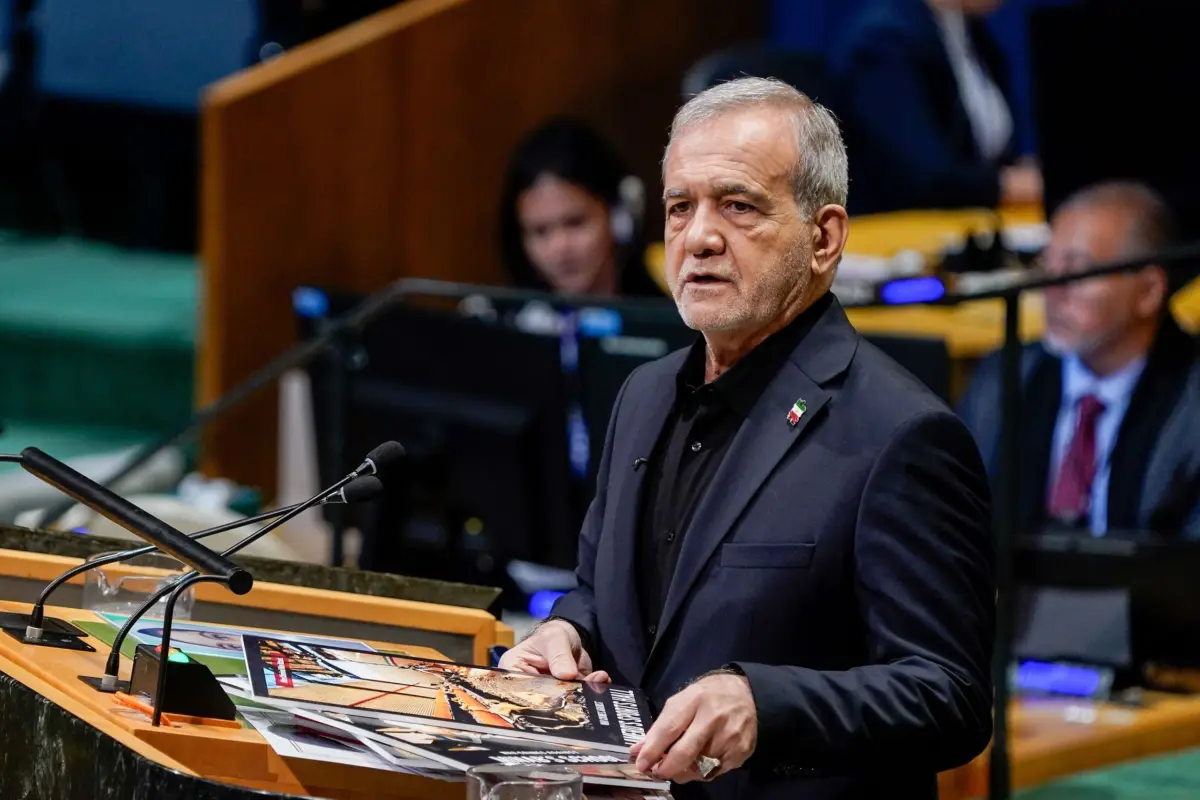
In late September, amid the world’s most intense geopolitical crisis in decades, Iranian President Mahmoud Pezeshkian arrived in New York for the United Nations General Assembly under conditions unprecedented in modern diplomatic history. Visibly worn by seven months of direct military conflict with the United States and Israel, Pezeshkian stepped onto American soil while operating under a unprecedented security arrangement: a combined protective detail of U.S. Secret Service, the New York Police Department, and elements of Iran’s Islamic Revolutionary Guard Corps (IRGC)—a military branch actively targeted by U.S. strikes.
The visit marked the first time the leader of a nation engaged in an active, direct war with the United States was permitted to enter the country. Operating out of the Iranian Ambassador’s Manhattan townhouse rather than the usual luxury hotel suites—a direct consequence of severe domestic economic distress and U.S. State Department sanctions—Tehran mounted an aggressive diplomatic push. Through indirect talks mediated by Qatar, Iranian officials presented a high-stakes, seven-day framework designed to immediately cease hostilities, lift the U.S. naval blockade, unlock billions in frozen assets, and reopen the critical Strait of Hormuz to global shipping.
Despite initial signs of engagement from U.S. envoys, the initiative swiftly disintegrated. President Donald Trump, while publicly characterizing the preliminary discussions as "very good," used his address at the UN floor to threaten the total annihilation of the Islamic Republic. By the end of the week, reports confirmed that Washington had rejected the seven-day proposal, choosing instead to maintain economic pressure and reserve the option for renewed air campaigns following the U.S. midterm elections. The failure of this brief diplomatic window leaves both nations locked in a costly war of attrition, with deep consequences for global energy stability, Middle Eastern security, and international law.
Read Also
Detailed Chronology: From Underground Bunkers to the UN Floor
   FEB 28               JUNE               JULY             LATE SEPT
     |                   |                  |                   |
 War Begins /        Islamabad MOU      MOU Collapses       Pezeshkian UN Visit /
 Khamenei Killed     Signed Remotely    Strait Incident     7-Day Peace Proposal Rejected
The Outbreak of War and the February Crisis
The war erupted on February 28, when a synchronized U.S.-Israeli military campaign launched targeted strikes across Iranian command infrastructure. The opening salvo resulted in the death of Supreme Leader Ayatollah Ali Khamenei alongside dozens of senior cabinet ministers and IRGC officers. Forced to govern from hardened underground installations to evade subsequent air strikes, President Pezeshkian inherited a state in existential peril.
The initial strikes brought severe civilian casualties and allegations of war crimes. In the southern city of Minab, an attack on an elementary school resulted in more than 150 deaths, the majority of them children. Simultaneously, a U.S. Precision-Strike Missile (PrSM)—a newly fielded weapon engineered to detonate in midair and disperse thousands of tungsten fragments—struck the Lamerd Sports Hall, killing over 20 young volleyball players and injuring approximately 100 others. A United Nations report published in September highlighted that these opening-day bombardments warrants investigation as potential war crimes.
The Islamabad Framework and July Breakdown
By June, temporary exhaustion on both sides led to indirect negotiations in Islamabad, Pakistan. These talks yielded a preliminary memorandum of understanding (MOU) signed remotely by President Trump and President Pezeshkian. The agreement outlined a pathway toward a cease-fire and the resumption of formal nuclear talks.
However, the arrangement collapsed in July. Iran intercepted and struck three commercial vessels traversing what Tehran designated an "unauthorized" route within the Strait of Hormuz. Claiming a breach of the maritime status quo, Washington responded with renewed, punishing air strikes targeting Iranian air defense networks and coastal missile sites, pushing the conflict back into full-scale engagement.
The New York Offensive and Qatar-Mediated Talks
Pezeshkian’s arrival in New York represented a calculated effort to bypass the military stalemate through intense shadow diplomacy. On Thursday of the General Assembly week, Iranian Foreign Minister Abbas Araghchi formally outlined a new proposal during three hours of indirect talks in Manhattan with U.S. envoys Steve Witkoff and Jared Kushner, mediated by Qatari diplomats.
       +--------------------------------------------------------+
       |             IRANIAN 7-DAY PEACE PROPOSAL               |
       +--------------------------------------------------------+
       |  U.S. Obligations:                                     |
       |  • Complete removal of economic sanctions              |
       |  • Immediate lift of naval blockade on Iranian vessels |
       |  • Release of $12 Billion in frozen assets              |
       |                                                        |
       |  Iranian Obligations:                                  |
       |  • Open Strait of Hormuz to all international transit  |
       |  • Immediate cessation of hostilites / missile strikes |
       |  • Cease-fire in Lebanon; resumption of nuclear talks  |
       +--------------------------------------------------------+
Araghchi characterized the proposal as an expedited framework capable of ending the war within seven days. The terms required Washington to lift its naval blockade and economic sanctions, while unfreezing roughly $12 billion in Iranian assets. In exchange, Iran promised to reopen the Strait of Hormuz to international shipping, cease hostilites with the U.S., assist in securing a cease-fire regarding Israeli operations in Lebanon, and return to negotiations over its nuclear program.
While U.S. envoy Steve Witkoff initially characterized the talks as "encouraging, constructive and successful," the momentum proved short-lived. By Friday night, the Wall Street Journal reported that President Trump had formally rejected the proposal, anticipating a potential renewal of major bombing campaigns following the U.S. midterm elections in November.
Supporting Context & Quantitative Metrics
Economic Devastation in the Islamic Republic
The seven-month conflict has inflicted structural damage on Iran’s economy, surpassing the disruption experienced during the eight-year Iran-Iraq War in the 1980s.
               ECONOMIC IMPACT ON IRAN (7-MONTH WAR)
  +---------------------------+---------------------------------+
  | Metric                    | Pre-War vs. Current Status      |
  +---------------------------+---------------------------------+
  | Gross Domestic Product    | Contracted by 10%               |
  | Crude Oil Exports         | Declined by >80%                |
  | Currency (Rial vs USD)    | Depreciated from 600K to 2.3M   |
  | Annual Inflation Rate     | Reached 84.4% (August)          |
  +---------------------------+---------------------------------+
The precipitous drop in crude exports—driven by the U.S. naval blockade—has stripped the regime of its primary source of foreign currency. The rial’s collapse has made basic goods unaffordable for broad segments of the population, while rolling blackouts regularly disrupt industrial output. Furthermore, fresh U.S. sanctions targeting all major Iranian commercial airlines have isolated the nation’s transport sector.
Iran’s primary economic and strategic counter-weight remains its physical control over the Strait of Hormuz. Through this narrow maritime choke point passes approximately 20 percent of the world’s petroleum and liquefied natural gas (LNG), supplying key energy markets across Asia and Europe.
                     STRAIT OF HORMUZ CHOKEPOINT
       [ Persian Gulf ] ===>  Strait of Hormuz  ===> [ Gulf of Oman ]
                                     ||
                 Handles ~20% of Global Energy Transit
Military Friction and the Cost to the United States
While Washington has maintained air supremacy over large portions of Iranian airspace, the conflict has exacted a notable financial and strategic toll on the U.S. military apparatus.
- Financial Expenditure: In early September, the Pentagon reported to Congress that direct operations had cost approximately $44 billion. Independent defense analysts estimate the total burden—including munitions replenishment, naval deployments, and auxiliary support—exceeds $100 billion.
- Domestic Energy Shock: The maritime standoff in the Middle East has pushed domestic U.S. fuel prices upward, with national averages reaching $4.50 per gallon for regular gasoline and $6.50 per gallon for diesel.
- Base Vulnerability: Former CIA Director and retired Army General David Petraeus noted that key American regional installations have suffered severe operational disruptions. Among them, Al Udeid Air Base in Qatar—the primary forward operating hub for U.S. Central Command—has seen its operational capacity compromised by Iranian drone and ballistic missile strikes.
- Asymmetric Warfare Dynamics: Reports from the Hudson Institute indicate that while U.S. forces have successfully destroyed numerous fixed Iranian launch sites, Tehran’s decentralized, low-cost drone ecosystem rapidly regenerates, allowing Iran to sustain long-range strike capabilities across 14 countries despite ongoing bombardment.
Official Statements & Diplomatic Maneuvers
The UN Podium: Divergent Visions of Conflict
The ideological chasm between the warring parties was fully visible during formal addresses at the General Assembly.
President Mahmoud Pezeshkian, wearing a black shirt in traditional mourning, delivered a bitter address to an assembly hall marred by mass walkouts from Western and allied delegations:
"No one in this region will have security alone. Either we build it together, or we will have to live under insecurity together. We are not afraid of fighting, of war, but we will not bend the knee to U.S. pressure."
To underscore his points, Pezeshkian presented three photographs to the assembly: one of the late Supreme Leader Ali Khamenei, one showing the civilian victims of the Minab elementary school strike, and a third illustrating the destruction at the Lamerd Sports Hall.
+-------------------------------------------------------------------------+
|                      KEY UN ADDRESSES & STATEMENTS                      |
+-------------------------------------------------------------------------+
| MAHMOUD PEZESHKIAN (Iran President):                                    |
| "Either we build [security] together, or we will have to live under     |
| insecurity together... We will not bend the knee."                      |
+-------------------------------------------------------------------------+
| DONALD TRUMP (U.S. President):                                          |
| "Annihilate the Islamic Republic, and do it quickly... drive Iran into   |
| Hell with no chance of survival."                                       |
+-------------------------------------------------------------------------+
| BENJAMIN NETANYAHU (Israeli Prime Minister):                            |
| "A battle against the barbarians... Launching the war on Iran had been  |
| one of the easiest decisions I've had to make."                         |
+-------------------------------------------------------------------------+
President Donald Trump offered a starkly different vision during his own address, threatening catastrophic escalation if Tehran refused to capitulate unconditionally:
"I am prepared to annihilate the Islamic Republic, and do it quickly, never giving them a chance to kill and destroy people and countries again. We are willing to drive Iran into Hell with no chance of survival and no hope of future greatness or generations."
Israeli Prime Minister Benjamin Netanyahu, facing domestic political pressures ahead of upcoming national elections, reaffirmed his government’s resolve to dismantle Iranian-aligned networks across the region, stating:
"This is a battle against the barbarians. Launching the war on Iran had been one of the easiest decisions I’ve had to make as Prime Minister, because if we hadn’t done it, we’d all be dead."
Netanyahu addressed a largely depleted hall following coordinated walkouts by dozens of international delegations. Observing the empty desks, he added: "If there are any other moral cowards who haven’t yet left this hall, please do so now." The Iranian delegation, having previously exited, left behind a framed portrait of General Qassem Soleimani on their empty table.
Domestic Political Pressures and Expert Commentary
The diplomatic overtures in New York generated friction within both domestic political spheres.
In Tehran, ultraconservative factions criticized Pezeshkian’s willingness to engage with Washington. Kayhan, a newspaper aligned with the office of the Supreme Leader, published an editorial declaring:
"New York is not a place for smiles and negotiations. Care must be taken that no signal is given during the New York trip that could be interpreted by the enemy as weakness."
Concurrently, Iranian dissident intellectuals pointed to systemic internal failures. Sadegh Zibakalam, a former University of Tehran political scientist, stated publicly:
"Our problem is neither with America, nor with the Arabs, nor even with Netanyahu. Our problem is with our own hard-liners who seized all power for thirty-six years and now aren’t willing to relinquish even a hair’s breadth of it—even at the cost of dragging ninety million Iranians through the mud."
In Washington, hawks within the Republican Party rejected any premature settlement. Senator John Kennedy of Louisiana expressed deep skepticism regarding diplomatic engagement with Tehran:
"I think that the people running Iran are reptiles. You can’t trust them. I wouldn’t turn my back on any of them, even if I thought and knew they were two days dead."
Analysing the strategic impasse, Robert Malley, former U.S. special envoy for Iran, observed that both nations are operating under fundamentally incompatible assumptions:
"Iran wants a deal because its economy is reeling under crushing U.S. sanctions. Tehran believed the first cease-fire was good in principle, but that given U.S. unreliability, it should front-load any future deal with economic concessions before reopening the strait. The problem is that the Trump Administration drew a very different lesson. It viewed the first deal as inherently flawed, concluding that Iran should first be strangled economically to force it to concede. With such diametrically opposed assessments, it’s unfortunately hard to imagine an agreement emerging anytime soon."
Ali Vaez, deputy director of Middle East programs at the International Crisis Group, emphasized that Iran’s proposal served a dual strategic purpose:
"Iran engineered a ‘heads I win, tails you lose’ proposition. If Trump accepts, Iran locks in a deal on favorable terms. If he rejects it, Tehran gets to argue that Washington—not Iran—is the obstacle to diplomacy."
Future Outlook & Strategic Imperatives
The rejection of the seven-day proposal leaves the conflict in a dangerous posture. With diplomatic channels largely stalled and formal proposals set aside, both nations face clear strategic risks moving into the late autumn of 2026.
                  POST-REJECTION STRATEGIC OPTIONS

          +-----------------------------------------------+
          |          US Strategic Dilemma                 |
          +-----------------------------------------------+
          | • Option A: Post-Election Military Escalation |
          | • Option B: Continued Economic Containment    |
          | • Risk: High Gas Prices & Base Vulnerability  |
          +-----------------------------------------------+
                                  |
                                  v
          +-----------------------------------------------+
          |         Iranian Strategic Dilemma             |
          +-----------------------------------------------+
          | • Option A: Asymmetric Regional Attrition     |
          | • Option B: Weaponization of Strait Chokepoint|
          | • Risk: Total Economic Hyperinflation/Collapse|
          +-----------------------------------------------+
Key Strategic Dynamics to Watch:
- The Post-Election Window: With the U.S. midterm elections approaching, Washington’s strategic calculus may shift. Should the administration decide to launch a broader air campaign after November, U.S. forces could target Iran’s remaining industrial and energy infrastructure. Conversely, continued domestic dissatisfaction over high gas prices ($4.50–$6.50/gallon) could pressure Washington to seek an alternative off-ramp.
- Sustained Energy Disruptions: As long as the naval blockade and Iranian counter-measures in the Strait of Hormuz persist, global energy markets remain vulnerable to price spikes. Sustained disruption in the passage of 20 percent of the world’s energy supply risks broader global economic stagnation.
- The Nuclear Verification Friction: Even if a temporary cease-fire is reached, resolving the broader dispute over Iran’s nuclear enrichment capabilities remains a long-term challenge. Analysts note that while the 2015 Joint Comprehensive Plan of Action (JCPOA) required over two years of negotiations among six world powers, current talks lack a shared framework or technical consensus.
- Asymmetric Attrition: Deprived of conventional economic avenues, Iran is likely to continue leveraging its decentralized drone and missile production networks to strike regional targets. As demonstrated by the operational constraints imposed on U.S. bases like Al Udeid, asymmetric warfare allows Tehran to impose ongoing costs on U.S. operations despite severe economic hardship at home.
As the diplomatic window opened during the UN General Assembly closes without a breakthrough, the war enters an uncertain phase—defined by severe economic pressure on Iran, high operational costs for the U.S., and a persistent risk of wider regional escalation.





Comments
Facebook App ID not configured. Please add it in the Customizer.