
Executive Overview
In the contemporary landscape of international cinema, few propositions are as conceptually tantalizing—or as inherently perilous—as a high-concept genre picture helmed by an auteur renowned for gritty realism and psychological dread. When celebrated South Korean filmmaker Na Hong-jin, the visionary behind The Chaser, The Yellow Sea, and The Wailing, turned his lens toward science fiction with the alien-invasion epic Hope, expectations reached a fever pitch. Reported to be among the most expensive domestic productions in South Korean cinematic history, with budget estimates ranging widely from $46 million to $74 million, the project promised a marriage of blockbuster scale and singular artistic perspective.
However, upon closer critical inspection, Hope emerges as a deeply polarizing paradox—a cinematic artifact caught in a perpetual civil war between visceral action direction and profound narrative and technical failures. Stripped of conventional storytelling mechanics, the film operates primarily as a dual-act relentless pursuit, punctuated by exposition that spells out its singular thematic thesis with blunt force. Yet, it simultaneously showcases breathtaking cinematography, masterclasses in mounting suspense, and sequences of kinetic momentum that rival the finest Hollywood spectacles.
This review-analysis explores the dichotomy of Hope, examining how an astronomical budget collided with catastrophic computer-generated imagery (CGI), why its narrative structure alienates traditional viewers, and where it fits into the broader historical continuum of modern cinematic blockbusters. Ultimately, Hope challenges critics and audiences alike to grapple with a confounding question: Can a film achieve greatness purely through technical bravura and manic energy when its foundational script and creature design fundamentally collapse?
Read Also
Detailed Chronology
To understand the polarizing nature of Hope, one must analyze its narrative trajectory and structural cadence, which defies standard screenwriting conventions in favor of pure, unrelenting kineticism.
Act I: The Gathering Storm and the Art of Concealment
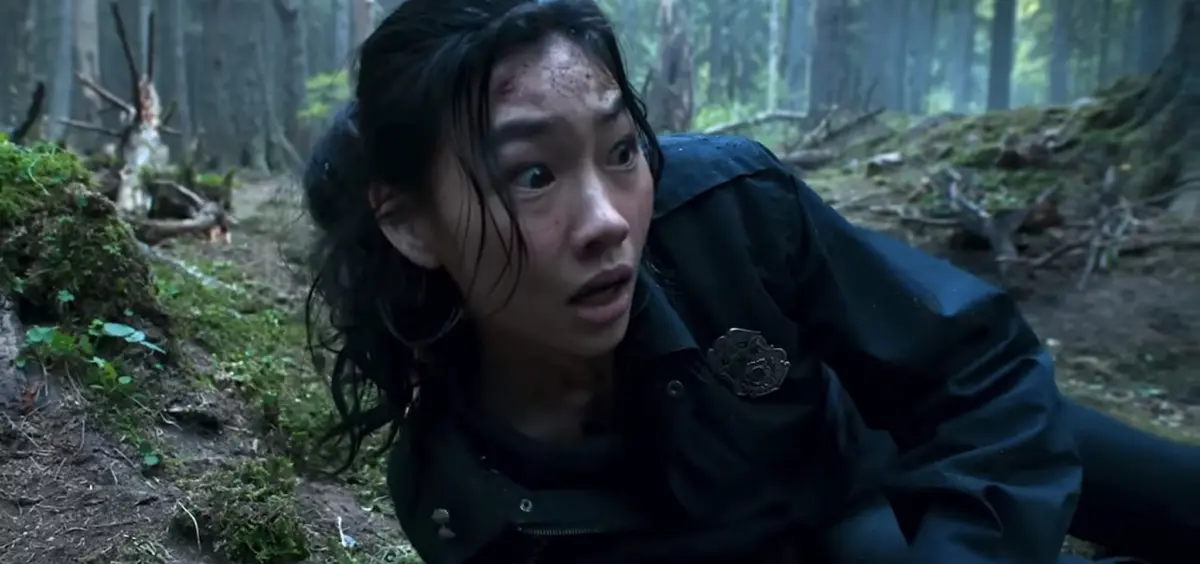
The opening half-hour of Hope stands as an unambiguously triumphant masterclass in atmospheric tension. Eschewing immediate exposition, Na Hong-jin drops the audience directly into a state of mounting dread within the isolated town of Hope, where an unknown, catastrophic force is wreaking havoc.
Here, the narrative follows Police Chief Ko Bum-seok, portrayed with grounded intensity by Hwang Jun-min, as he attempts to investigate the escalating devastation while desperately staying one step ahead of the destruction. In these formative sequences, Na employs a timeless cinematic strategy reminiscent of Steven Spielberg’s approach in Jaws: he hides the monster.
By keeping the extraterrestrial threats strictly off-screen, the film weaponizes the imagination. The sheer scale of the environmental carnage—wrought by unseen perpetrators just out of the camera’s frame—exponentially raises the narrative stakes. The suspense is palpable, suggesting a sophisticated psychological thriller wrapped in apocalyptic packaging. The audience is invited to care deeply about the unfolding mystery, anchoring themselves to Ko’s boots-on-the-ground perspective as he navigates the escalating chaos.
Act II: The Arrival, the Chases, and the Narrative Collapse
This finely tuned atmospheric tension abruptly fractures the moment the aliens are finally unveiled. Hope transitions away from its atmospheric mystery, shedding its investigative roots and mutating into two prolonged, back-to-back chase sequences separated by a brief interlude dedicated to heavy-handed thematic exposition.
During this transitional lull, the film pauses its momentum to explicitly articulate its core thematic thesis: "man is the real monster." Rather than allowing this idea to emerge organically through character arcs or subtext, the script spells it out with jarring didacticism. This heavy-handed approach immediately hobbles the audience’s rooting interest. Compounding this issue is the frustrating invulnerability of certain human protagonists, whose survival defies logic without offering the cathartic satisfaction of intelligent character choices or well-earned narrow escapes.
Following this narrative stumble, the film plunges headfirst into its extended pursuits—staged across diverse terrains via automobiles and horseback. Here, the narrative thread is virtually severed; the story is no longer driving the experience. Instead, the film becomes a breathless, relentless physical exercise, building toward a sequel tease that feels utterly disconnected from any meaningful emotional resolution.
Supporting Context & Metrics
The production history and aesthetic execution of Hope offer a fascinating case study in the limitations of capital within the global film industry.
The Budget-to-Quality Disconnect
At an estimated $46 million to $74 million, Hope commands a staggering budget by South Korean standards. While this figure represents a mere fraction of the $200M+ expenditures typical of Hollywood superhero blockbusters, it is nonetheless a massive financial commitment for a domestic production aiming to compete on an international scale.
This financial reality creates a jarring cognitive dissonance on screen. The physical production values—encompassing tangible locations, elaborate set design, complex stunt coordination, and sweeping landscape cinematography—look undeniably expensive and visually arresting. Yet, whenever the digital creations occupy the frame, the illusion shatters. The contrast between tangible reality and digital artifice is so extreme that it threatens to pull the viewer entirely out of the cinematic experience.
Technical Failures in Creature Design and Animation
The computer-generated aliens in Hope fall victim to nearly every historical pitfall of digital effects integration:
- Spatial Disconnection: The creatures consistently fail to read as if they occupy the same physical space as the actors and practical environments. They lack the nuanced lighting interactions, shadow-casting, and ambient occlusion necessary to ground them in reality.
- Anatomical Inconsistencies: While utilizing motion-capture data for facial expressions, the production apparently abandoned it for the bodies. Consequently, the humanoids move with a bizarre, unnatural cadence that defies physics without achieving a compellingly alien grace.
- The Practical Counter-Example: The illusion becomes even more painful when the first alien is killed and transforms into a physical, practical corpse. This tangible prop looks immeasurably more authentic and terrifying than its digital living counterparts, highlighting the limitations of the computer animation.
- Stylistic Exceptions: Interestingly, the digital effects achieve a momentary pass when the primary alien undergoes a radical transformation into a less traditionally humanoid form. As animation logic dictates, viewers are far more willing to accept digital limitations when a creature’s anatomy is inherently grotesque and fantastical—such as a face resembling a biological anomaly—than when it attempts to mirror recognizable human physiognomy (bear-hugging the uncanny valley likeness of actors like Michael Fassbender).
Comparative Analysis: The Attack on Titan Precedent
To contextualize Hope’s digital failings, one can look toward the live-action film adaptations of Hajime Isayama’s manga Attack on Titan. The first alien encountered in Hope bears a striking resemblance to Eren Jaeger’s iconic Attack Titan form.
Despite being widely panned for their narrative shortcomings, the live-action Attack on Titan films successfully rendered their giant humanoid monsters. By striking a careful balance between stylization and tactile believability—effectively blending digital manipulation with practical creature suits and makeup—those films achieved the exact brand of unsettling, nightmarish atmosphere that Hope strives for. Given that the Attack on Titan adaptations operated on a fraction of Hope’s budget, it serves as definitive proof that capital alone cannot compensate for flawed execution in digital creature design.
Official Statements & Critical Reception
The critical reception of Hope has transformed into an industry-wide debate regarding the evolution of aesthetic standards, particularly concerning the resurgence of appreciation for historically maligned digital effects.
The Nostalgia Curve of Bad CGI
Film historians and critics have long pointed to notorious digital misfires—such as Dwayne "The Rock" Johnson’s infamous Scorpion King in The Mummy Returns (2001)—as cautionary tales of over-reliance on early CGI. However, contemporary viewing habits suggest a fascinating cultural shift.
Much like the affectionate embrace of rubber monster suits in classic television or Mystery Science Theater 3000 selections, modern audiences are increasingly finding nostalgic charm in amateur or unpolished digital effects. This phenomenon is further evidenced by international box office anomalies, such as the surprise success of low-budget Chinese features like Niu Lai, which thrive precisely because their unrefined aesthetics invite communal mockery and celebration.
As the cultural landscape becomes increasingly saturated with hyper-processed, algorithmically generated "AI slop," audiences are developing a strange fondness for tangible, albeit poorly executed, human-driven CGI. In this climate, the glaring flaws in Hope’s digital monsters cease to be purely offensive; instead, they oscillate between genuine terror, breathtaking action choreography, and unintended comedy.
Intentional Satire vs. Inadvertent Camp
A central question facing critics is whether the absurdity within Hope is an accident of production or part of a calculated satirical design. The film features moments of undeniable, deliberate black comedy:
- An elderly villager (portrayed by Im Hyuk-skik) delivering a deadpan monologue about witnessing the extraterrestrial onslaught while suffering from a severe bout of diarrhea.
- A battlefield surgeon attempting to perform an autopsy with a chainsaw after traditional scalpels fail against alien tissue.
These beats suggest a filmmaker operating with a wry sense of humor. This raises the intriguing possibility that Na Hong-jin is executing a Paul Verhoeven-esque subversion—deliberately mocking blockbuster conventions through heightened absurdity. If viewed as a biting satire on the clichés of franchise-building and alien-invasion tropes, the film’s baffling, sequel-baiting conclusion transforms from a lazy narrative cop-out into a brilliant, provocative punchline. However, without concrete authorial confirmation, critics are left to guess whether the joke is on the audience or the filmmakers themselves.
Future Outlook
As Hope prepares for wider international distribution and digital streaming, its long-term legacy remains suspended in critical limbo.
When uploading notices to aggregator sites like Rotten Tomatoes, critics find themselves wrestling with a frustrating binary: assigning a "fresh" or "rotten" designation feels fundamentally inadequate for a project of this nature. A "fresh" score feels unearned given the paper-thin characterizations and jarring digital execution; a "rotten" score feels equally dishonest, failing to capture the exhilarating, breathtaking highs of Na Hong-jin’s directorial bravura during the action set-pieces.
Ultimately, Hope leaves the cinematic community in a state akin to a pop-culture philosophy seminar. Is it a good film? A bad film? The good kind of bad, or the bad kind of good? As the boundaries between high-art auteurism and chaotic blockbuster spectacle continue to blur, Hope stands as a monumental, messy testament to ambition. It proves that even when a film stumbles over its own digital creations and narrative structure, the sheer, unbridled energy of a master director can keep audiences transfixed until the very last, confounding frame.




Comments
Facebook App ID not configured. Please add it in the Customizer.