
Executive Overview
In an era dominated by instantaneous digital retrieval, algorithmic feeds, and the relentless homogenization of human knowledge, the very nature of discovery has fundamentally shifted. Today, the answers to humanity’s most obscure historical, scientific, and cultural queries are rarely more than a keystroke away. Yet, this seamless efficiency has arguably impoverished the intellectual journey. The friction of the search—the tactile labor of thumbing through dog-eared pages, pooling gas money to drive towns over in search of a singular, esoteric record, or descending into the windowless depths of a university archive—has largely vanished.
Enter Chronovisor, a fascinating and formally audacious new film by the filmmaking collective Cosmic Salon (comprising directors Kevin Walker and Jack Auen). Billed as a "research thriller," the movie stands as both a narrative mystery and a cultural artifact lamenting the erosion of deep, analog inquiry. Starring real-life academic Anne Laure Sellier as Columbia professor Dr. Béatrice Courte, the film eschews high-octane modern CGI and rapid-fire pacing in favor of something far rarer in contemporary cinema: an unabashed celebration of the intellectual rabbit hole.
Set against the atmospheric backdrop of Manhattan’s dimly lit research libraries, Chronovisor follows Dr. Courte as she unearths cryptic references to a legendary, suppressed piece of mid-century technology: a device purported to capture the auditory and visual echoes of past events. As Béatrice navigates physical books in four different languages, rotary telephones, and guarded academic circles, Walker and Auen construct an immersive cinematic experience that feels less like a modern sci-fi flick and more like a lost masterwork from the golden age of intellectual mystery.
Read Also
Detailed Chronology of the Investigation
The narrative architecture of Chronovisor relies heavily on procedural accumulation, charting a meticulous path through forgotten history.
Phase I: The Spark of Inquiry
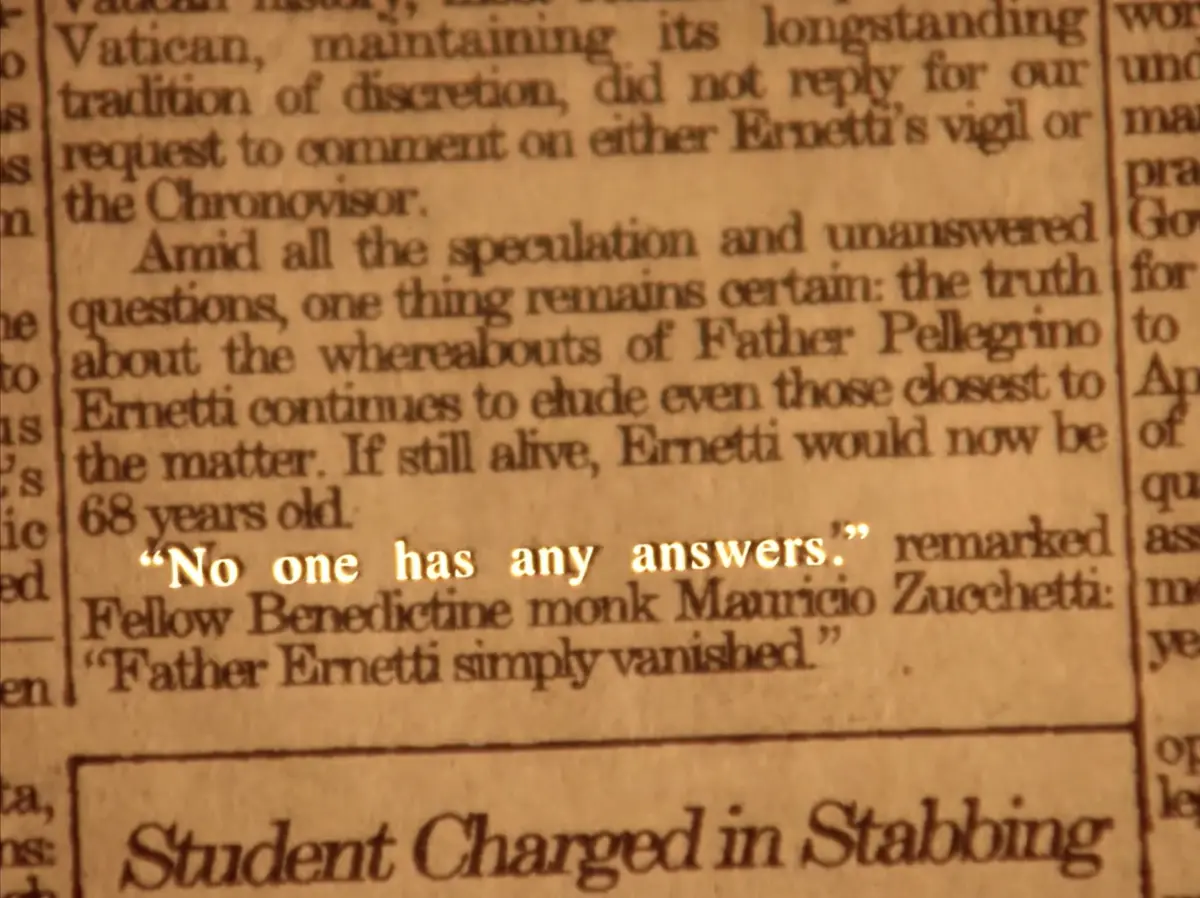
The story begins within the specialized domain of human memory mechanics. Dr. Béatrice Courte, a scholar at Columbia University studying how humanity perceives and retains the passage of time, stumbles upon anomalous textual references during routine literature reviews. These cryptic fragments point toward an extraordinary historical footnote: the Chronovisor, an experimental apparatus purportedly invented in the 1950s by an Italian Benedictine monk and scientist, Father Pellegrino Ernetti.
Rather than deploying modern web searches or querying digital databases, Dr. Courte embarks on a decidedly analogue crusade across New York City. The film plunges viewers into the tactile reality of physical archives. The cinematography emphasizes the sensory dimensions of serious scholarship: rooms lined with heavy mahogany shelves, illuminated by the warm, golden glow of old-school desk lamps and the sickly green rectangles of CRT monitors. The air onscreen practically carries the scent of aged paper, decaying leather bindings, and library dust.
Phase II: The Polyglot Paper Trail
As the investigation deepens, books fail to provide straightforward answers, forcing Béatrice to cast a wider net. A significant portion of the film’s runtime is dedicated to the unglamorous, patient act of reading. The camera lingers on dense, multi-lingual texts, occasionally highlighting specific passages or offering English translations of Latin, German, Italian, and French sources.

When textual evidence hits a wall, Dr. Courte turns to the telephone. She systematically reaches out to any living academic, cleric, or technician with a tenuous link to Father Ernetti. Quickly, she realizes that the subject makes people deeply uncomfortable. Doors close, tones shift, and subtle warnings begin to accumulate. The investigation transforms from a dry academic exercise into a high-stakes geopolitical and spiritual conspiracy.
Phase III: The Mechanics of the Phantom Machine
Through her painstaking inquiries, the true nature of the Chronovisor begins to crystallize. Far from a sophisticated digital quantum computer, the historical and cinematic device was an eccentric Frankenstein-esque assembly of standard CRT television components, an oscilloscope, various vintage vacuum-tube technologies, and an array of chaotic antennae.
According to the lore uncovered by Dr. Courte, this crude apparatus possessed an impossible capability: it could tune into the electromagnetic echoes of historical events, capturing the visual projections and spoken words of the dead and transmitting them in real-time. Because its early developers were men of profound spiritual and academic conviction, much of their testing reportedly focused on retrieving lost texts of ancient classical plays—and, more controversially, recording the Crucifixion itself.
However, before the device could be fully understood or widely replicated, the Vatican allegedly intervened. Papal authorities stepped in, seizing the equipment and ordering it dismantled and destroyed. Whether this suppression was motivated by institutional self-preservation, political pressure, or the sheer terror of a machine capable of broadcasting the voices of the deceased remains an open question within the narrative. Béatrice’s ultimate realization is chilling: the machine may not have been destroyed at all; it may have been stolen prior to Vatican seizure, and it could still be operational.
Supporting Context & Metrics
To fully appreciate Chronovisor, one must examine both the real-world historical mythos that inspired it and the deliberate aesthetic choices made by Cosmic Salon.
| Feature / Element | Real-World History (Pellegrino Ernetti) | Cinematic Adaptation (Chronovisor) |
|---|---|---|
| The Inventor | Father Pellegrino Ernetti (Benedictine monk, musicologist, physicist) | Portrayed via historical legacy; driving force of the narrative mystery. |
| Decade of Origin | Claimed invention in the 1950s; public revelations in the early 1960s/70s. | Integrated into a contemporary setting operating under an analog aesthetic framework. |
| The Device | A television-like monitor displaying past events using "light and sound waves left behind." | A physical assemblage of oscilloscopes, CRT monitors, and antennae transmitting historical echoes. |
| The Suppression | Ernetti later recanted his claims before his death, leading to theories of Vatican conspiracy. | Explored as an active conspiracy involving the highest levels of religious and political power. |
| Protagonist | N/A (Based on historical accounts and fringe scientific lore) | Dr. Béatrice Courte, played by real-life cognitive time-perception scholar Anne Laure Sellier. |
The Aesthetics of Analog Tactility
Directors Kevin Walker and Jack Auen made the decisive choice to shoot Chronovisor on 16mm film stock. The resulting visual texture is grainy, warm, and rich with physical depth. Shadows carry weight, and light behaves with organic imperfection. This aesthetic choice mirrors the thematic core of the movie: in a world where data is weightless and invisible, physical media—vinyl records, magnetic videotapes, and bound volumes—possesses a reassuring gravity.
Furthermore, the film’s sound design amplifies its unique psychological atmosphere. Every time Dr. Courte dons a pair of vintage headphones to listen to archived audio recordings, subtle, eerie background noises bleed through the mix. The camera lingers slightly too long on empty corridors and shadowed corners, evoking the sensibilities of classic psychological horror and speculative fiction, channeling literary giants like Jorge Luis Borges and Umberto Eco.

Official Statements & Filmmaker Perspectives
In interviews discussing the intellectual philosophy behind their project, co-directors Kevin Walker and Jack Auen articulated a manifesto for the modern intellectual explorer.
"We view the act of research and scholarship itself as high adventure in its own right," Walker and Auen noted when discussing the central ethos of Chronovisor. Rather than relying on car chases, shootouts, or explosions to manufacture excitement, the filmmakers sought to locate adrenaline within the silent, creeping realization of a historical breakthrough.
The production also breaks conventional casting rules by placing Anne Laure Sellier—a genuine academic whose professional life is dedicated to studying how human beings mentally process time—in the lead role. Sellier’s performance grounds the speculative narrative in authentic intellectual rigor. Her navigation of real-world New York research libraries provides the film with an ethnographic authenticity that professional actors rarely capture when mimicking scholarship.
Future Outlook & Critical Reception
While Chronovisor has generated substantial buzz among cinephiles and academic circles following its festival run, it resists easy categorization. Reviewers note that while the marketing and atmospheric tension hint at a taut, supernatural horror-thriller, the film ultimately subverts expectations. It refuses to devolve into a mindless blockbuster or a predictable creature-feature.
Instead, Chronovisor prompts profound philosophical questions for contemporary audiences:
- What are the ethical boundaries of historical observation? If we could truly witness the private moments, tragedies, and triumphs of the dead, would our modern society be psychologically equipped to handle the revelation?
- Is instant access robbing us of deep comprehension? By outsourcing our memory and research to algorithms, have we lost the capacity to fall down genuine intellectual rabbit holes?
- How does cinema itself function as a chronovisor? As legendary filmmaker Andrei Tarkovsky famously described filmmaking as "sculpting in time," movies like Chronovisor remind us that artistic mediums are, at their core, devices designed to capture, preserve, and transmit human consciousness across temporal divides.
Ultimately, Chronovisor stands out as a rare cinematic achievement—a speculative puzzle box that rewards patience, honors the disappearing craft of deep-dive research, and leaves viewers questioning whether the most terrifying mysteries of the universe are hidden not in the future, but recorded in the immutable wake of our own past.





Comments
Facebook App ID not configured. Please add it in the Customizer.