
Executive Overview
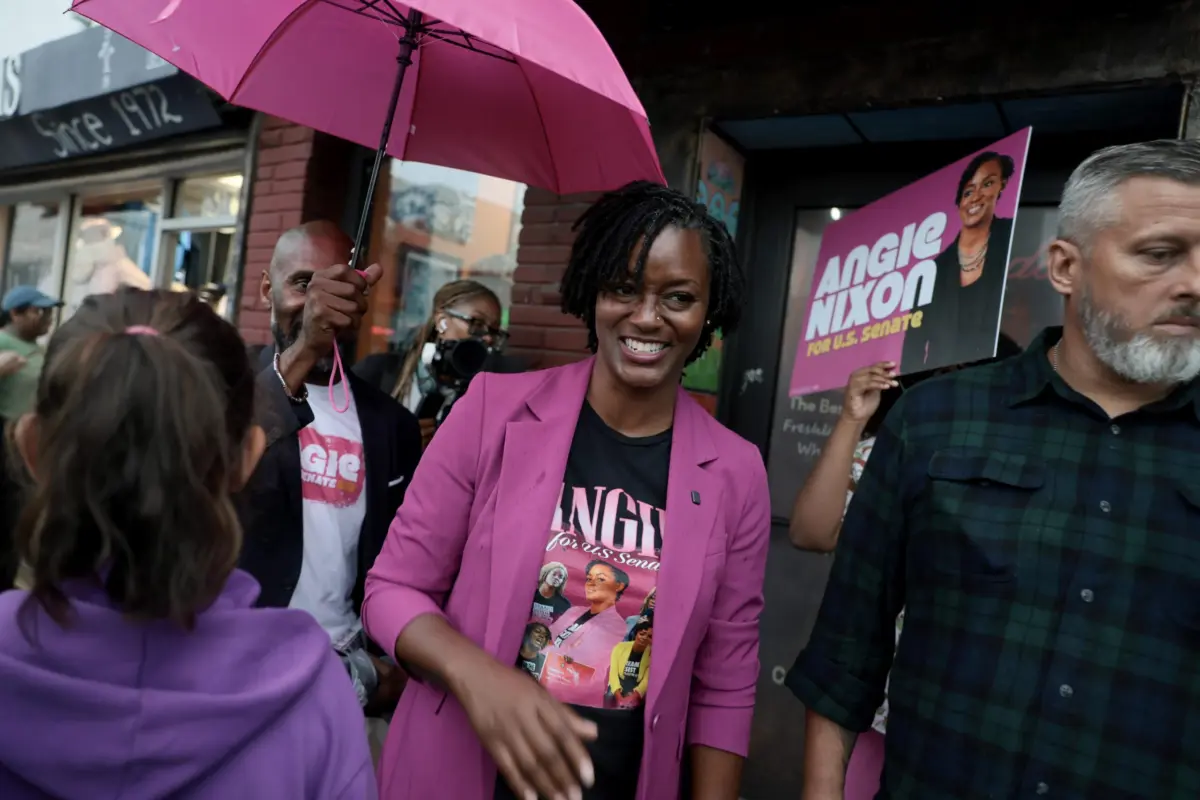
The American political landscape is undergoing a profound, if often chaotic, ideological restructuring. Last month, Florida state Representative Angie Nixon secured the Democratic nomination for the United States Senate in a stunning primary upset, defeating her heavily funded, establishment-backed opponent, retired Army Lieutenant Colonel Alex Vindman. In the immediate wake of her victory, political pundits and media outlets rushed to categorize Nixon’s win as the latest chapter in a burgeoning progressive insurgency—a narrative reinforced by similar primary upsets in states like Michigan, Colorado, and New York.
Yet, to view Nixon’s campaign through the simplistic lens of a progressive-versus-centrist factional war is to miss the structural reality of modern grassroots politics. While Nixon unabashedly champions progressive policies—ranging from universal healthcare and affordable housing to criminal justice reform and a dramatic shift in United States foreign policy in the Middle East—her path to victory was forged through relentless, old-school coalition-building. Drawing on her extensive background as a union and community organizer, Nixon out-worked and out-organized an opponent who dramatically out-raised her.
As she sets her sights on the general election in what many political prognosticators still consider a solidly red state, Nixon faces immense skepticism. Political forecasters have largely dismissed her chances, moving the race back into safe Republican territory and warning that a progressive platform in Florida is a recipe for electoral disaster. However, Nixon is unfazed. In a recent appearance on a special pop-up episode of Vox’s America, Actually, hosted by Astead Herndon, Nixon broke down the mechanics of her primary victory, addressed her controversial foreign policy positions, clarified her stance on policing, and outlined a cross-partisan populist strategy designed to challenge incumbent Republican Senator Ashley Moody.
Read Also
This report provides an in-depth analysis of Nixon’s historic primary win, the strategic dimensions of her campaign, the controversies surrounding her policy portfolio, and the broader implications of her insurgent run for the future of the Democratic Party.
Detailed Chronology
The Primary Upset
The trajectory of Florida’s 2026 Democratic Senate primary shifted decisively last month when Angie Nixon pulled off a major upset against Alex Vindman. Vindman entered the race as the presumptive favorite, backed by substantial financial resources, national network connections, and the traditional imprimatur of the party establishment. Nixon, by contrast, ran a lean, grassroots-driven campaign that was out-raised by an astonishing margin of 18 to 1.
Despite the profound financial disparity, Nixon leveraged her roots as a former single mother and professional organizer to mobilize voters who typically feel alienated by institutional politics. Her victory sent shockwaves through the national Democratic apparatus, immediately inviting comparisons to progressive insurgencies across the country. However, Nixon has consistently pushed back against the notion that her win was merely an accidental byproduct of a national progressive wave, attributing it instead to systematic door-to-door engagement and a message focused squarely on the material needs of everyday Floridians.
Confronting the Skeptics
Following her primary win, political forecasters at organizations like the University of Virginia’s Center for Politics shifted the Senate race back to "Safe Republican," arguing that Nixon’s left-wing platform makes a statewide victory in Florida mathematically improbable. Pundits across the political spectrum have warned that national Democrats should refrain from investing capital in the race, labeling any expenditure in Florida as squandered money.
Nixon’s response to these critiques is grounded in her primary playbook: building a diverse, unorthodox coalition. Rather than relying solely on reliable Democratic base voters, her primary campaign successfully drew crossover support from Republicans and libertarians drawn to her no-nonsense, anti-corruption message. In the general election, she aims to weaponize voter frustration against incumbent Republican Senator Ashley Moody, whom Nixon accuses of enabling the misallocation of state resources and looking out for corporate billionaires at the expense of working families.
Legislative Record and Foreign Policy Flashpoints
Nixon’s legislative career in the Florida state House has not been without controversy. In November 2023, she introduced a resolution calling for an immediate de-escalation and ceasefire in Israel and Gaza. The resolution was overwhelmingly rejected by a vote of 104 to 2, earning her severe backlash from members of the Florida Jewish Caucus, who characterized the measure as uninformed and antisemitic.
The debate over Nixon’s foreign policy stance touches a raw nerve within the broader national Democratic Party. In the wake of political fallout from the 2024 presidential election—where many analysts argue the Biden-Harris administration suffered due to its unwavering support for Israeli military operations—Nixon has taken a hardline stance against continuing military aid to Israel. Furthermore, when pressed on the Boycott, Divestment, Sanctions (Banc/Sanctions/Divestment – BDS) movement, Nixon explicitly voiced her support, drawing parallels between the contemporary Palestinian rights movement and the historical civil rights struggles fought by Black Americans and descendants of enslaved people.
Supporting Context & Metrics
To understand the mechanics of Nixon’s campaign, one must examine the socio-economic and political metrics defining the modern Florida electorate.
- The Funding Gap: Vindman’s campaign held an overwhelming financial advantage, out-raising Nixon nearly 18 to 1. This disparity highlights a recurring theme in modern American elections: the tension between elite-funded centrist candidates and resource-poor grassroots organizers. Nixon’s ability to overcome this deficit underscores the potency of direct voter contact over television ad saturation.
- The Legislative Environment: The Florida state House remains heavily dominated by a conservative Republican supermajority. Nixon’s tenure in the legislature has been defined by confrontational advocacy, such as her 2023 ceasefire resolution, which failed 104-2, illustrating the steep ideological hurdles she faces even within state governance.
- Coalition Demographics: While traditional electoral maps categorize Florida as a reliably red state, Nixon’s primary data reveals a unique undercurrent of cross-partisan support. By tapping into libertarian-leaning and disaffected independent voters who prioritize anti-corruption and government accountability, Nixon has charted an electoral path that defies traditional ideological boxes.
Official Statements & Excerpts
The following condensed excerpts from Astead Herndon’s interview with Angie Nixon on America, Actually capture the candidate’s perspective on her campaign, her policy positions, and her vision for the future:
On Being Underestimated and Grassroots Organizing
Astead Herndon: "Why do you think your victory took so many by surprise?"
Angie Nixon: "It took so many by surprise because people both tend to underestimate a Black woman — especially a progressive Black woman in politics — and then one who wasn’t able to raise as much money. But as a former single mom for 12 years, I know how to make a dollar stretch. This win is attributed to good old-fashioned grassroots organizing. I am a former union organizer. I am a community organizer, and I know the importance of people power…"
On the Definition of Her Platform and Electability
Angie Nixon: "Just because we want access to quality healthcare and affordable housing and fully funded public schools, they try to fear-monger and make it seem as though we are communist and we’re not. We are not communist. We are people who want to put hardworking, everyday people in power… The same way that I was able to win a primary being outspent and out-raised 18 to 1. I am building a very unique, diverse coalition of people. We’ve had Republicans and independents that crossed over in the primary to vote for me…"
On Foreign Policy and the Israel-Gaza Conflict
Astead Herndon: "Do you think that was a mistake for Democrats [not to break more explicitly with Israel’s actions in Gaza]?"
Angie Nixon: "I would say yes. I would say that we have to have really uncomfortable conversations amongst our different communities and we just have to talk. But I feel that they did do a disservice in regards to just going along with the AIPAC lobby… [Regarding BDS] I’m a Black woman who is a descendant of slaves, and who is the descendant of people from the civil rights movement, and I know how we used boycotts and we used protest to gain our civil rights for our community. So I’m fully supportive of that."
On Policing and Public Safety
Angie Nixon: "What I would say is, making sure that we invest in making sure people have more jobs and we invest in community control of the police… One of the things that I believe could help that right off the bat is things like universal healthcare, or at a minimum, extending the ACA subsidies so that we can drive down these healthcare premium costs. Or fully funding these programs that allow people to have access to first-time homebuyer programs."
On Rejecting Labels and Confronting the Trump Regime
Angie Nixon: "We’re coalition builders, we’re aggregators… We need all these things to fight back against this Donald Trump regime. Look, this man is not going to leave willingly in 2028. He’s created a paramilitary force in the form of ICE that is getting away with shooting people… First lady Michelle Obama says, ‘They go low, we go high.’ I’m saying, ‘We get loud, we push back. We organize stronger and harder so that we can win and change this country and build a new vision for the next 250 years, where we have a Florida and an America for all.’"
Future Outlook
As the general election approaches, Angie Nixon’s campaign stands as a fascinating stress test for the Democratic Party. The national establishment remains deeply skeptical, arguing that her unapologetically progressive platform and controversial stances on foreign policy and policing are electoral poison in a state as strategically vital and politically complex as Florida.
Yet, Nixon’s strategy relies on a fundamental re-evaluation of voter motivation. By pivoting away from cautious triangulation and leaning into an aggressive, populist critique of corporate power, corruption, and systemic inequality, she aims to prove that working-class voters across ideological lines are more motivated by material relief—such as affordable housing, universal healthcare, and economic security—than by stale partisan labels.
Whether this insurgent model can successfully bridge the gap in a statewide general election against incumbent Senator Ashley Moody remains to be seen. Regardless of the November outcome, Nixon’s primary victory has irrevocably altered the conversation around how insurgent progressive campaigns can be run outside of deep-blue urban centers, signaling that the debate over the future of the Democratic Party is far from settled.





Comments
Facebook App ID not configured. Please add it in the Customizer.