
Executive Overview
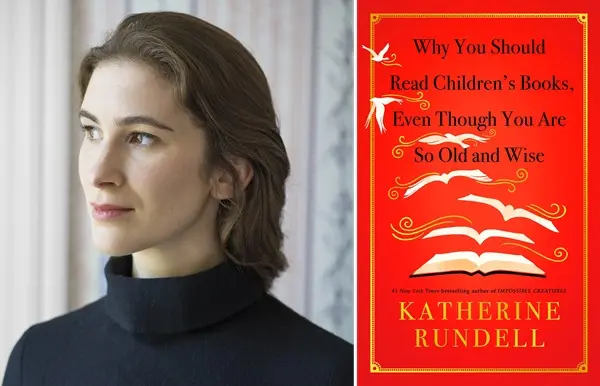
In an era dominated by hyper-niche genre categorization, algorithmic reading suggestions, and the relentless pursuit of high-literary seriousness, celebrated British author Katherine Rundell issues a provocative, joyful challenge to the literary establishment. With the September 1 release of her new essay-length volume, Why You Should Read Children’s Books, Even Though You Are So Old and Wise (Knopf), Rundell steps forward not merely as a defender of youth-oriented fiction, but as an impassioned evangelist for its profound adult utility.
Rundell—an acclaimed writer of children’s fiction, an award-winning biographer of adult nonfiction, and a fellow of All Souls College, Oxford—argues that children’s literature has long suffered from systemic cultural underevaluation. Far from being a lesser literary tier or a simple stepping stone toward "serious" reading, children’s books represent a pinnacle of artistic distillation. In her view, they tackle the most formidable human dilemmas—mortality, loneliness, love, power, and existential dread—with a fierce, uncluttered clarity that modern adult fiction frequently misplaces beneath layers of irony and academic posturing.
Simultaneously, Rundell’s creative footprint is expanding across multiple cultural mediums. While her new essay collection hits shelves, she is actively adapting Impossible Creatures (Knopf)—the first installment in her sweeping middle-grade fantasy series—into a major feature screenplay for Disney. Furthermore, the third volume in the series, The Neverfear, arrives in the United States on the exact same day, cementing a landmark autumn for the author.
Read Also
In an exclusive, wide-ranging conversation with Publishers Weekly, Rundell unpacks the personal genesis of her latest manifesto, compares the mechanics of writing academic adult biographies to crafting children’s fantasy, and explains why she considers children’s stories to be nothing less than "literary vodka."
Detailed Chronology: From Zimbabwe’s Dust to Oxford’s Spires
To understand Katherine Rundell’s fierce protection of children’s literature is to understand a childhood defined by physical distance from literary supplies and an early, visceral hunger for stories.
Growing up in Zimbabwe, where her father worked for the Department for International Development, Rundell experienced a childhood marked by scarcity of a very specific kind. While her favorite authors back in the United Kingdom were continuously publishing fresh adventures, the geographic and logistical realities of the time meant those books took months to cross oceans and arrive in Southern Africa.
This delay birthed a profound psychological state: an acute, physical longing for narratives. Rundell recalls pleading with her family members in the UK to mail over incoming releases. To young Katherine, the hunger for a new book was indistinguishable from the craving for sweets or favorite foods. It was a sensory-driven urgency. When the packages finally arrived, she devoured the pages with speed, driven by a desperate desire to be flooded with the physical pleasure of a well-told story. This formative experience shaped her lifelong conviction that reading is not merely an intellectual exercise, but an embodied, visceral human need—one that requires a diverse ecosystem of books to properly feed developing minds, much as a healthy diet requires variety.
Decades later, that same urgency migrated from the sun-scorched plains of Zimbabwe to the solemn, stone-clad quadrangles of Oxford University. As a fellow of All Souls College, Oxford, Rundell navigated two distinct professional worlds: the rarefied heights of academic and adult nonfiction, and the vibrant, imagination-heavy realm of children’s fiction.
It was during this decade-long balancing act that the seed for Why You Should Read Children’s Books, Even Though You Are So Old and Wise was planted. Rundell noticed a stark sociological phenomenon: the way people interacted with her shifted dramatically depending on which facet of her professional life she disclosed. Admit to being an academic or a biographer of seventeenth-century poets, and you were met with immediate intellectual deference. Admit to writing books for children, and the tone frequently shifted into a patronizing, affectionate indulgence—as though children’s literature were a pleasant hobby rather than a rigorous artistic discipline.
That professional dissonance galvanized her. Over the years, Rundell synthesized her frustrations into a razor-sharp thesis: that the children’s literary ecosystem, particularly over the last century, has produced some of the most daring, formally inventive, and emotionally resonant art in human history. Her new book, published on September 1 by Knopf, is the crystallization of that decade-long defense.
Supporting Context & Metrics: The Anatomy of "Literary Vodka"
To dismiss children’s literature as simplistic is to fundamentally misunderstand its mechanics. In her interview with Publishers Weekly, Rundell dismantles this misconception by introducing one of the most striking metaphors in contemporary literary criticism: she asks readers to think of children’s books as "literary vodka."
+-----------------------------------------------------------------+
|                    THE LITERARY DISTILLATION                     |
|                                                                 |
|   ADULT FICTION:         Wide canvas, subtextual irony,       |
|                          multivalent perspectives, structural   |
|                          digressions.                           |
|                                                                 |
|                          [ DISTILLATION PROCESS ]               |
|                                                                 |
|   CHILDREN'S BOOKS:      "Literary Vodka." Stripped of cynicism,|
|   ("Literary Vodka")     distilling vast existential dread,     |
|                          courage, and love into sharp,          |
|                          uncluttered clarity.                   |
+-----------------------------------------------------------------+
Rather than viewing children’s books as deficient because they are short, structurally tight, and linguistically direct, Rundell argues that they are masterclasses in distillation. Where adult fiction often relies on layers of irony, subtext, and structural digression to explore human nature, children’s literature takes the widest, most terrifying questions of human vulnerability—power, loneliness, dread, love, sacrifice, and moral courage—and condenses them into something sharp, intoxicating, and undeniably powerful.
These stories do not talk down to their audiences; instead, they address the fundamental questions that hang over every human life:
- Did I make the right moral choice?
- Can an individual alter their predestined fate?
- Is it possible to save a life through sheer cleverness, empathy, and stubborn love?
To illustrate this, Rundell points to Tove Jansson’s timeless masterpiece, Moominland Midwinter. On the surface, it is a charming, illustrated Scandinavian children’s book. On a deeper, distilled level, Rundell argues that it is an unflinching examination of existential isolation. The book confronts the hard truth that every human being will eventually face moments where they must stride out into the world entirely alone—moments where despair tracks their heels, the cold closes in, and the darkness feels absolute. Yet, Jansson’s work insists that within that profound lostness lies truth, unexpected companionship, and the quiet, miraculous promise that the sun will eventually rise, flooding the snow with gold, pink, and red.
Crucially, Rundell asserts that these texts are not locked in amber for a specific age bracket. A child of six reads Moominland Midwinter and finds an adventure; an adult of thirty-eight reads the exact same book and uncovers a mirror for grief, resilience, and survival. The text does not change; the reader deepens.
Official Statements & Authorial Philosophy
Despite the apparent gulf between writing biographies of seventeenth-century metaphysical poets and crafting high-fantasy epics featuring mythical beasts, Rundell insists that her creative brain does not flip a switch when shifting between demographics. In her discussion with PW, she noted that both adult nonfiction and children’s fiction originate from the exact same internal impulse.
"There isn’t some switch in my head that’s being flicked. They feel like they’re coming from the same place," Rundell explained.
While the mechanical execution differs—her award-winning biography Super-Infinite: The Transformations of John Donne demanded exhaustive archival research, absolute historical fidelity, and towering piles of fact-checking notes—the philosophical core remains identical.
"Ultimately, what you’re asking readers is, ‘Does this matter? Is this true?’ With Super-Infinite, I mean that literally, and with something like a dragon, I mean that emotionally."
This commitment to emotional truth is the beating heart of Rundell’s bibliography. Whether she is charting the turbulent life of John Donne or charting the magical realms of Impossible Creatures, her work is anchored in the belief that art must serve as a reliable compass through the complexities of human experience.
Future Outlook: A Landmark Autumn for Katherine Rundell
As the autumn publishing season commences, Katherine Rundell stands at a fascinating crossroads of print, academia, and Hollywood. September 1 marks a dual milestone in the United States: the official release of Why You Should Read Children’s Books, Even Though You Are So Old and Wise alongside The Neverfear, the highly anticipated third installment of her Impossible Creatures middle-grade fantasy series.
Furthermore, the adaptation of Impossible Creatures into a major feature screenplay for Disney signals a significant expansion of her fictional universes into visual media. As Disney brings her expansive world of hidden mythologies and endangered magic to the screen, a global audience will soon experience the cinematic scope of her imagination.
Yet, despite these high-profile Hollywood ventures and her academic standing at Oxford, Rundell’s core mission remains wonderfully grassroots: to convince cynical adults to drop their guard, pick up a children’s book, and rediscover the intoxicating, unadulterated clarity of literature written for the young. In doing so, she reminds us all that growing older should never mean outgrowing the capacity to be transformed by a story.





Comments
Facebook App ID not configured. Please add it in the Customizer.