
Executive Overview
The publishing landscape is undergoing a quiet yet profound revolution. For over a decade, digital reading has been synonymous with the glowing screens of e-readers and the steady, upward trajectory of e-book sales. However, fresh data from the mid-point of 2026 reveals a historic paradigm shift: digital audiobooks have officially surpassed e-books in market dominance within the traditional publishing sector.
Driven by an insatiable consumer appetite for multitasking formats and robust double-digit revenue growth, spoken-word literature is no longer just a companion to print or a niche alternative for commuters—it is a powerhouse driving modern publishing revenue. According to the latest market metrics from June 2026, digital audiobooks generated $97.4 million for the month, decisively outstripping e-books, which brought in $86.4 million. Year-to-date metrics further cement this trend, with digital audiobooks soaring to $597.8 million, while e-books trail at $516.1 million.
This deep-dive analysis examines the financial trajectories, consumer behaviors, and industry catalysts propelling audiobooks to the forefront of the book market. By breaking down the numbers, exploring listening habits, and assessing the broader economic implications, we explore how the spoken word conquered the digital page.
Read Also
Detailed Chronology and Financial Breakdown
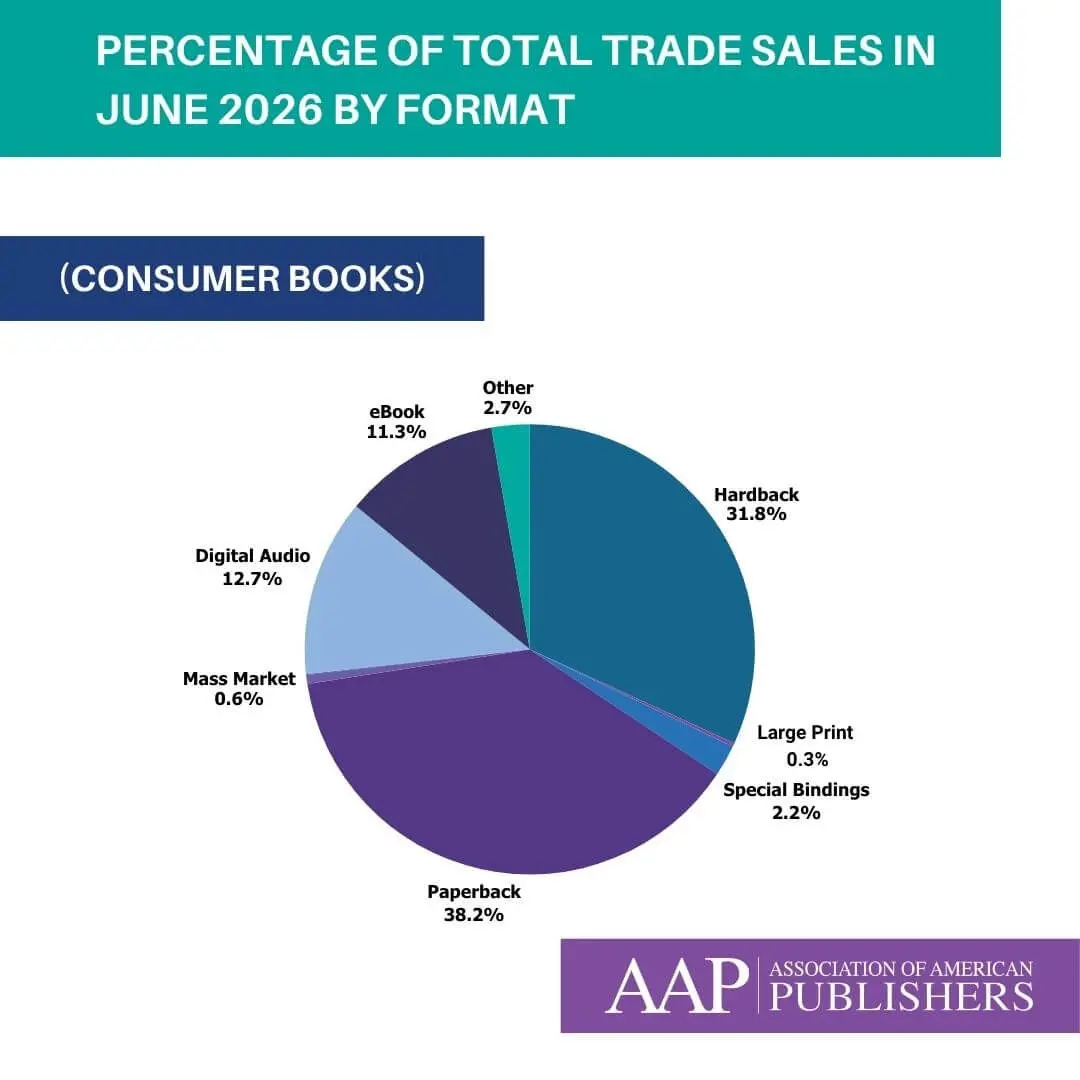
To understand the magnitude of this milestone, one must trace the financial performance of digital reading formats through the first half of 2026. While print formats—led by paperbacks at a robust 38.2% market share ($38.2 million equivalent scale) and hardbacks at 31.8%—still anchor overall book sales, the digital battleground has decisively flipped.
The June 2026 Snapshot
In June 2026, traditional publishers experienced contrasting fortunes across digital mediums:
- Digital Audiobooks: Reached $97.4 million, marking a healthy 3.9% year-over-year increase compared to the same period in 2025.
- E-Books: Slid slightly by 0.3%, settling at $86.4 million.
- Physical Audio: Continued its steep, long-term decline, plummeting 30.1% to a marginal $500,000, signaling the near-complete obsolescence of cassettes, CDs, and other physical spoken-word mediums.
Year-to-Date Performance (January–June 2026)
The broader half-year picture underscores that June’s triumph was not an isolated anomaly, but rather the culmination of sustained momentum:
- Digital Audiobooks YTD: Surged by 12.6%, hitting a massive $597.8 million.
- E-Books YTD: Contracted by 3.0%, totaling $516.1 million.
- Physical Audio YTD: Dropped 12.3%, resting at $2.7 million.
When looking at the overall book market share, digital audiobooks now command over 11% of the total industry revenue, comfortably edging ahead of e-books and establishing a formidable third pillar alongside paperbacks and hardbacks.
Supporting Context and Metrics: The Anatomy of the Audiobook Consumer
What is fueling this relentless expansion of the spoken word? The answer lies in shifting consumer lifestyles, technological accessibility, and the inherent flexibility of audio formats.
Data from the Audio Publishers Association (APA) 2026 Consumer Survey—conducted by research heavyweights Edison Research at SSRS—paints a vivid picture of the modern listener.
Engagement and Frequency
Audiobook consumption is no longer an occasional treat; it has embedded itself into daily routines:
- 63% of surveyed consumers reported listening to at least one audiobook over the past year.
- 35% engaged with an audiobook within the last 30 days alone.
- Active listeners devoured an average of 3.8 audiobooks over the past year.
- Power listeners are driving a significant portion of volume: 26% of respondents reported listening to four or more titles within the last year.
Multi-Platform Access Drives Ecosystem Growth
Unlike the early days of digital audio, when consumers were locked into single, proprietary ecosystems, today’s listeners utilize a diverse mosaic of platforms to source their content. The APA survey highlights a remarkably fragmented yet accessible distribution landscape among annual listeners:

- 49% purchased audiobooks directly from publisher or author websites and standalone apps.
- 48% utilized mainstream subscription services for unlimited or tiered listening.
- 46% borrowed titles digitally through public library apps (such as Libby and Hoopla).
- 42% relied on monthly membership credits from dedicated audiobook storefronts.
This multi-channel approach demonstrates that friction-free access—whether through public funding via libraries or convenient subscription models—is drastically lowering the barrier to entry for new listeners.
Official Statements and Industry Insights
Industry veterans and analysts view this crossing of paths as a watershed moment for the business of books. For years, publishing executives whispered about the plateau of e-book growth, noting that while e-reading devices carved out a loyal baseline following, they failed to capture the explosive imagination of a multitasking populace.
Michael Kozlowski, editor-in-chief of Good e-Reader and a fifteen-year veteran analyst of digital publishing trends, notes that the rise of audiobooks represents a fundamental change in how humans consume narrative content.
"We are no longer just a society of readers; we are a society of listeners," industry analysts observe. "The e-book solved the problem of physical weight and portability, but it still required dedicated, undivided visual attention. The digital audiobook conquered the modern curse of time scarcity, allowing consumers to read while driving, cooking, exercising, and working."
Traditional publishers have taken note. Major houses are increasingly shifting capital toward high-production-value audio recordings, often hiring full-cast ensembles, investing in cinematic sound design, and securing high-profile celebrity narrators to treat audiobooks not merely as secondary derivative works, but as premier, simultaneous launches alongside hardcover editions.
Future Outlook: What Lies Ahead for Digital Reading?
As we look beyond 2026, the trajectory of the publishing industry is pointing firmly toward a diversified digital future. Several key trends will dictate how e-books and digital audiobooks coexist and compete in the years to come.
1. The Proliferation of AI and Synthetic Narration
One of the most disruptive frontiers in digital audio is the rapid advancement of artificial intelligence and synthetic voice narration. While human-narrated blockbusters will continue to dominate bestseller lists, AI narration is opening up backlist catalogs that were previously economically unviable to produce in audio format. As synthetic voices grow more nuanced and emotionally resonant, the volume of available digital audio titles is projected to skyrocket, further fueling consumption.
2. Subscription Fatigue vs. Value Realization
With nearly half of all listeners relying on subscription models and library apps, publishers and platform operators face the ongoing challenge of maintaining creator compensation while offering consumer-friendly access. The tension between subscription streaming payouts and a-la-carte credit systems will likely shape the business negotiations of late 2026 and 2027.
3. E-Books Fight Back: Interactivity and Integration
E-books are far from dead. To counter the rise of audiobooks, e-book publishers are leaning into enhanced reading experiences—integrating embedded multimedia, seamless cross-device synchronization (Whispersync-style audio/text switching), and community-driven reading platforms. The future may not be a zero-sum game where one format destroys the other, but rather a synergistic "read-and-listen" ecosystem where consumers fluidly swap between formats depending on the time of day.
Conclusion
The June 2026 data serves as a definitive milestone: digital audiobooks have officially stepped out of the shadow of e-books. Backed by compelling demographics, everyday convenience, and an evolving distribution network, the spoken word has captured the hearts, minds, and ears of the modern reading public. Traditional publishing has successfully adapted to the rhythm of the twenty-first century, proving that a good story will always find an audience—whether through the glowing screen or directly through the headphones.



Comments
Facebook App ID not configured. Please add it in the Customizer.