
Executive Overview
For authors across every genre and level of experience, a single, recurring question dictates the anxiety of the blank page: Where do I start the story?
Once isolated to the technical craft of writing, the term "info dumping" has evolved into a household critique. Today, even casual readers weaponize the phrase to explain why they are abandoning a book within the first few pages, weighing whether a narrative’s characters and world-building are worth their time. In an era defined by fractured attention spans and an oversaturated literary market, the bar for entry has never been higher.
This challenge is magnified exponentially for fantasy and romantic-fantasy ("romantasy") authors. While contemporary and historical novelists rely on a reader’s innate understanding of physics, societal norms, and historical timelines, fantasy authors must construct an entirely novel framework from scratch.
Read Also
Romantasy takes this difficulty a step further. Authors must not only introduce an alien universe governed by unestablished rules, but they must also make the reader fall in love—all within the span of a single chapter. Creators must prove within a page or two that the emotional and financial investment of the reader’s time is justified.
Consequently, first chapters are drafted, discarded, and rewritten ad infinitum. A brilliantly executed midpoint or a breathtaking finale matters little if a reader cannot make it past the initial pages sampled in a bookstore. This investigative report examines how contemporary romantasy masters ground readers in unknown cosmos, entice them to commit to 450-page journeys, and spark an immediate emotional connection.
(Author’s Note: While this analysis focuses strictly on opening chapters, readers should beware of minor plot spoilers ahead and proceed with caution.)
Detailed Chronology: Case Studies in the Art of the Hook
To understand how modern romantasy succeeds in capturing immediate engagement, we must examine the specific mechanical strategies employed by the genre’s leading titles.
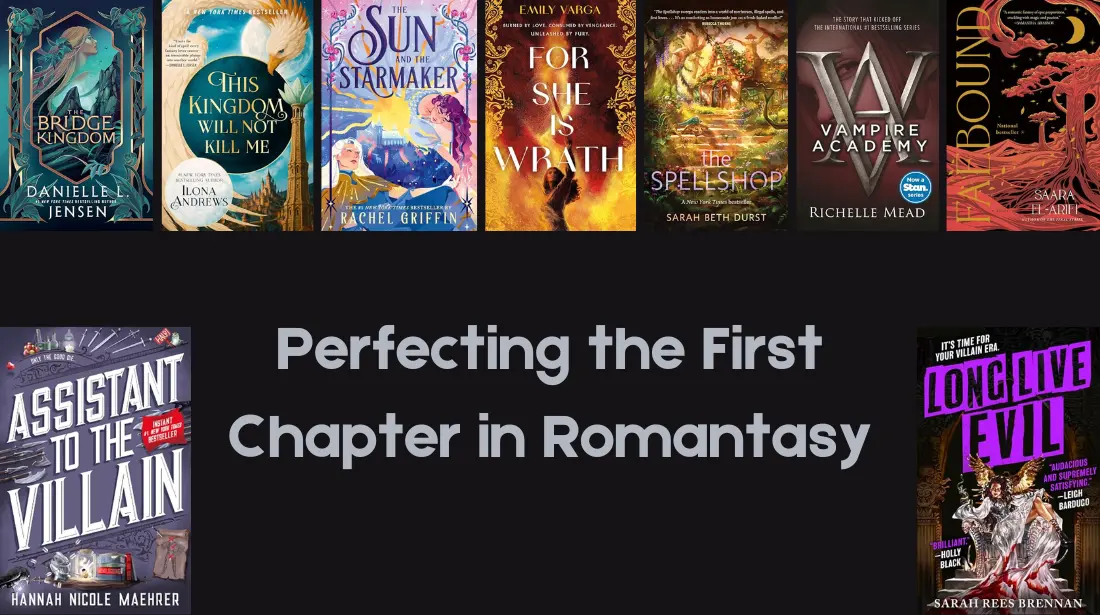
1. The Shock-and-Awe Approach: The Bridge Kingdom by Danielle L. Jensen
Any seasoned reader of Danielle L. Jensen expects a calculated one-two punch right at the starting line. Epitomizing the "enemies-to-lovers" trope, The Bridge Kingdom follows Lara Veliant, a princess raised as a lethal assassin, who is dispatched to marry an enemy ruler and dismantle his kingdom from within.
- The Opening Mechanism: Jensen bypasses traditional world-building exposition entirely. The story opens around a high-stakes dinner table where Lara systematically eliminates all eleven of her half-sisters—who were raised as her direct competitors for the mission—to secure the throne-bound role.
- The Result: By chapter two, the narrative transitions seamlessly to the journey toward the wedding. The reader is hooked, held captive by a potent mix of shock, cinematic pacing, and a fiercely compelling female protagonist (FMC).
2. The Genre-Subverting Premise: This Kingdom Will Not Kill Me by Ilona Andrews
Portal fantasies inherently double the difficulty of an opening: they must ground the reader in two distinct realities simultaneously. The bestselling husband-and-wife writing team Ilona Andrews utilizes a direct, self-aware approach in This Kingdom Will Not Kill Me.
- The Opening Mechanism: Protagonist Maggie is thrust into a brutal portal fantasy that happens to be her favorite—albeit criminally unfinished—book series. She immediately deconstructs the genre tropes for the reader, contrasting standard expectations with the harsh reality of her situation.
- The Result: Romantasy readers adore a resourceful protagonist. Maggie is instantly endearing, even as she wakes up battered and bruised in a gutter each time the violent world of Kair Toren attempts to execute her.
3. The Atmospheric Prologue: The Sun and the Starmaker by Rachel Griffin
Mastering the poetic prologue, Rachel Griffin’s The Sun and the Starmaker begins with prose that establishes an immediate emotional resonance.
- The Opening Mechanism: The novel opens with a folklore-style bedtime story told to heroine Aurora Finch. It recounts a sun goddess who takes human form to save the mountain village of Reverie, falling in love with a man she is destined to lose.
- The Result: The opening chapters read like classic mythology. Whimsical and atmospheric, the prologue instills immediate nostalgia, assuring the reader they are embarking on an epic, high-stakes romance.
4. In Media Res and Female Rage: For She Is Wrath by Emily Varga
For She Is Wrath—a Pakistani-inspired young adult romantic fantasy retelling of The Count of Monte Cristo—begins inside a crucible of conflict.
- The Opening Mechanism: The book opens on Dania, who has spent 364 days unjustly imprisoned after being framed by the boy she loved.
- The Result: The narrative explodes into a storm of grief, sisterhood, and vengeance. The bold, bloody opening sequence establishes a fierce, uncompromising tone for a narrative driven by female agency and retribution.
Supporting Context & Metrics: Decoding Reader Psychology
The structural choices analyzed above are not accidental; they are calibrated responses to shifts in reader behavior and digital publishing metrics.
| Opening Strategy | Primary Psychological Trigger | Target Demographic / Trope |
|---|---|---|
| Direct Violence / High Stakes (The Bridge Kingdom) | Adrenaline surge & moral ambiguity | Enemies-to-lovers, Dark Fantasy |
| Meta-Commentary (This Kingdom Will Not Kill Me) | Intellectual engagement & humor | Portal Fantasy, Relatable Heroines |
| Atmospheric Lore (The Sun and the Starmaker) | Nostalgia & emotional investment | Cozy/Epic Fantasy, High Prose |
| Instant Injustice (For She Is Wrath) | Empathy & righteous anger | Revenge arcs, Retellings |
Market research indicates that online sample chapters (such as Amazon’s "Look Inside" feature or Kindle previews) account for a significant percentage of pre-order conversions. When a consumer reads a sample on a mobile device or e-reader, formatting must pack an immediate psychological punch.
According to literary agents specializing in speculative fiction, a manuscript’s opening chapter faces a critical window: if the world-building is front-loaded with exposition or "info-dumping" within the first 500 words, bounce rates rise sharply. Conversely, openings that anchor the reader in a character’s immediate sensory experience—such as Evie Sage tumbling into the forbidden forest in Hannah Nicole Maehrer’s Assistant to the Villain—demonstrate markedly higher retention rates.
Official Statements & Industry Perspectives
Industry professionals emphasize that the opening chapter must function as a psychological contract between author and reader.
"When you write romantasy, you are asking a reader to surrender their skepticism," notes an anonymous developmental editor specializing in fantasy blockbusters. "In traditional epic fantasy, you have fifty pages to explain the magic system. In romantasy, if the reader isn’t mentally undressing the love interest or weeping over the protagonist’s trauma by page ten, you’ve lost them."
Authors themselves are acutely aware of this mechanical pressure. Sarah Rees Brennan, author of Long Live Evil, utilizes structural framing—such as cutting from a bloody imperial execution directly to a hospital bedside—to bridge the gap between grand high-fantasy stakes and intimate, relatable human desperation.
Similarly, Hannah Nicole Maehrer’s opening line for Assistant to the Villain—“It was an ordinary day when Evie met The Villain.”—relies on a conscious contradiction. Industry analysts point to this sentence as a masterclass in hook construction: it subverts expectations instantly, assuring the reader that the narrative will balance high-stakes danger with self-aware humor.
Future Outlook: The Evolution of Romantasy Openings
As the romantasy genre continues its meteoric rise on bestseller lists and social media platforms like BookTok, the craft of the first chapter will only grow more rigorous.
Future publishing trends indicate a shift toward even tighter, punchier pacing. As readers consume increasingly diverse subgenres—ranging from cozy fantasy hybridizations like Sarah Beth Durst’s The Spellshop to dark institutional romances like Richelle Mead’s foundational Vampire Academy—authors are experimenting with non-linear timelines, unreliable narrators, and immediate tonal shifts.
Ultimately, whether an author chooses to open with a burning library, a prison break, or a witty internal monologue, the core mandate remains unchanged. The opening chapter must act as both a key and a compass: unlocking a brand-new universe while pointing the reader directly toward the heart of the characters who will guide them through it.


Comments
Facebook App ID not configured. Please add it in the Customizer.