
Executive Overview
The ultra-portable e-reader market is experiencing a quiet yet significant evolution, driven by consumer demand for lightweight, distraction-free reading devices that can slip easily into a pocket or small bag. In this niche, the newly released XTEINK X4 Pro has emerged as a compelling contender. Breaking away from exclusive direct-to-consumer distribution channels, the X4 Pro has officially made its debut on Amazon, offering buyers an unprecedented level of purchase security, customer protection, and streamlined logistics.
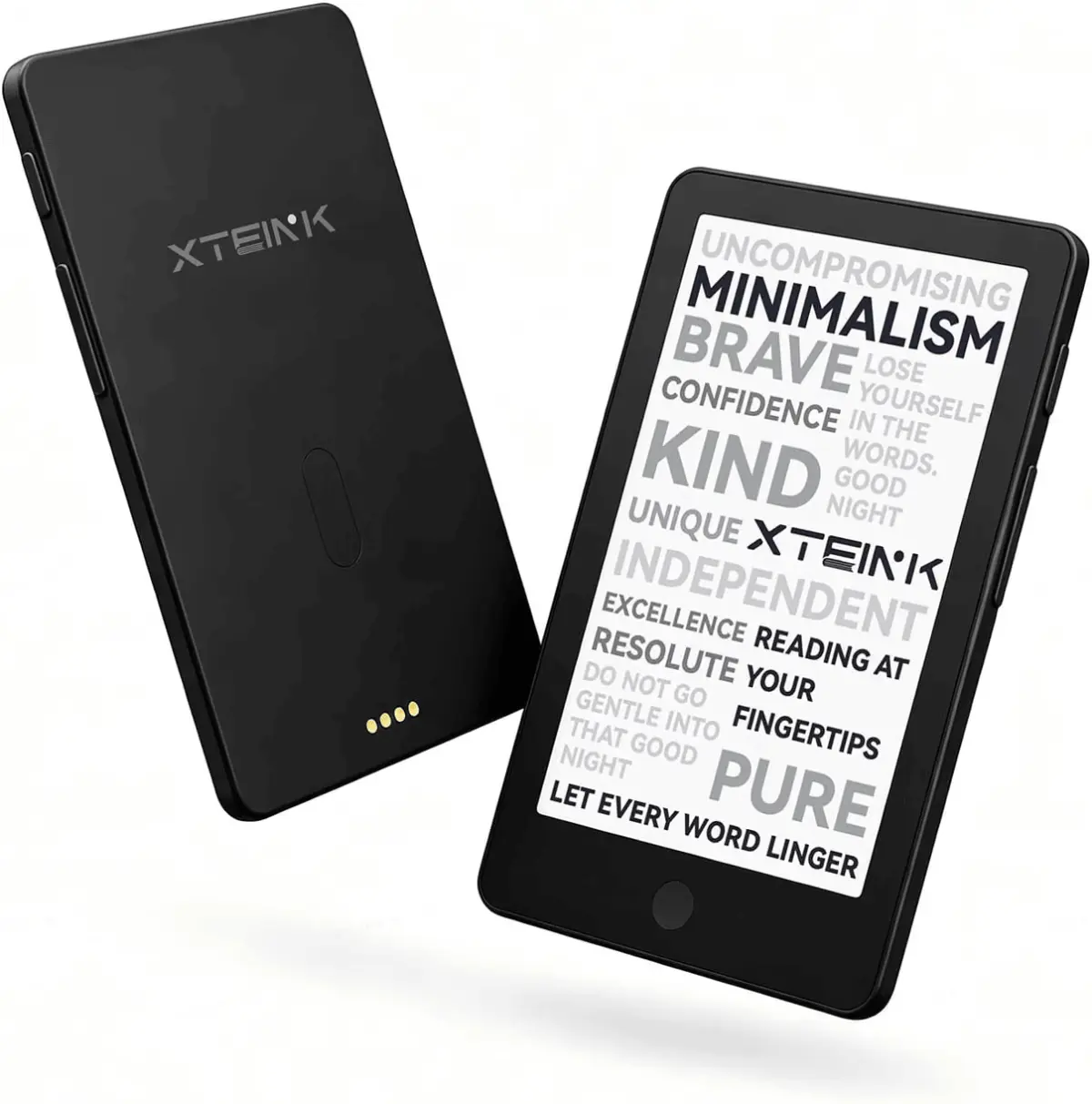
For enthusiasts of compact electronic paper displays, the X4 Pro represents a major generational leap. Building upon the foundation laid by its predecessor, the first-generation X4, this upgraded iteration introduces a suite of highly anticipated hardware refinements. Most notably, it integrates a built-in front-light system—a feature glaringly absent from earlier models—while simultaneously shaving down the overall chassis thickness to an astonishing 5.98mm.
Yet, the device is not without its idiosyncratic design choices. Retaining its ultra-compact 4.3-inch form factor, the X4 Pro bridges the gap between old-school tactile navigation and modern touchscreen interactivity by featuring both physical page-turn buttons and an E-Ink touchscreen. Under the hood, it pairs modest processing architecture with generous expandable storage, targeting dedicated readers who prefer minimalism over multimedia bloat. This report provides an exhaustive, multi-faceted analysis of the XTEINK X4 Pro, examining its retail availability, technical specifications, design philosophy, and its place within the broader e-reader ecosystem.
Read Also
Detailed Chronology: From Niche Direct-Sales to Global Retail
The Genesis of the X4 Series
When XTEINK initially introduced its pocket-sized e-reader line, the devices caught the attention of minimalists and travel-heavy bookworms. The original X4 model established the brand’s footprint in the micro-form-factor segment, championing an ultra-compact reading experience reminiscent of the classic pocket paperbacks of the mid-20th century. However, the initial rollout suffered from significant friction points, primarily concerning consumer accessibility and post-purchase support.
Purchasing products directly from XTEINK’s proprietary e-commerce storefront historically presented substantial hurdles for international buyers. Chief among these consumer complaints was the company’s restrictive return policy. Unlike mainstream consumer electronics vendors who accommodate returns for buyers remorse or minor defects, XTEINK’s direct store policies notoriously lacked robust buyer protections. Reports of difficulties regarding damaged goods arriving from overseas factories and the absence of a streamlined return mechanism deterred many potential early adopters from taking a chance on the brand.
The Amazon Breakthrough
Recognizing the barrier to entry created by its restrictive direct-sales model, XTEINK’s strategic pivot to list the X4 Pro on Amazon marks a watershed moment for the company. By leveraging Amazon’s sprawling logistics network and customer-centric return policies, the brand has effectively neutralized the primary deterrents that previously kept risk-averse consumers from purchasing its hardware.
The Amazon listing guarantees that buyers can benefit from standard e-commerce safeguards: reliable shipping timelines, straightforward dispute resolution, and hassle-free returns for defective units. This transition signals a maturing hardware manufacturer willing to play by mainstream retail rules to capture a wider, more mainstream audience that values consumer protection as much as device innovation.
Technical Specifications & Deep-Dive Analysis
Display Technology and Illumination
At the heart of the XTEINK X4 Pro is a 4.3-inch E-Ink touchscreen display boasting a pixel density of 220 PPI (Pixels Per Inch). While high-end 6-inch to 10-inch e-readers routinely push 300 PPI, a 220 PPI density on a 4.3-inch screen yields remarkably crisp text rendering. Because the physical dimensions of the screen are constrained, individual pixels are difficult to discern with the naked eye, ensuring that typography remains sharp and legible for standard book fonts.
The crowning achievement of the Pro iteration, however, is the integration of an integrated front-light system. The original X4 required users to rely entirely on ambient room lighting or invest in cumbersome, external clip-on reading lamps to enjoy books after dark. The X4 Pro solves this ergonomic shortcoming by embedding a discrete illumination layer over the E-Ink panel. This allows readers to adjust brightness levels for comfortable reading in pitch-black bedrooms, dimly lit aircraft cabins, or low-light cafes without inducing eye strain or disturbing those nearby.
Engineering Feats: Dimensions and Ergonomics
Adding layers to an E-Ink display—specifically a capacitive touch sensor grid and a front-light guide film—typically results in a thicker, heavier chassis. Counterintuitively, the engineers at XTEINK managed to defy this hardware trend.
- First-Generation X4 Thickness: 6.4mm
- X4 Pro Thickness: 5.98mm
Achieving a sub-6mm profile while packing in more hardware components is a notable engineering feat. The X4 Pro feels featherlight in the hand, easily slipping into a shirt pocket, jeans pocket, or small clutch without creating an unsightly bulge or weighing down the user.
Furthermore, XTEINK resisted the industry-wide temptation to strip away physical controls in the pursuit of bezel-less design. The X4 Pro retains dedicated physical page-turn buttons alongside its new touchscreen capabilities. This dual-input approach offers superior versatility: users can swipe and tap on the screen or rely on tactile, clicky buttons when reading one-handed while bundled up in winter clothing or commuting on a crowded subway.

Processing Power, Memory, and Storage
Underneath its slim exterior, the XTEINK X4 Pro employs a minimalist hardware configuration designed strictly for text-based reading rather than media consumption or web browsing:
- RAM: 8MB. By modern smartphone or tablet standards, 8MB of RAM sounds vanishingly small. However, for a dedicated single-tasking E-Ink operating system running optimized e-reader software (such as stripped-down reading apps handling ePub, TXT, or PDF files), this amount is adequate to process page turns and manage basic menus without demanding heavy computational overhead.
- Internal Storage: 16GB of fixed internal flash memory. This capacity can house tens of thousands of digital books, far exceeding the lifetime reading capacity of the average user.
- Expandable Storage: For bibliophiles with gargantuan digital libraries, the inclusion of a physical SD card slot supporting up to 256GB is a massive selling point. Users can carry entire reference libraries, academic journals, and massive audiobook collections wherever they go.
- Connectivity: The device features built-in Wi-Fi and Bluetooth. While web browsing on a 4.3-inch E-Ink screen is an exercise in patience, the Wi-Fi module is essential for downloading books directly to the device and syncing reading progress. Bluetooth capabilities open up possibilities for connecting wireless audio accessories, particularly for users exploring auxiliary features.
Battery Life and Power Management
Powering the device is a 1100mAh internal battery. Given the low power draw of E-Ink technology—which only consumes electrical current when the image on the screen is actively changing—an 1100mAh cell translates into phenomenal endurance. XTEINK estimates that a single charge can easily sustain up to a month of moderate reading (defined as roughly 30 minutes to an hour per day with modest front-light usage).
However, a notable divergence from modern industry standards lies in the charging interface. While the first-generation X4 adopted the universally accepted USB-C standard, the X4 Pro pivots to a magnetic, bespoke pogo-pin charging cable.
The USB-C vs. Pogo-Pin Debate
- The Pros: Pogo-pin magnetic connectors are exceptionally durable against physical wear and tear. There is no fragile USB-C port receptacle inside the device housing to collect pocket lint, bend, or snap off after thousands of plug-in cycles. Furthermore, snapping a magnetic cable onto the back or bottom of the device in the dark is effortless.
- The Cons: Proprietary cables introduce the friction of specificity. If a user loses or forgets their bespoke X4 Pro charging cable while traveling, they cannot simply borrow a standard USB-C cable from a traveling companion’s smartphone charger. They must rely exclusively on the proprietary cord included in the box.
Supporting Context & Metrics: The Pocket E-Reader Market
To fully appreciate the significance of the XTEINK X4 Pro, one must contextualize it within the broader e-reader landscape, which has long been dominated by giant conglomerates such as Amazon (Kindle), Kobo, and Boox.
| Feature / Metric | XTEINK X4 Pro | Standard 6-inch E-Reader (e.g., Kindle Basic) | Smartphone Reading App (e.g., iOS/Android) |
|---|---|---|---|
| Screen Size | 4.3 inches | 6.0 inches | 5.5 to 6.7 inches |
| Weight / Portability | Extremely lightweight; pocket-first design | Moderate; requires a bag or large pocket | Varies; high eye strain from OLED/LCD |
| Display Technology | E-Ink Pearl / Carta with front-light | E-Ink Carta 1200 | Backlit OLED / LCD |
| Battery Endurance | Weeks to a month | Weeks to six weeks | Hours to two days |
| Distraction Level | Zero notifications; pure reading | Minimal notifications (depending on model) | High (push notifications, social media) |
As consumers increasingly experience digital fatigue—bombarded by relentless push notifications, blue-light exhaustion from glowing smartphone screens, and algorithmic feeds—micro-readers like the X4 Pro represent a digital wellness movement. By offering a dedicated device that can do only one thing (read books) without cellular radio distractions or social media apps, products in this category cater to a growing demographic of mindful readers.
Official Industry Perspectives and Expert Insights
Industry analysts monitoring the micro-reader segment note that while devices with screens under 5 inches occupy a hyper-niche market, they enjoy fiercely loyal user bases.
According to hardware reviews and commentary aggregated across tech journalism platforms, the primary appeal of form factors like the X4 Pro lies in situational utility. Commuters who stand on crowded subway trains where holding a standard 7-inch or 10-inch e-reader is awkward find 4.3-inch devices transformative. They operate much like a stack of index cards or a compact passport, easily manipulated with a single thumb while holding an overhead strap.
However, critics frequently point out the trade-offs inherent in miniaturization. Typography with complex formatting, heavy tables, or scientific PDFs can become unreadably cramped on a 4.3-inch canvas. Consequently, the XTEINK X4 Pro is explicitly positioned as a companion device for narrative fiction, light essays, and casual reading, rather than an all-purpose academic workstation.
Future Outlook: What the X4 Pro Means for Portable Tech
The arrival of the XTEINK X4 Pro on Amazon marks a potential turning point for alternative e-reader brands seeking mainstream traction in Western markets. By smoothing out the logistical and customer-support friction associated with direct-from-factory importing, XTEINK has lowered the barrier for curious tech enthusiasts to test boundary-pushing form factors.
Looking ahead, several questions remain for the pocket e-reader category:
- Will competitors respond? Major manufacturers like Kobo or Amazon have largely abandoned sub-5-inch screens in favor of 6-inch baseline standards. If the X4 Pro proves commercially successful on Amazon, it may prompt legacy players to re-evaluate ultra-portable form factors.
- Will charging standards standardize? While proprietary magnetic pogo pins offer durability, consumer pushback against non-standard cables remains vocal in an era dominated by European Union USB-C mandates. Future iterations of micro-readers may need to balance magnetic ease-of-use with universal port compatibility.
- Software Ecosystem Evolution: As these devices find broader distribution, consumer expectations regarding software fluidity, dictionary lookups, and library synchronization (such as integration with Calibre or cloud reading apps) will inevitably rise.
For now, the XTEINK X4 Pro stands as a fascinating exercise in miniaturization and consumer-focused retail expansion. For readers seeking an unpretentious, pocket-friendly digital book container with a built-in reading light and the safety net of Amazon’s return policies, the X4 Pro is poised to carve out a unique and enduring space in the modern library.




Comments
Facebook App ID not configured. Please add it in the Customizer.