
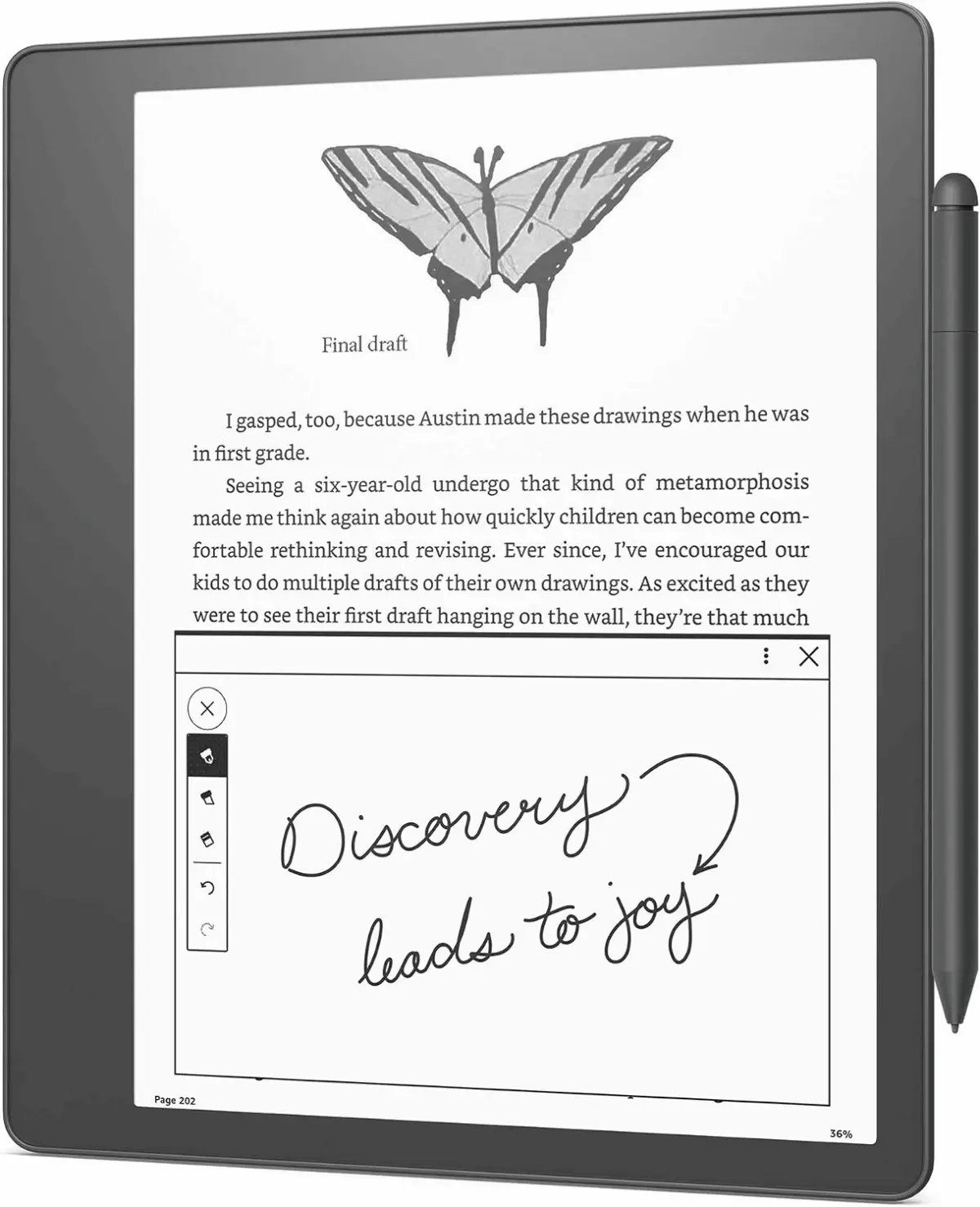
In a significant pricing move that has caught the attention of digital journal enthusiasts, academic researchers, and avid readers alike, Amazon has slashed the price of its flagship Kindle Scribe Premium Pen by an impressive 40%. Originally retailing at a standard price point that often led prospective buyers to carefully weigh their accessory investments, the stylus is currently available for $47.99 across Amazon’s primary U.S. marketplace.
Crucially, this promotional discount is not restricted solely to American consumers. Regional availability has expanded to include concurrent sales across Amazon’s Canadian and United Kingdom storefronts, making it a globally coordinated retail event for the e-reading ecosystem.
For current owners of the Kindle Scribe who have been operating with the standard basic stylus—or for those seeking a reliable replacement for a lost or damaged tool—this markdown lowers the barrier to entry for Amazon’s most advanced note-taking implement. The Premium Pen is engineered specifically to elevate the Scribe from a traditional e-reader into an interactive digital notebook, blending the tactile sensation of graphite on paper with the infinite organizational capabilities of cloud-connected hardware.
Read Also
This analytical report explores the technical architecture of the Kindle Scribe Premium Pen, evaluates the broader context of accessory discounting within the e-paper market, reviews official product features, and assesses the future outlook for Amazon’s expanding e-note device ecosystem.
Detailed Chronology: The Evolution of E-Reader Input and the Scribe Premium Strategy
To fully understand the significance of a 40% price reduction on the Kindle Scribe Premium Pen, one must examine the chronological progression of stylus technology within dedicated e-reading devices.
The Early Era of E-Ink: Pure Consumption
For well over a decade following the commercialization of consumer e-readers, devices manufactured by industry pioneers—including early iterations of the Amazon Kindle, Kobo, and Sony Reader lines—were designed strictly for consumption. The screen technology, while revolutionary for reducing eye strain through front-lit reflective panels, suffered from notoriously slow refresh rates. Incorporating a digitizer layer to support active stylus input was technically unfeasible due to high latency, cost, and the degradation of optical clarity caused by additional display layers. Users interacted with their books exclusively via capacitive touchscreens for page-turns, dictionary lookups, and marginal annotations via sluggish virtual keyboards.
The Hybrid Pivot: The Rise of E-Notes
By the late 2010s, advancements in electronic paper display controllers—most notably E Ink’s Carta and Kaleido technologies, coupled with faster processors—paved the way for a new device category: the e-note. Competitors such as Onyx Boox, Supernote, and reMarkable successfully carved out a lucrative niche by offering large-format monochrome tablets optimized for handwritten notes and PDF markup.
Recognizing a strategic gap in its hardware portfolio, Amazon entered the large-format space in late 2022 with the introduction of the original Kindle Scribe. Unlike its stablemates, the Scribe was built around a massive 10.2-inch, 300 PPI Paperwhite display specifically engineered to support real-time digital ink rendering.
Segmentation of Input Tools: Basic vs. Premium
From the outset of the Kindle Scribe product lifecycle, Amazon adopted a tiered hardware strategy regarding its input devices, dividing accessories into two distinct categories:

- The Basic Pen: Shipped as the default inclusion with base-tier Scribe bundles, this stylus offered fundamental writing capabilities but lacked physical shortcut customizations or a dedicated onboard eraser.
- The Premium Pen: Marketed as an upgraded accessory for power users, students, and professionals, this version introduced localized physical enhancements designed to mimic traditional writing implements more closely.
By discounting the Premium Pen to $47.99, Amazon is effectively blurring the lines between its accessory tiers, encouraging a broader user base to experience the hardware’s full functional capabilities without paying a premium surcharge.
Supporting Context & Technical Metrics: Inside the Kindle Scribe Premium Pen
The appeal of the Kindle Scribe Premium Pen lies not merely in its branding, but in the sophisticated engineering housed within its sleek, ergonomic chassis. A technical breakdown reveals why this accessory is considered essential for maximizing the utility of Amazon’s largest e-reader.
Battery-Free EMR Technology
One of the most praised engineering achievements of the Kindle Scribe stylus ecosystem is its reliance on Electromagnetic Resonance (EMR) technology. Unlike active styluses produced by competitors (such as the Apple Pencil or Microsoft Surface Pen), which require internal lithium-ion batteries, periodic USB-C charging, and Bluetooth pairing, the Kindle Scribe Premium Pen operates entirely without an internal power source.
The screen of the Kindle Scribe emits a low-power electromagnetic field that energizes a resonant circuit inside the pen tip. This enables seamless, lag-free communication between the stylus and the digitizer grid beneath the E-Ink panel. For end users, the practical benefit is profound: the pen never needs to be charged, eliminates battery degradation anxiety, and works instantly the moment the tip touches the display glass.
Dedicated Top-Mounted Digital Eraser
One of the primary ergonomic complaints regarding early digital styluses was the cumbersome requirement to manually select an eraser tool from an on-screen menu toolbar whenever a mistake was made. The Kindle Scribe Premium Pen addresses this friction point by integrating a physical, pressure-sensitive eraser situated at the top end of the stylus barrel—just like a traditional wooden pencil.
Flipping the pen over instinctively triggers the digital eraser mode, allowing users to scrub away handwritten notes, sketches, or highlights with natural, intuitive movements before instantly flipping it back to resume writing.
Customizable Shortcut Button
Positioned along the lower barrel of the Premium Pen is a discreet, tactile shortcut button. Through the Kindle Scribe’s user interface settings, this button can be programmed to execute various quick-access commands. Common user configurations include:
- Instantly toggling between a pen and a highlighter tool.
- Opening a sticky note or margin annotation window on the fly.
- Creating a blank page within an active notebook.
This hardware-level shortcut significantly reduces the number of taps required to navigate software menus, preserving the immersive, distraction-free environment that e-reader users prize.
Magnetic Attachment Capabilities
Addressing the perennial challenge of stylus portability, the Premium Pen features integrated internal magnets designed to secure the device firmly to the magnetic strip running along the right bezel of the Kindle Scribe. While not a replacement for a protective folio case with an integrated loop, this magnetic latching mechanism ensures the pen remains securely docked during casual in-home reading sessions or when sliding the device into a briefcase.

Official Statements and Industry Reception
While manufacturers typically refrain from publishing exhaustive press releases for temporary accessory markdowns, the broader commercial strategy behind Amazon’s pricing adjustment reflects a mature understanding of consumer psychology in the consumer electronics sector.
Retail analysts point out that accessory discounting is a proven method for increasing ecosystem lock-in. By lowering the cost of high-margin peripherals like the Premium Pen, Amazon encourages higher engagement rates with its Kindle Store, Kindle Unlimited, and cloud synchronization services. Users who find it effortless to annotate books, export PDF documents, and organize handwritten journals are statistically more likely to remain within the Amazon hardware ecosystem when upgrading devices in the future.
Furthermore, consumer review data aggregated across global tech platforms highlights overwhelmingly positive sentiment regarding the Premium Pen’s weight distribution, matte finish, and balance. Unlike hyper-glossy styluses that can feel slippery during extended writing sessions, the matte tungsten finish provides a secure grip that mimics high-end fountain pens or mechanical pencils.
Future Outlook: The Trajectory of E-Notes and Stylus Integration
As the market for electronic paper devices continues to expand beyond niche hobbyist circles into mainstream corporate offices and university lecture halls, the role of the stylus is undergoing rapid transformation.
Software Enhancements and AI Integration
Hardware is only as effective as the software driving it. In recent firmware updates, Amazon has steadily improved the Kindle Scribe’s operating system, introducing features such as:
- Direct-to-text conversion for handwritten notes.
- Enhanced PDF reading and markup tools that allow users to write directly on imported documents rather than relying exclusively on pop-up sticky notes.
- Better organization options, including folder sub-categories and improved search functionality for handwritten text.
Industry watchers anticipate that future iterations of Kindle software may incorporate advanced machine learning models to organize handwritten notes, summarize marginalia, and sync seamlessly with third-party productivity suites like Microsoft Office and Google Workspace.
Sustainability and Longevity
The reliance on battery-free EMR technology positions the Kindle Scribe Premium Pen as a more sustainable alternative to rechargeable active styluses. In an era where consumers increasingly scrutinize the lifecycle and recyclability of personal electronics—particularly concerning lithium-ion battery degradation—styluses that never require power cells offer an inherently longer operational lifespan.
Conclusion
The current 40% price reduction, bringing the Kindle Scribe Premium Pen down to $47.99 on Amazon U.S., Canada, and the U.K., represents an opportune moment for consumers to upgrade their digital stationery setup. Whether utilized for rigorous academic research, professional document review, or casual journaling, the combination of EMR battery-free operation, a dedicated physical eraser, and customizable shortcut functionality ensures that the Premium Pen remains a benchmark accessory in the evolving landscape of modern e-reading technology.


Comments
Facebook App ID not configured. Please add it in the Customizer.