
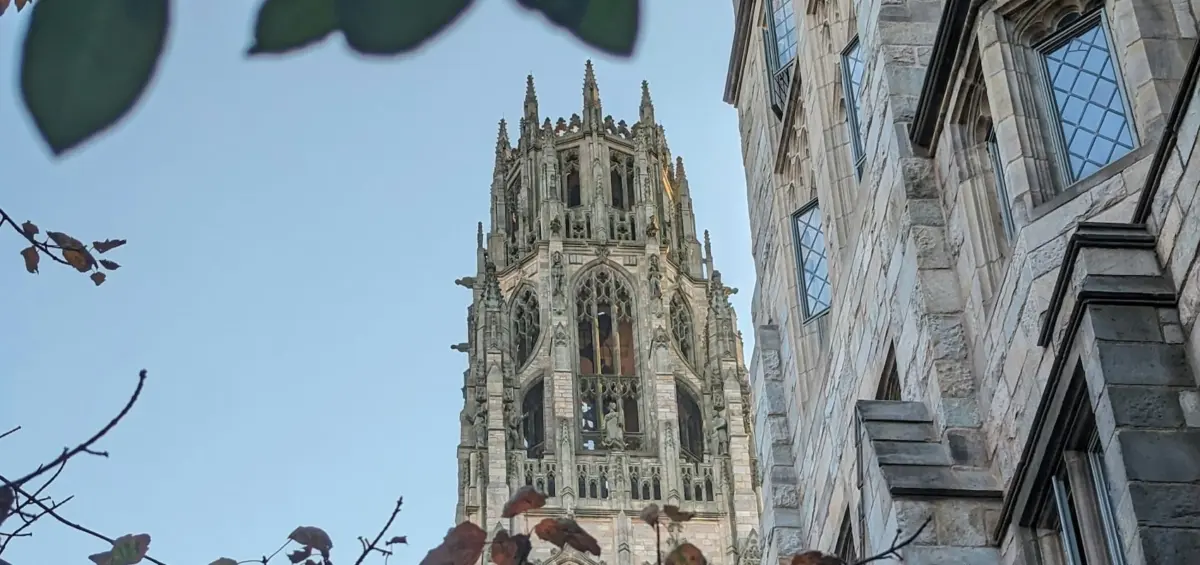
NEW HAVEN, Conn. — In the shadowed halls of elite American higher education, where secular orthodoxy has reigned supreme for generations, a quiet and profound cultural shift is taking place. Far from the ideological battlegrounds of contemporary campus politics, a distinct intellectual current is drawing record numbers of Gen Z undergraduates into deep engagement with a tradition long marginalized in secular academies: Catholicism.
The epicenter of this unlikely renaissance is a history course at Yale University bearing a title that would have raised eyebrows—and likely drawn administrative censure—just two decades ago: The Catholic Intellectual Tradition.
Launched thirteen years ago as an experimental elective with a modest cohort of twenty students, the course has exploded in popularity. Today, enrollment stands at an astonishing eighty-five undergraduates, making it the single most popular undergraduate offering within Yale’s prestigious Department of History. Its surprising trajectory—and what it reveals about the shifting spiritual and intellectual appetites of modern youth—has sparked national conversations, recently highlighted in an essay by teaching fellow Sergio Infante published in Slate, titled, "I Teach at Yale. There Are Gen Z Catholics All Around Me. I Know What Must Be Done."
Read Also
As universities across the Western world grapple with declining enrollments in the humanities and a widening chasm between academic curricula and student existential needs, the Yale experiment offers a compelling counter-narrative. It suggests that contemporary students are not running away from rigorous traditions of faith and philosophy; rather, they are starving for them.
Executive Overview
The dramatic surge in popularity of The Catholic Intellectual Tradition challenges conventional wisdom regarding the secularization of elite American youth. While cultural commentators frequently characterize Generation Z as uniformly secular, disconnected from organized religion, and driven entirely by material or technocratic concerns, professors on the ground are witnessing a very different reality.
For over a decade, this Yale seminar has attracted intensely motivated students eager to explore dimensions of human thought that have been systematically filtered out of modern education. Remarkably, this intellectual starvation crosses all demographic boundaries. It affects cradle Catholics who spent their formative years in parochial schools just as acutely as it does Protestants, non-Christians, and staunch atheists.
The course’s success underscores a broader institutional failure and opportunity: modern universities have largely abandoned the rigorous exploration of religious thought, ceding ground to dogmatic secularism. Yet, when institutions offer deep, unvarnished primary-source engagement with historic faith traditions—presented not as indoctrination, but as a serious intellectual framework for confronting human mortality and suffering—students respond in droves. The phenomenon at Yale is not merely an anomaly of a single charismatic professor; it is an indicator of a subterranean cultural hunger sweeping through contemporary higher education.
Detailed Chronology: The Genesis of an Academic Blockbuster
Fall 2013: The Unplanned Experiment
The course did not emerge from a strategic institutional initiative or a market-tested departmental plan; it was born out of serendipity and informal faculty collaboration. During the fall semester of 2013, a veteran educator stepped into a Yale classroom with a brand-new syllabus. With no track record, no institutional pedigree, and zero historical student evaluations to lean on, the course relied entirely on the sheer curiosity of approximately twenty brave undergraduates.
The creation of the seminar was an unplanned collaborative effort sparked by a philosopher colleague, Jeff Brenzel. During a series of casual conversations, Brenzel provided the intellectual flint, discussing what kind of curriculum could authentically introduce Yale students to the vast architecture of Catholic thought. Joined shortly thereafter by Giuseppe Mazzotta, a distinguished scholar of literature, the trio formulated a foundational pedagogical philosophy: eschew secondary textbooks and immerse students directly in primary sources—the foundational texts written by history’s great minds.
The Accidental Title
In academic administration, course titles are battlegrounds of branding. Lacking the budget for an advertising consultant, the founding professors initially settled on a straightforward, generic The Catholic Tradition, designed merely to stir curiosity while conveying basic categorical information.
However, when the official university course listings were published, an uncredited administrative hand altered the landscape. Someone inserted the word "Intellectual" directly into the middle of the phrase, transforming it into The Catholic Intellectual Tradition.
While the change went officially unexplained, the faculty viewed it as providential. That single injected word turned a passive historical category into a positive, assertive claim—a direct challenge to a secular age that routinely loves to deny, deride, or dismiss the very possibility of a rigorous Catholic intellect.
Thteen Years of Exponential Growth
From its humble origins of twenty students, the course steadily gained legendary status through word-of-mouth student recommendations. By its thirteenth year, enrollment peaked at eighty-five students per semester. This milestone cemented its status not just as a popular religious studies elective, but as a titan within the history department itself—an unprecedented feat for a niche humanities seminar in the 21st-century academy.
Supporting Context & Metrics: Demographics of the Modern Seeker
To understand the appeal of The Catholic Intellectual Tradition, one must look closely at the demographic and psychological profile of the students who fill its lecture halls. The seminar attracts seekers from a kaleidoscopic variety of backgrounds, hailing from every continent on Earth save Antarctica.
The Erasure of Identity Politics in the Classroom
Despite the intense contemporary academic obsession with identity markers—race, gender, socioeconomic background, and sectarian affiliation—the classroom operates on an entirely different plane. Faculty members have deliberately chosen never to poll students regarding their religious upbringing, personal faith identity, or philosophical leanings.
This policy of purposeful blindness to identity politics is foundational to the course’s success. In an educational climate where students are frequently conditioned to view texts exclusively through the narrow lens of their own identity, this seminar demands that students step outside themselves. Identity issues are strictly barred from dictating what is read, discussed, or debated.
From Atheists to Mystics
When students spontaneously reveal their personal backgrounds—as they frequently do in office hours or seminar discussions—the spectrum of belief and practice is breathtakingly wide. The room contains:
- Hardcore Atheists: Rigorous analytical thinkers who approach the texts with philosophical skepticism.
- Devout Catholics and Protestants: Traditional believers seeking intellectual depth to anchor their faith.
- Global Religious Adherents: Students representing nearly every major world religion, as well as minor traditions.
- Eclectic Seekers: Occultists, metaphysical explorers, and adventurous undergraduates drawn to religious frameworks through unexpected avenues, including the burgeoning modern interest in psychedelic philosophy.
Despite these disparate starting points, all are united by a common intensity. Educators with over fifty years of classroom experience—including those who taught in eras when student bodies consisted exclusively of seminarians and monastics—report having rarely witnessed this level of raw, existential engagement with assigned readings. For these Gen Z students, the syllabus is not a box to be checked; it is a map for navigating the crisis of meaning in the modern world.
Official Statements & Institutional Friction: Confronting Academic Prejudice
The success of The Catholic Intellectual Tradition has not occurred without friction. Even within an elite institution ostensibly dedicated to the unfettered pursuit of truth, the course’s existence has repeatedly brought deep-seated cultural prejudices to the surface.
Faculty members recount encounters with academic colleagues that highlight the lingering anti-Catholic bias prevalent in upper echelons of higher education. Upon learning of the seminar’s launch, one Ivy League colleague openly asked:
"Catholic Intellectual Tradition? Isn’t that a contradiction in terms?"
Weeks later, another faculty member expressed sheer bewilderment regarding the instructor’s motivations, asking:
"Why are you teaching that course? You’re not Catholic."
Upon being informed that the professor was indeed a practicing Catholic, the colleague’s reaction transitioned from bewilderment to active astonishment. Following a stunned silence and visible hesitation, the colleague stammered out a revealing defense:
"But . . . but . . . you’re so tolerant!"
This anecdote lays bare the underlying assumptions of modern academia: that religious orthodoxy is inherently incompatible with intellectual rigor, and that authentic engagement with historic faith traditions must necessarily be fronted by fundamentalist intolerance. By subverting these lazy stereotypes week after week, the course forces the university community to confront its own intellectual blind spots.
Future Outlook: A Blueprint for Higher Education
The phenomenon documented at Yale carries profound implications for the future of the humanities in higher education. For decades, universities have attempted to arrest declining enrollment in liberal arts programs by chasing transient, hyper-modern trends, diluting historical curricula, or packaging courses in hyper-politicized frameworks.
The success of The Catholic Intellectual Tradition points toward a radically different solution: authenticity, depth, and the unapologetic engagement with foundational human questions.
As Sergio Infante argued in his seminal Slate essay, universities must do far more to connect with an increasingly religious and spiritually hungry student body. The prevailing assumption that higher education must maintain a strict, sterilized distance from religious thought is not only pedagogically bankrupt; it is commercially and culturally self-defeating.
The core premise of the course—summed up by its veteran instructors as "two thousand years of thinking about the deepest and most perplexing questions about human existence, especially mortality and the existence of evil"—possesses universal, cross-temporal appeal. By anchoring this inquiry in the life and teachings of Jesus while examining a community of believers stretching unbroken across two millennia, the course transcends both narrow sectarianism and sterile secularism.
The takeaway for university administrators nationwide is clear: The seekers are out there, scattered across every campus, public and private, desperately searching for frameworks that offer more than careerist pragmatism or cynical deconstruction. They are looking for truth, depth, and history. As the Yale model proves, if universities have the courage to offer the intellectual substance these students so deeply crave, the students will arrive not in trickles, but in droves.




Comments
Facebook App ID not configured. Please add it in the Customizer.