
Executive Overview
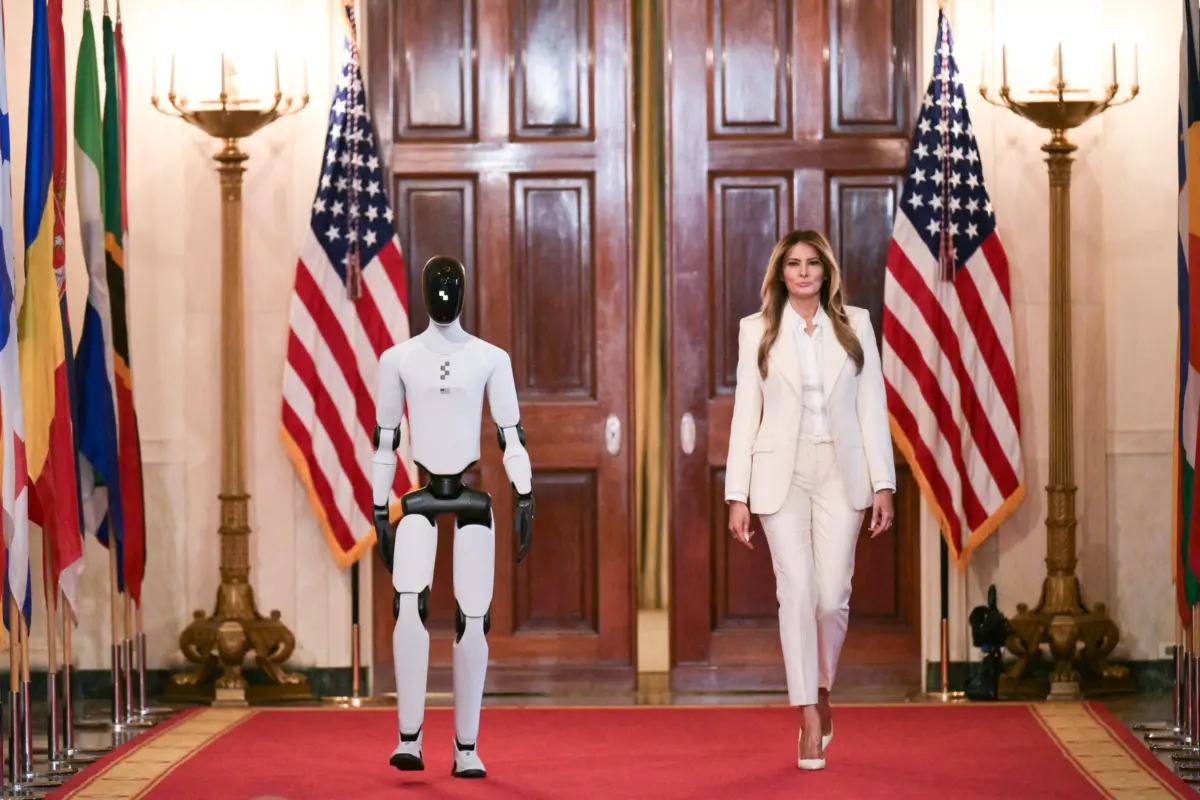
Six months ago, First Lady Melania Trump stepped onto the stage at a White House education summit, standing shoulder-to-shoulder with a faceless, artificial intelligence-powered humanoid robot. Billed as "Plato," this futuristic educator was introduced as a harbinger of a new era—one where personalized, instantaneous instruction would bring humanity’s entire corpus of knowledge directly into the homes of American children. Weeks prior, the administration highlighted this pivot toward automated instruction by hosting a 10-year-old student from Alpha School, a rapidly expanding private network where children spend just two hours a day learning core academics from proprietary AI software, trading traditional educators for adult "guides."
The Trump administration’s message was unmistakable: artificial intelligence is the future of American schooling, and the race to integrate it must not be slowed by hesitation or red tape. Yet, the White House picked a precarious moment to demand public trust in classroom automation. Just weeks before the summit, top leaders from OpenAI, Anthropic, and Google DeepMind publicly sounded the alarm, urging an industry-wide slowdown on AI development to prevent catastrophic losses of human control. The administration swiftly dismissed these warnings as a "hoax," adopting a laissez-faire "let them cook" philosophy predicated on the geopolitical axiom that "whoever wins AI wins."
This unyielding accelerationist stance has collided head-on with a profound, cross-partisan wave of public skepticism. Parents, school administrators, and lawmakers across the political spectrum are pushing back against the tech takeover of classrooms. Paradoxically, much of this resistance is originating from deep within the conservative coalition itself—setting up a high-stakes ideological civil war between pro-tech innovators and traditionalists who argue that excessive screen time and algorithmic instruction have already wreaked havoc on children’s mental health, attention spans, and academic foundational skills.
Read Also
As the battle lines solidify between the White House’s pro-automation agenda and a growing anti-tech populist movement, the American education landscape stands at a critical crossroads.
Detailed Chronology: The Accelerated Push and Rapid Pushback
The collision between aggressive federal AI policy and grassroots resistance unfolded across a rapid succession of policy battles, legislative actions, and institutional shifts throughout 2025 and 2026.
- April 2025: President Trump signs an executive order establishing a White House task force aimed at integrating artificial intelligence into K-12 classrooms, training teachers for an AI-centric economy, and cultivating an "AI-ready workforce" to maintain global dominance over geopolitical rivals like China.
- Summer 2025: Alpha School dramatically accelerates its expansion plans, acquiring key assets from a shuttered Montessori chain (Higher Ground Education) and announcing plans to open 10 new campuses, followed by an announcement for 27 additional locations nationwide by late 2026. Concurrently, the Texas State Board of Education rejects Alpha’s bid to open publicly funded charter schools due to a lack of verified data regarding lower-income student performance.
- Late 2025 / Early 2026: Investigative reports from Wired and 404 Media reveal extensive student surveillance systems within Alpha campuses—tracking keystrokes, mouse activity, and eye movements—while internal documents purportedly concede that some AI-generated lessons occasionally do "more harm than good." Alpha fiercely disputes these characterizations.
- March 2026: The Heritage Foundation releases a critical report warning that addictive design features in educational AI threaten student attention spans and mental health, advising schools to establish strict limits. Concurrently, First Lady Melania Trump hosts the White House summit introducing the humanoid robot "Plato."
- Spring/Summer 2026: State legislatures begin erecting guardrails. Utah bars generative AI on student assignments without direct teacher approval and mandates parent notification. Oklahoma passes SB 1734 unanimously, requiring districts to disclose AI tools and data collection practices while granting families opt-out rights. Major municipal school districts follow suit: New York City bans student-facing generative AI through eighth grade, and Los Angeles Unified blocks it across all student devices.
- July 2026: The Manhattan Institute publishes a framework recommending that New York State bar AI use until third grade and ban it from all standardized testing.
- August 2026: Polling data reveals deep bipartisan anxiety over educational technology, showing 85 percent of voters worried about students using AI to bypass authentic learning. Republican voters express even higher demands for regulatory guardrails (80 percent) than Democrats (76 percent).
- September 2026: Florida’s Board of Education adopts pioneering rules requiring parents to explicitly opt their children in before using AI at school, mandating non-AI alternatives, and outright banning "companion" chatbots. Meanwhile, Alpha School pivots heavily toward state voucher programs (such as Texas Education Freedom Accounts) to fund its private network, bypassing traditional charter oversight.
Supporting Context & Metrics: The Evidence Gap and Public Anxiety
The ideological debate over educational AI is increasingly informed by empirical research probing the real-world cognitive impacts of algorithmic tutors. For years, ed-tech boosters have claimed that personalized software can double or triple learning speeds. Alpha School, for example, points to internal MAP testing data indicating its students learn 2.6 times faster than peers in traditional settings. However, until recently, these claims lacked independent, third-party verification.
Independent scrutiny has revealed mounting red flags. A randomized trial involving nearly 1,000 students at a Turkish high school found that students granted access to a GPT-based math tutor that readily supplied direct answers scored 17 percent lower on subsequent unassisted examinations. A parallel working paper tracking nearly 27,000 Chinese students similarly discovered that while AI integration inflated monthly homework scores by 18 percent, it suppressed monthly exam scores by 20 percent within a six-month window. These findings validate the core fear expressed by 85 percent of American voters: that generative AI serves as a crutch that facilitates task completion without genuine comprehension.
Recognizing the urgent need for objective data, independent researchers are stepping in. MIT’s Blueprint Labs has begun designing experimental pilot studies to rigorously measure the impact of Alpha’s model on student achievement and engagement, with researchers retaining absolute control over methodologies. Simultaneously, Harvard’s Human Flourishing Program is planning a longitudinal study to evaluate student well-being and life skills.
Yet, public patience has worn thin. The convergence of declining post-pandemic academic metrics and ubiquitous screen exposure has fueled a broader cultural backlash. Bestselling critiques like neuroscientist Jared Cooney Horvath’s The Digital Delusion have become foundational texts for lawmakers questioning the wisdom of digitizing childhood.
Official Statements and Divergent Perspectives
The schism over educational AI highlights deep policy divisions, exposing friction not merely between the political left and right, but within the conservative movement itself.
The Administration and Pro-Tech Boosters
The White House maintains that hesitation is a luxury the United States cannot afford in a high-stakes global technology race. Education Secretary Linda McMahon praised Alpha School’s Austin campus as "the most exciting thing" she had witnessed in education in years. Proponents argue that market-driven innovation and school choice are the only mechanisms capable of disrupting bureaucratic, underperforming public education systems.
"Our academics can be delivered so much more efficiently and effectively… Access to the classical studies is now instantaneous—humanity’s entire corpus of information is available in the comfort of your home."
— First Lady Melania Trump
Conservative Skeptics and Traditionalists
Conversely, a powerful alliance of social conservatives, institutional think tanks, and populist parents views the push for classroom automation as a betrayal of child development principles. Traditionalists champion the classical education movement—which surged between 2020 and 2024, with roughly one-third of the nation’s 895 classical schools opening or converting during that window—emphasizing human moral mentorship over digital engagement.
"What we found out is that not only is it not the education of the future, but it is destroying the education of the past."
— Kansas State Education Bill Sponsor
The School Choice Dilemma
A particularly nuanced fault line exists among school choice advocates. While reformers celebrate alternatives to failing public schools, institutional gatekeepers draw a hard line at public subsidization without accountability.
"That doesn’t mean the rest of us shouldn’t be skeptical, or that we shouldn’t worry about fraud, or that we shouldn’t allow public funding to flow to these schools without proof."
— Mike Petrilli, Thomas B. Fordham Institute
Future Outlook: The Looming GOP Civil War and 2028 Horizon
As state legislatures enact strict protective frameworks—from Utah and Oklahoma to Florida’s aggressive opt-in mandates and companion chatbot bans—the friction between federal accelerationism and state-level resistance is reaching a boiling point.
The epicenter of this impending political conflict lies within the expansion of state voucher programs. When private networks like Alpha School—having faced rejection from state boards of education for publicly funded charter status due to missing or inadequate performance data—pivot to state-funded educational savings accounts and vouchers (such as Texas’s TEFA program), they bypass traditional oversight. Because private schools utilizing vouchers are frequently exempt from standardized testing mandates and transparent reporting requirements, critics argue that taxpayer dollars are effectively bankrolling unverified, screen-heavy experiments on children.
This creates a severe political dilemma for the Republican Party. While the executive branch champions an unbridled tech-forward agenda framed around national competitiveness against China, grassroots conservative voters are displaying a profound hunger for guardrails, with 80 percent supporting government regulation of classroom tech.
As this debate spills into the 2028 political cycle, candidates across the spectrum will be forced to answer a defining question: Whose definition of parental rights and child welfare will prevail—the Silicon Valley innovators promising hyper-efficient automation, or the populist families demanding a return to human-centered, low-screen education? Until that question is answered, the American classroom will remain the frontline of an ideological war with permanent consequences for the next generation.





Comments
Facebook App ID not configured. Please add it in the Customizer.