
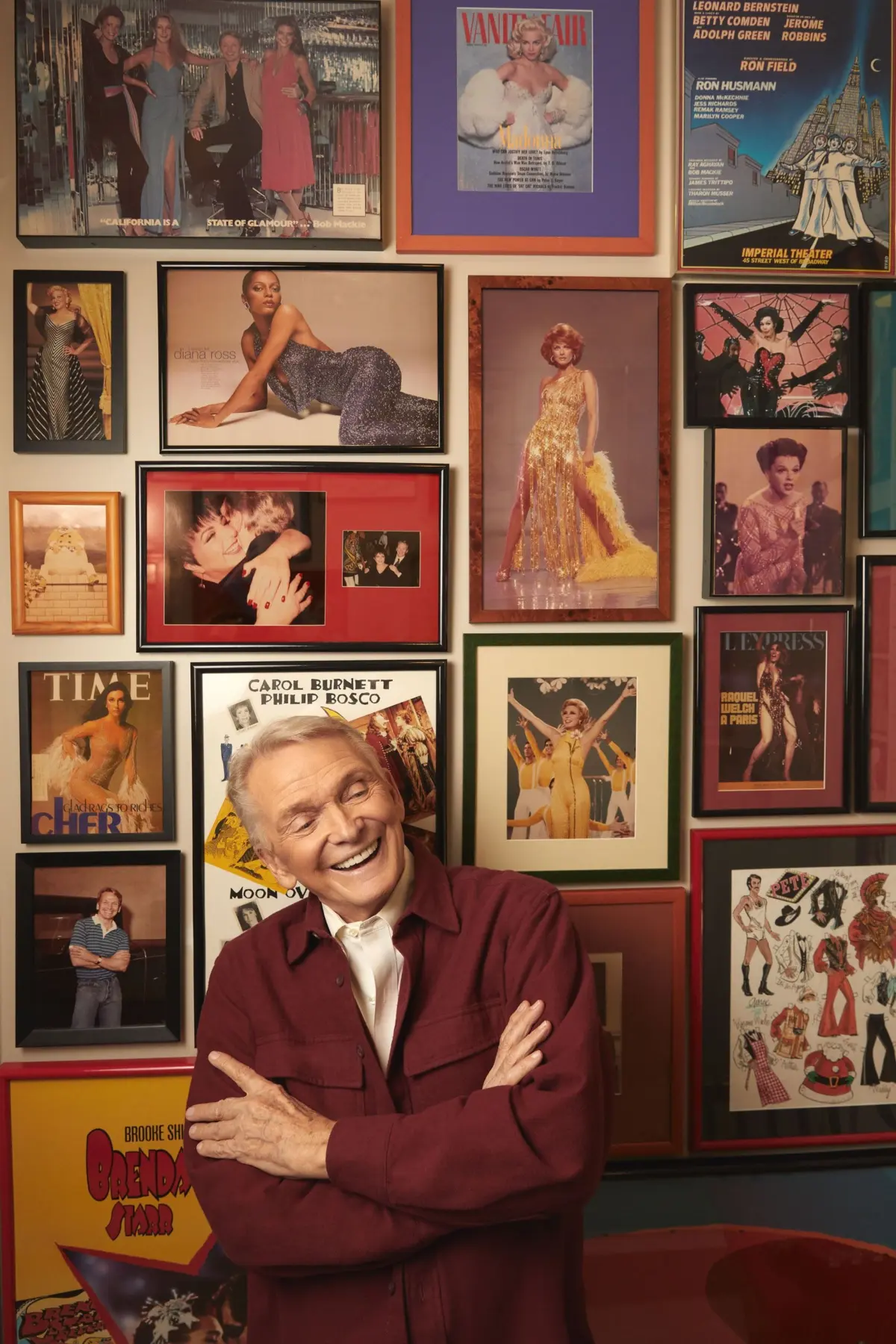
Executive Overview
Bob Mackie, the legendary costume and fashion designer whose dazzling, high-octane creations redefined American entertainment and pop-culture glamour, died on Monday from pneumonia at the age of 87. His passing marks the end of an era for spectacle fashion—a genre he virtually invented and dominated for over six decades.
Mackie occupied a unique space in the fashion pantheon. While the fashion establishment in New York and Paris historically favored quiet minimalism, architectural tailoring, and sartorial restraint, Mackie leaned unapologetically into extreme theatricality, high camp, and meticulous hand-beading. Dressed in his hyper-embellished, body-conscious creations, figures like Cher, Carol Burnett, Diana Ross, Tina Turner, Bette Midler, Liza Minnelli, and Elton John became visual icons of the late 20th century.
In 2001, the Council of Fashion Designers of America (CFDA) created a custom, unprecedented award specifically for him: the honor for "Fashion Exuberance." No designer had received it before, and none has received it since. It was a formal acknowledgment by the industry that Mackie’s oeuvre existed in a category of its own. Eighteen years later, in 2019, the CFDA bestowed upon him its Lifetime Achievement Award, cementing his legacy not merely as a costumer for Hollywood and television, but as a transformational force in fashion history whose influence dictates modern celebrity dressing and red-carpet showmanship to this day.
Read Also
Detailed Chronology
==================================================================================================
BOB MACKIE: A CAREER CHRONOLOGY
==================================================================================================

1938             • Born Robert Gordon Mackie in Monterey Park, California.
--------------------------------------------------------------------------------------------------
1950s–1960s      • Studies at Chouinard Art Institute.
                 • Begins career as a Hollywood sketch artist under Edith Head (Paramount)
                   and Jean Louis (Columbia).
                 • Contributes early sketches for landmark cinema wardrobe, including Marilyn
                   Monroe's "Happy Birthday, Mr. President" dress.
--------------------------------------------------------------------------------------------------
1967–1978        • Serves as head costume designer for "The Carol Burnett Show," creating
                   thousands of costumes, including the iconic "Went with the Wind!" curtain dress.
--------------------------------------------------------------------------------------------------
1971–1975        • Begins transformative partnership with Cher on "The Sonny & Cher Comedy Hour"
                   and "The Cher Show," launching her reveal-coat routines and sheer, midriff-baring
                   aesthetic.
--------------------------------------------------------------------------------------------------
1970s–1980s      • Expands into music and stage performance, dressing Elton John (feathered
                   "Rocket Man" ensembles), Tina Turner, Diana Ross, and Bette Midler.
--------------------------------------------------------------------------------------------------
1986             • Crafts Cher’s notorious Oscar "revenge dress"—a black lattice bra top and
                   spiky mohawk headdress—after she is snubbed for her role in "Mask."
--------------------------------------------------------------------------------------------------
1988             • Designs Cher’s translucent black-lace Oscar gown, worn when she wins Best
                   Actress for "Moonstruck."
--------------------------------------------------------------------------------------------------
1990s–2000s      • Expands into wearable ready-to-wear, fragrance, and collector Barbie designs.
--------------------------------------------------------------------------------------------------
2001             • Honored at the CFDA Fashion Awards with a bespoke, one-time-only award for
                   "Fashion Exuberance."
--------------------------------------------------------------------------------------------------
2019             • Wins a Tony Award for Best Costume Design in a Musical for "The Cher Show."
                 • Receives the CFDA Lifetime Achievement Award.
--------------------------------------------------------------------------------------------------
2025             • Passes away on Monday of pneumonia at the age of 87.
==================================================================================================
The Formative Years and Hollywood Apprenticeship
Mackie was raised in Southern California and developed an early obsession with cinema, performance, and vibrant visual expression. He frequently recalled childhood memories of the actress Carmen Miranda—famous for her fruit-laden turbans and energetic Technicolor musical numbers—as his personal gold standard of beauty and visual delight.
After studying at the Chouinard Art Institute in Los Angeles, Mackie entered the studio system during the twilight of Hollywood’s Golden Age. Working as a sketch artist, he learned the technical mechanics of pattern-making, drape, and light reaction under two mid-century costuming titans: Edith Head at Paramount Pictures and Jean Louis at Columbia Pictures. Under Louis, Mackie’s precise hand sketched the translucent, rhinestone-encrusted gown worn by Marilyn Monroe when she sang "Happy Birthday, Mr. President" to John F. Kennedy in 1962—a key moment that presaged Mackie’s signature aesthetic of illusion mesh and strategically placed sparkle.
The Television Revolution and the "Cher Era"
By the late 1960s, the center of visual gravity in American pop culture had shifted from film sets to primetime television. Mackie made the leap to TV, taking over costume design for The Carol Burnett Show in 1967. Over eleven seasons, Mackie designed as many as sixty to seventy costumes per week, proving his ability to deliver high drama, period authenticity, and visual comedy at a rapid pace.
It was his pairing with Cher, beginning on The Sonny & Cher Comedy Hour (1971) and continuing onto The Cher Show (1975), that revolutionized pop-star iconography. Mackie created a signature formula: slinky, midriff-baring silhouettes, dangerous low-waisted skirts, and sheer illusion fabrics adorned with thousands of hand-sewn sequins and beads. On The Cher Show, Mackie introduced a recurring theatrical routine where Cher stepped onto stage wrapped in an oversized coat or dramatic cape, only to strip off her outerwear and reveal a daring bandeau top, sheer gown, or bejeweled pasties beneath—a visual trick that earned her the moniker of a "disco Scheherazade."
Red-Carpet Provocations and Industry Validation
Throughout the 1980s, Mackie’s work defined the outer boundaries of red-carpet fashion. His most famous sartorial strike occurred at the 1986 Academy Awards. Angered that the Academy had omitted Cher from the Best Actress nominations for her critically acclaimed role in Mask, Cher asked Mackie to design an outfit that functioned as a visual statement of defiance. The result was a black gothic ensemble featuring a lattice-work bra top, low-slung skirt, and a towering, two-foot-tall spiky feather headdress. The look divided critics at the time, but dominated international news cycles and became one of the most re-printed images in Oscar history. Two years later, Cher accepted her Best Actress Oscar for Moonstruck in another Mackie masterpiece: a sheer, hand-beaded black lace column gown.
As the fashion industry reevaluated its stance on costume design in the 21st century, Mackie received critical redemption. In 2001, he received the CFDA’s unique "Fashion Exuberance" award, followed in 2019 by both a Tony Award for The Cher Show on Broadway and the CFDA Lifetime Achievement Award.
Supporting Context & Aesthetic Metrics
The "Mackie Aesthetic" and Technical Craftsmanship
To evaluate Mackie’s contribution to fashion, one must understand the technical rigors behind his "exuberance." What appeared on television screens as effortless camp was built on demanding couture craftsmanship.
- Materiality and Embellishment: Mackie favored ultra-saturated, punchy colorways—frequently citing tangerine, Capri blue, and electric watermelon as signatures. His garments relied heavily on feather plumes, bugle beads, Swarovski crystals, tassels, and fluid gold lamé.
- Illusion Mesh Engineering: Mackie perfected the use of illusion net—a delicate stretch fabric matched precisely to the wearer’s skin tone. By embroidering beads and sequins onto this net, he created the illusion that jewels were floating directly on bare skin, allowing performers maximum physical mobility while maintaining a daring visual impression.
- Proportions and Architecture: Drawing from Las Vegas revue showgirls and Busby Berkeley’s geometric film choreography, Mackie built heavy shoulder structures, sweeping trains, and exaggerated headpieces designed to extend the performer’s physical presence on wide-angle camera shots and cavernous concert stages.
+-----------------------------------------------------------------------------------+
|                        ELEMENTS OF THE MACKIE AESTHETIC                          |
+------------------------------------+----------------------------------------------+
| PALETTE                            | Tangerine, Capri Blue, Electric Watermelon,  |
|                                    | Metallic Golds, Deep Jet Black               |
+------------------------------------+----------------------------------------------+
| KEY MATERIALS                      | Illusion Netting, Ostrich/Rooster Feathers,  |
|                                    | Swarovski Crystals, Bugle Beads, Gold Lamé   |
+------------------------------------+----------------------------------------------+
| INSPIRATIONAL SOURCES              | Carmen Miranda, Busby Berkeley Musicals,     |
|                                    | Las Vegas Showgirl Revues, Studio Glamour    |
+------------------------------------+----------------------------------------------+
| TECHNICAL INNOVATIONS              | Bodysuit Engineering for Live Performance,    |
|                                    | Structural Headpieces, Reveal Outerwear      |
+------------------------------------+----------------------------------------------+
Primetime Reach vs. High-Fashion Snobbery
For decades, high fashion looked down upon Mackie’s work as overly theatrical, vulgar, or trivial because it was produced for primetime television and concert arenas rather than European runways. However, in terms of sheer cultural metrics and visual reach, Mackie outpaced traditional couture houses:
- Mass Audience Penetration: During the height of The Carol Burnett Show and The Sonny & Cher Comedy Hour in the 1970s, Mackie’s creations were viewed weekly by 30 to 40 million households in the United States alone. By contrast, traditional haute couture shows were seen by only a few hundred wealthy patrons and fashion editors.
- Longevity of Red Carpet Impact: The 1986 Oscar dress created for Cher remains one of the most published images in entertainment journalism, reprinted continuously across nearly four decades of Academy Award coverage.
- Crossover into Male Performance: Mackie broke rigid gender norms in stage dressing by outfitting male stars in equal parts sparkle and plumage. His work for Elton John during his mid-1970s "Rocket Man" era set a new benchmark for male pop spectacle, directly paving the way for contemporary stage wardrobes worn by artists like Harry Styles and Lil Nas X.
Official Statements and Tributes
The creation of the CFDA "Fashion Exuberance" award in 2001 served as a explicit acknowledgment of Mackie’s unclassifiable talent. Mackie himself viewed the industry’s initial hesitation with characteristic self-awareness and dry wit:
"They wanted to give me something, but they didn’t know what to do with me."
— Bob Mackie, speaking to Vogue in 2019 regarding his 2001 CFDA Award
Despite the fashion world’s ambivalence toward the world of costume and camp, Mackie’s peers and clients recognized the sheer force of his singular vision. Jan Strimple, a fashion-show producer, model, and longtime client, captured his unique standing within the design community:
"The award sums up everything Mackie, because he’s an original. You can’t ignore his presence and his success even if he’s not your cup of tea."
— Jan Strimple, Model and Fashion-Show Producer
Joe McFate, who worked closely alongside Mackie as his primary design partner for twenty-six years, reflected on the lasting impact of the famous 1986 Oscar ensemble and Mackie’s modest view of his own provocations:
"People hadn’t seen her in one of those outrageous get-ups—Bob called them get-ups—in a while. But for years afterwards that dress got reprinted every Oscar season. It still does!"
— Joe McFate, Design Partner of 26 years
Mackie summarized his own core design philosophy simply, noting that his vivid, beaded, and often shocking creations were never built for the faint of heart:
"My clothes were meant for the woman who is not afraid to be noticed."
— Bob Mackie
Future Outlook and Enduring Legacy
While Bob Mackie has passed, his visual DNA is permanently encoded into modern fashion, celebrity styling, and contemporary pop culture.
The Foundation of Modern Met Gala Culture
The contemporary red carpet—characterized by viral "naked dresses," dramatic reveals, camp themes, and headline-grabbing headpieces—is a direct descendant of Mackie’s work from the 1970s and 1980s. Modern events like the Met Gala, which explicitly celebrate sartorial drama and thematic excess, operate on the principles that Mackie pioneered when designing for television variety hours. Modern luxury houses like Schiaparelli, Mugler, and Jean Paul Gaultier regularly revisit the high-camp theatricality that Mackie popularized decades earlier.
Archival Revival and Pop-Culture Homage
In recent years, a new generation of style icons has actively sought out archival Bob Mackie creations to make authoritative fashion statements:
- Zendaya regularly wears vintage Mackie ensembles on high-profile press tours, showcasing the timeless construction and striking relevance of his 1980s and 1990s designs.
- Kim Kardashian paid explicit tribute to Mackie and Cher at the 2019 Met Gala and subsequently wore original Mackie pieces for major appearances.
- Miley Cyrus chose vintage Mackie gowns for high-profile Grammy performance moments, demonstrating that his stage pieces retain their ability to captivate audiences.
Historical Reappraisal
As fashion scholarship expands to recognize performance art, drag culture, and television costuming as vital disciplines within the broader history of design, Mackie’s legacy is undergoing a major institutional reappraisal. Museum retrospectives, academic studies on camp, and archival conservation projects now frame Bob Mackie not as a mere costumer who operated on the fringes of Seventh Avenue, but as a master builder of 20th-century American iconography—a designer who recognized that fashion, at its absolute best, is an act of pure, unadulterated joy.





Comments
Facebook App ID not configured. Please add it in the Customizer.