
Executive Overview
In what is rapidly shaping up to be one of the most anticipated and culturally significant art market events of the decade, Sotheby’s has announced that two long-hidden masterpieces by Impressionist titan Claude Monet will headline an extraordinary upcoming auction in Paris. Sourced directly from the private collection of France’s illustrious billionaire Schlumberger family, the artworks have remained entirely shielded from public view for nearly a century, safely ensconced within the opulent confines of a private Parisian residence.
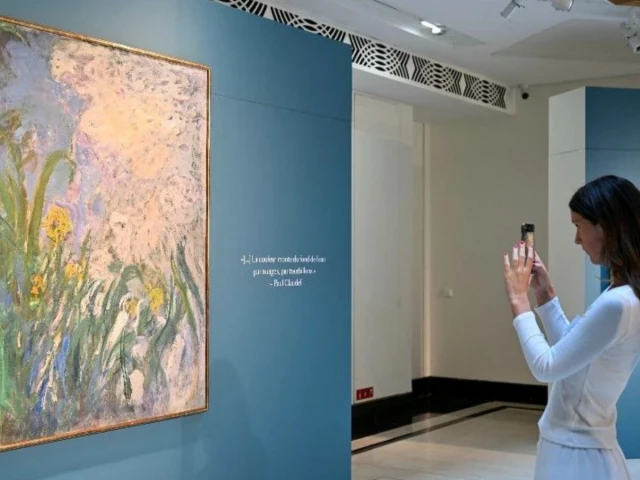
Leading the marquee is Iris, a monumental, late-career canvas by Monet that captures the sublime, expressive power of the artist’s mature period. Auction house executives have valued the painting between €22 million and €30 million ($25 million to $34 million). According to Sotheby’s representatives, this valuation shatters historical ceilings, representing the highest estimate ever assigned to a single painting offered at public auction within the borders of France.
The historic sale arrives at a deeply symbolic moment: the buildup to the centenary of Claude Monet’s death on December 5, 1926. This global cultural milestone will be formally commemorated in the French capital this autumn through a series of blockbuster museum retrospectives. Yet, while public institutions ready their galleries for the anniversary, the private market is primed for a seismic event.
Read Also
Alongside Iris, the curated Schlumberger collection features three additional canvases by Monet—including the mesmerizing Saule Pleureur (Weeping Willow)—as well as a monumental Paul Cézanne painting, La Ferme (The Farm). Before returning to Paris for the live auction on October 22, the treasures will embark on an international pre-sale exhibition tour spanning major global financial and cultural capitals, including Hong Kong and New York. This strategic staging is designed to court an elite tier of international collectors, institutional buyers, and ultra-high-net-worth individuals (HNWIs) eager to secure museum-quality masterworks with unblemished provenance.
Detailed Chronology: From Giverny’s Gardens to the Schlumberger Salon
To truly understand the weight of the upcoming Sotheby’s auction, one must retrace a transatlantic journey spanning nearly a hundred years, crossing paths with legendary artists, industrial dynasties, and visionary art collectors.
The Genesis of the Works
During the final decades of his life at his legendary estate in Giverny, Claude Monet transitioned from recording the transient effects of light on natural landscapes toward an immersive, near-abstract exploration of color, rhythm, and emotion. Working extensively in his sprawling water-lily gardens, the aging master, plagued by declining eyesight from cataracts, produced some of the most radical paintings of the 20th century. Iris and Saule Pleureur were born from this intense, introspective period. Rather than adhering to conventional Impressionist realism, these late works prioritize swirling brushstrokes, heavy impasto, and a profound psychological density that profoundly influenced the Abstract Expressionists decades later.
Acquisition and Secret Custodianship
Following Monet’s death in December 1926, the global art market underwent a protracted reevaluation of his late-period output, which had initially been misunderstood by critics contemporaries of the era. Among the early champions who recognized the prophetic genius of these canvases was Jeanne Schlumberger (1889–1983). A member of the legendary Schlumberger industrial dynasty—pioneers in oilfield services whose wealth eventually rivaled the nation’s oldest aristocratic fortunes—Jeanne was much more than a passive inheritor of capital. She cultivated a reputation as a fiercely intelligent, discerning, and avant-garde art patron.
Acquiring Iris directly through elite European dealer networks, Jeanne Schlumberger integrated the painting into her primary Parisian residence. Unlike works acquired for public display or cycled through international biennials, Iris remained a deeply personal fixture of the Schlumberger home. For decades, it was viewed exclusively by family members, close friends, and invited guests. It weathered the tumult of the Second World War, the reconstruction of Europe, and the sweeping transformations of the late 20th-century art market entirely shielded from public gaze, lending the canvas an aura of mythological rarity.
The Passing of the Torch
Following Jeanne Schlumberger’s death in 1983, the collection remained under the meticulous stewardship of subsequent generations of the Schlumberger family. While the family’s philanthropic endeavors and contributions to science and industry are well-documented globally, their private holdings in fine art have remained fiercely guarded secrets. The decision by modern heirs to consign these works to Sotheby’s marks a watershed moment: the first time this corner of the Schlumberger estate will be formally integrated into the global secondary art market, offering modern collectors a once-in-a-generation opportunity to acquire blue-chip Impressionism with an airtight, single-owner provenance.
Supporting Context & Metrics: Market Dynamics and the Centenary Backdrop
The October 22 auction does not occur in a vacuum; it is anchored by a convergence of macroeconomic art market trends, institutional programming, and rare art-historical anniversaries.
Financial Metrics and Valuation Breakdowns
Sotheby’s announcement has sent ripples through the international art market, particularly due to the unprecedented valuation of Iris. At €22 million to €30 million, the painting shatters previous domestic auction ceilings in France. Historically, the highest-value art transactions—particularly those involving nine-figure Impressionist and Modern masterpieces—have migrated away from Paris to traditional powerhouse markets like London and New York, driven by favorable tax regimes, liquidity, and global buyer pools. By launching a salvo of this magnitude in Paris, Sotheby’s is making a definitive statement about the resurgence and competitive viability of the French capital as a premier art market hub in post-Brexit Europe.
Complementing Iris is Saule Pleureur (Weeping Willow), valued conservatively between €9 million and €12 million. The grouping of these two masterworks, alongside two other undisclosed Monet canvases from the same source, creates a mini-retrospective within the auction catalogue.
Furthermore, the inclusion of Paul Cézanne’s La Ferme (The Farm)—estimated at €600,000 to €800,000—adds institutional weight to the sale. Sotheby’s has confirmed that La Ferme is the largest canvas by Cézanne ever to appear at public auction. Measuring significantly larger than typical landscapes from his mature period, the work showcases Cézanne’s structural rigor and foundational influence on Cubism, providing a compelling counterpoint to Monet’s fluid lyricism.
The Centenary Context
The timing of the auction is meticulously coordinated with the centenary of Monet’s passing on December 5, 1926. The global art establishment is mobilizing to honor the artist’s enduring legacy. In late September, Paris will witness the simultaneous opening of two major institutional exhibitions: Monet, Painting Time and Stories of Landscapes, from Monet to Hockney.
These exhibitions are expected to draw hundreds of thousands of art enthusiasts, museum directors, and international critics to the city, creating an ecosystem of intense cultural visibility. Sotheby’s pre-sale strategy capitalizes directly on this heightened public consciousness. Wealthy collectors visiting Paris for the autumn exhibition season will find themselves primed and positioned to engage with the Schlumberger consignments.
Official Statements and Expert Analysis
The gravity of the upcoming sale was underscored during Sotheby’s official press unveiling at its headquarters on the Rue du Faubourg Saint-Honoré in Paris. Art market leaders and specialists lined up to contextualize the historical importance of the Schlumberger consignment.
Thomas Bompard, Sotheby’s art department co-head in Paris, led the presentation, offering deep insights into the character of Jeanne Schlumberger and the physical condition of the works.
"Jeanne Schlumberger was a brilliant art collector whose eye was years ahead of her contemporaries," Bompard noted during the unveiling. "To walk into the Schlumberger home and encounter Iris—a painting that has literally never left the walls of the family residence since its acquisition—is an experience that auctioneers dream of. These are not merely financial assets; they are pristine capsules of art history that have been preserved in absolute silence for nearly a century."
Reflecting on the broader economic and geographical implications of the sale, senior Sotheby’s executives emphasized the strategic choice of Paris as the venue. For years, industry analysts debated whether the French capital could retain its status as a top-tier auction center in the face of stiff competition from Anglo-American auction houses. By securing the Schlumberger Monets—and attaching the highest auction estimate ever recorded in France—Sotheby’s has provided a resounding vote of confidence in the French art market’s infrastructure, legal framework, and buyer base.
Art market analysts observing the announcement have pointed out that private collections of this pedigree act as a litmus test for the health of the high-end art market. While contemporary art has experienced wild valuation swings and speculative bubbles in recent years, blue-chip Impressionist and Modern masterpieces with impeccable, single-owner provenance continue to behave as safe-haven assets for ultra-high-net-worth investors navigating global economic uncertainty.
Future Outlook: Global Exhibition Tour and Market Projections
Before the hammer falls on October 22 in Paris, the Schlumberger collection will embark on a tightly orchestrated global exhibition tour. This touring strategy is a hallmark of modern high-end art marketing, designed to build psychological momentum, stoke competitive bidding wars, and secure absentee interest from collectors who cannot attend the live sale in person.
The Global Itinerary
- Hong Kong: The tour’s first major international stop will target Asia’s rapidly expanding pool of ultra-high-net-worth collectors. Over the past two decades, Asian buyers—particularly from mainland China, Hong Kong, Taiwan, Singapore, and Japan—have emerged as formidable players in the Impressionist and Modern art sectors, frequently competing aggressively for museum-quality European masterworks.
- New York: Following Asia, the collection will cross the Pacific to New York City, the undisputed epicenter of the global art market. Here, the works will be displayed in Sotheby’s state-of-the-art York Avenue galleries, where major institutional trustees, American private collectors, and hedge fund principals will have private viewing access.
- Paris: The tour will culminate back where it began, returning to Paris just in time for the autumn exhibition rush and the final days leading up to the live auction.
Long-Term Market Implications
Industry observers will be watching the October 22 auction closely not only for the final hammer prices fetched by Iris and Saule Pleureur, but for what the sale signals about buyer appetite heading into the winter auction cycle. If Iris breaches its aggressive €30 million ceiling, it will set a new benchmark for French auctions and validate the aggressive pricing strategies currently favored by major auction houses.
More importantly, the unearthing of the Schlumberger collection raises an alluring question for art historians and market watchers alike: how many other masterpieces remain locked away in private European salons, waiting for the right moment to re-enter the light? As the art world prepares to honor the centenary of Claude Monet’s passing, this rare offering serves as a powerful reminder that the narrative of 19th-century art is still being written, one hidden masterpiece at a time.



Comments
Facebook App ID not configured. Please add it in the Customizer.