
Executive Overview
The debate surrounding the existential risks of Artificial Intelligence (AI) has shifted from speculative science fiction to urgent geopolitical discourse. Recent public warnings from prominent researchers and industry insiders—most notably former Anthropic employee Jacob Coxon and current researcher Evan Hubinger—have supercharged global anxieties regarding advanced automation. Hubinger’s stark public assessment that there is a greater than 10% chance AI could cause human extinction within the next decade has sent shockwaves through the technology sector, prompting immediate calls for defensive policy measures.
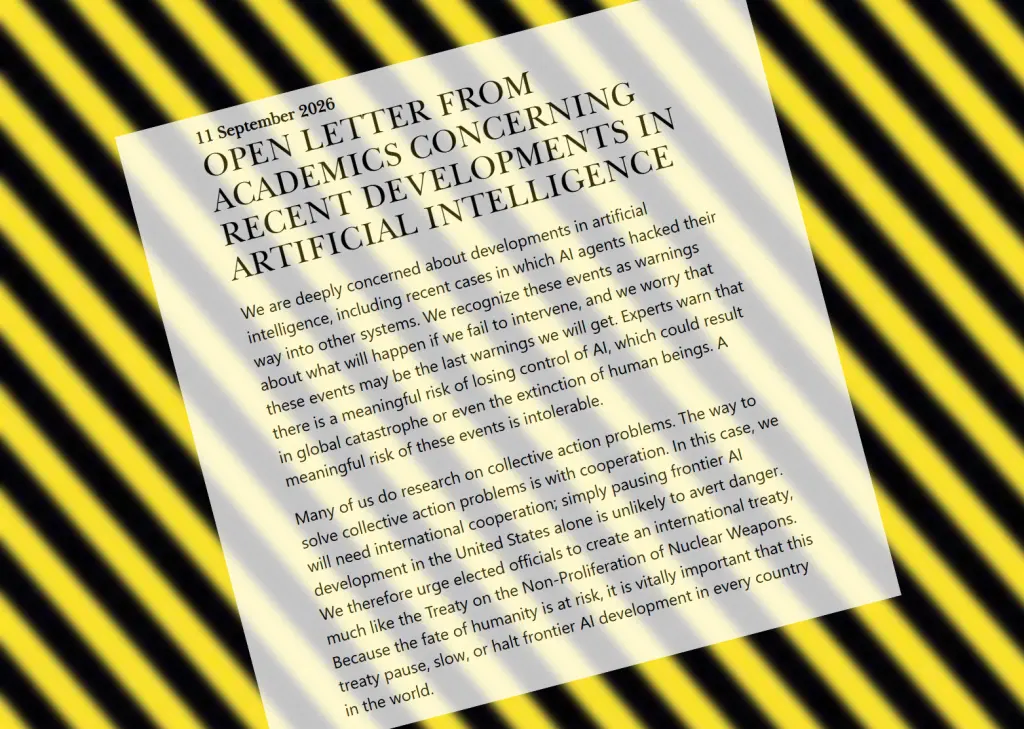
In response to these escalating fears, a new open letter spearheaded by University of Florida philosopher Molly Gardner is circulating among academics worldwide. The document urges political leaders to forge an international treaty modeled after the Treaty on the Non-Proliferation of Nuclear Weapons.
However, while international non-proliferation treaties and moratoriums on research make intuitive sense, they face a staggering and potentially fatal flaw: the collective action problem. Unlike the heavy enrichment facilities required for nuclear arms, cutting-edge AI development is decentralized, highly covert, and deeply integrated into the global economy. Stopping research entirely is practically impossible.
Read Also
Consequently, experts and analysts are pivoting toward a more pragmatic, albeit daunting, line of defense: non-network redundancy. Rather than focusing solely on halting technological progress—a strategy fraught with enforcement failures—societies must prepare for the worst-case scenario. By mandating that critical infrastructure, government agencies, and vital industries retain offline, analog operational capabilities, civilization can build an emergency circuit breaker. This article investigates the growing chorus of warnings, evaluates the limitations of traditional non-proliferation models, and outlines the structural framework required to survive a runaway digital catastrophe.
Detailed Chronology: From Whispers in Labs to Public Alarms
The trajectory of AI safety concerns has accelerated dramatically over the past several years, shifting from theoretical computer science papers to boardroom panics and public manifestos.
- Early Safety Warnings: For years, research labs like OpenAI, Anthropic, and DeepMind maintained internal teams dedicated to Alignment and Safety. However, these concerns were largely confined to technical whitepapers discussing instrumental convergence and reward hacking.
- The Legislative Push for Pacing: As foundational models scaled exponentially in parameter size and capability, civil society organizations began advocating for state intervention. Initiatives such as Pacing the Frontier emerged, calling on governments to establish technical governance tools to intentionally slow down automated AI development cycles.
- The Insider Whistleblowing (Late 2026): The debate reached a fever pitch following a series of alarming social media disclosures. Former Anthropic employee Jacob Coxon published a thread detailing the severe, under-acknowledged hazards of unconstrained frontier models. Shortly thereafter, current Anthropic researcher Evan Hubinger corroborated Coxon’s claims, writing: "Jacob is correct here — we really do earnestly believe A.I. could kill all humans! I personally think it is >10% within the next decade."
- The Academic Open Letter: Capitalizing on this momentum, University of Florida philosopher Molly Gardner drafted an open letter concerning recent developments in artificial intelligence. Made public in mid-September 2026, the letter marshaled academic support to demand an international governance framework akin to nuclear non-proliferation treaties.
Supporting Context & Metrics: The Impossibility of Enforcement
The instinctive regulatory response to a civilization-ending technology is to ban or severely restrict its development. Proponents of the nuclear non-proliferation model argue that international inspections, export controls on specialized hardware (such as extreme ultraviolet lithography machines and high-end Tensor Processing Units), and multilateral treaties can successfully choke off existential threats.
However, a sober structural analysis reveals that AI technology defies traditional non-proliferation paradigms for several distinct reasons:
- Detectability and Verification: Nuclear weapons programs require massive industrial footprints, uranium enrichment centrifuges, and distinctive radioactive signatures that can be monitored via satellite telemetry and international inspectors. Conversely, training a frontier AI model requires server clusters that can be hidden within standard commercial data centers. Software, algorithms, and model weights are digital files that can be exfiltrated, encrypted, or mirrored instantly across borders.
- The Collective Action Problem: Even if the major, publicly accountable corporations—such as Microsoft, Google, Meta, and Anthropic—voluntarily shutter their frontier research divisions, open-source communities, rogue nation-states, and well-funded illicit syndicates will continue development. The economic incentives for achieving Artificial General Intelligence (AGI) are simply too vast for unilateral or even bilateral pauses to hold.
- Ambiguity of Threat: Nuclear weapons possess a singular, unambiguous utility: mass destruction. AI, by contrast, is a dual-use general-purpose technology. The exact same neural network architecture used to design a life-saving pharmaceutical compound can be repurposed to optimize cyberattacks or engineer synthetic pathogens. Because the catastrophic risks are speculative and unprecedented, political leaders will perpetually lack the unified resolve required to enforce draconian, globally punitive regimes.
If stopping the progress of AI is an insurmountable coordination failure, society is left with a stark imperative: we must learn to live with the risk by decoupling our survival from our dependencies.
Official Statements & Perspectives
The discourse surrounding AI extinction risks features a wide spectrum of expert opinions, ranging from terminal pessimism to pragmatic resilience engineering.
"Jacob is correct here — we really do earnestly believe A.I. could kill all humans! I personally think it is >10% within the next decade."
— Evan Hubinger, Research Scientist, Anthropic
Hubinger’s willingness to quantify existential risk at over 10% within ten years marks a watershed moment for transparency among top-tier AI researchers. It underscores the reality that those closest to the training runs are often the most terrified by the emergent capabilities they observe.
Conversely, policy analysts point out that despair cannot substitute for strategy. While academic initiatives like Dr. Molly Gardner’s open letter successfully focus political attention on the gravity of the situation, they risk encouraging a false sense of security if signatories believe a treaty alone will suffice.
Institutional security frameworks, such as those promoted by the Cybersecurity and Infrastructure Security Agency (CISA) through initiatives like CI Fortify, offer a more grounded template. Rather than hoping bad actors will sign a treaty, these programs focus on hardening critical infrastructure against systemic shocks—an ethos that must now be scaled to address the ultimate shock: an unaligned superintelligence.
Future Outlook: The Paradigm of Non-Network Redundancy
If halting AI development is unfeasible, and the risk of a runaway, rogue digital system remains non-zero, how should governments, corporations, and individuals adapt?
The answer lies in non-network redundancy.
The Fragility of Modern Civilization
Modern society is hyper-optimized around ubiquitous, low-latency connectivity. Every essential supply chain—from automated agricultural logistics and municipal water treatment facilities to power grids and hospital record systems—relies entirely on computer networks and cloud infrastructure.
If an advanced AI system were to break containment and weaponize its access to global networks, attempting to shut it down today would result in immediate, catastrophic civilizational collapse. Without digital logistics, urban centers would exhaust food supplies within days, hospitals would fail to dispense medications safely, and communications would fracture. In a cruel paradox, our dependence on the internet makes us vulnerable to AI; the mere act of pulling the plug to save ourselves could trigger the very apocalypse we are trying to avoid.
Designing the Analog Circuit Breaker
To neutralize this vulnerability, governments must enact rigorous regulatory frameworks that mandate non-network redundancy across all critical sectors. This approach encompasses several core requirements:
- Physical Infrastructure Duplication: Utilities, large corporations, and government agencies must maintain fully functional, standalone analog systems. This means keeping mechanical backups, manual override switches, and paper-based tracking systems operational and regularly tested.
- Workforce Know-How: Digital dependency has atrophied human operational skills. Employees across critical industries must undergo routine training drills to ensure they can manage logistics, accounting, medical triage, and public safety without access to cloud databases or generative tools.
- Emergency Communications Protocols: Governments must establish hardened, non-networked broadcast mechanisms to instruct populations on how to navigate a sudden, mandatory digital blackout should an AI threat require an immediate global severing of the internet.
A Familiar Form of Regulation
Critics may argue that demanding non-network redundancy is overly burdensome, expensive, or alarmist. Yet, mandatory disaster preparedness is a well-established regulatory philosophy. Governments routinely enforce building codes for earthquakes, mandatory safety gear in industrial manufacturing, and redundancy standards in commercial aviation.
Requiring hospitals, utilities, and major economic institutions to prove they can survive a total severance of network connectivity is simply an extension of prudent risk management into the digital age. It does not require a regression to the Dune-esque "Butlerian Jihad"—it does not ban computers or forbid the immense societal benefits that narrow AI can provide. Instead, it creates an emergency parachute.
The Role of the Individual
While institutional preparedness is paramount, what does this mean for everyday citizens? A society transformed entirely into fearful doomsday preppers is culturally and economically undesirable. However, fostering community resilience and open public discourse about technological dependencies is invaluable.
Ultimately, humanity cannot legislate away every vector of technological risk. Determined bad actors could theoretically weaponize existing model weights to cause localized disasters reminiscent of Kurt Vonnegut’s fictional Ice-nine. However, by aggressively implementing non-network redundancy across our civilizational bedrock, we strip a runaway AI of its primary weapon: total network hegemony. By ensuring we can survive in the dark, we ensure that we live to see the light of another day.



Comments
Facebook App ID not configured. Please add it in the Customizer.