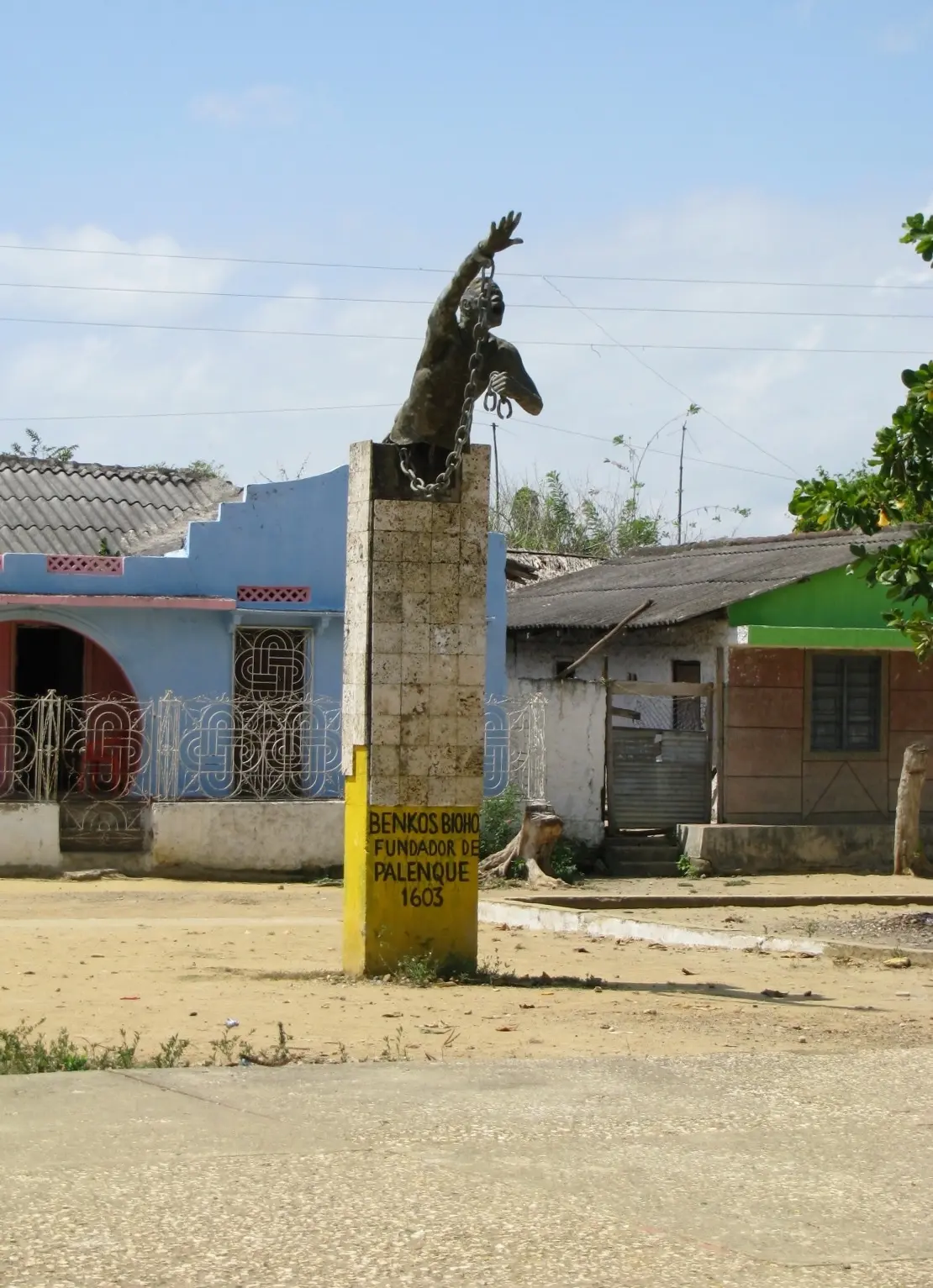
In the heart of San Basilio de Palenque, Colombia—celebrated by UNESCO as the “first free people of the Americas”—stands a bronze monument dedicated to the legendary maroon leader Benkos Biohó. Sculpted by Luis Guillermo Vallejo and installed in 1997 through international heritage initiatives, the monument was intended to anchor collective memory, celebrate Black liberation, and symbolize historical continuity. Yet, a rigorous examination of the sculpture reveals a striking, deeply paradoxical configuration: the champion of anti-colonial resistance is depicted enchained, his torso seemingly dragged down by a heavy concrete pedestal, his posture echoing the trauma of the transatlantic slave trade rather than absolute freedom.
Over the past three decades, this bronze figure has transformed into a profound site of public contestation. Through a continuous, grassroots process of rewriting epigraphs, altering architectural surroundings, and modifying the statue itself, the Palenquero community has persistently challenged official narratives imposed by the Colombian state and international bodies. This investigative report explores the complex dialectics of memory, monumentality, and freedom inscribed in San Basilio de Palenque. By juxtaposing modern heritage frameworks—such as Siegfried Giedion, Jean-Luc Sert, and Fernand Léger’s 1943 manifesto “Nine Points on Monumentality”—with archival research and historical ethnography, this article interrogates how a community reclaims its history far beyond the constraints of institutional representation.
Detailed Chronology: The Evolution of a Contested Monument
To understand the tensions surrounding the monument to Benkos Biohó, one must trace its physical, textual, and spatial transformations from its inception to the present day.
[1603] ──> Founding of the early Palenque by Benkos Biohó
[1621] ──> Trial and public execution of Biohó by the Spanish Crown
[1713] ──> The "Entente Cordiale" and legal reduction of San Basilio
[1997] ──> Installation of Vallejo’s bronze sculpture; initial "Palenke" inscription
[2009] ──> Epigraph amended to Hispanicized spelling ("Palenque")
[2012] ──> Chains removed and pedestal masked by concrete steps (cenotaph phase)
[2015] ──> State-funded plaza renovation, heliocentric tiling, and detailed historical scroll
[Present] ──> Final epigraph removal and chiseled secondary pedestal
1. The Pre-Monumental Era and Mythological Origins
The history of San Basilio de Palenque is rooted in the fierce resistance of cimarrones (maroons) who escaped slavery in Cartagena de Indias starting in the sixteenth century. Led by figures like Benkos Biohó—an African king enslaved on the coast of Guinea who established early fortified settlements in the dense jungles of La Matuna—these communities fought off repeated military expeditions.
Although historical research by María Cristina Navarrete distinguishes between Biohó’s early militant palenque around 1603 and the legal constitution of San Basilio through the Entente Cordiale in 1713, popular imagination conflates these timelines. The town’s unique Hispanic-Kikongo creole language, Palenquero, flourished alongside a fierce warrior ethos recognized globally when UNESCO designated the village a Masterpiece of the Oral and Intangible Heritage of Humanity in 1995.
2. The 1997 Installation and the First Inscription
Following UNESCO’s commemoration, researcher Nina de Friedemann collaborated with sculptor Luis Guillermo Vallejo to bring a bronze sculpture of Benkos Biohó to Palenque. Before receiving its pedestal, the bronze statue was housed inside the local church for nearly two years, where residents initially treated it as a miraculous, saint-like image.
Once mounted on a rudimentary concrete base outside in 1997, the monument bore a handwritten epigraph:
Palenke Fundado por BENKOS BIOHO en 1603 (“Palenke Founded by Benkos Biohó in 1603”)
This initial iteration was politically charged. By spelling Palenke with a "k," the inscription served as a subtle act of linguistic resistance against Hispanicization. Furthermore, the syntactic order equated the town directly with its founder: Benkos was Palenke, and Palenke was Benkos.
3. The Second Inscription and the Paradox of Chains
As the town’s built environment adapted to a traditional colonial layout of church, plaza, and monument, the epigraph was subsequently corrected to align with standardized historical conventions. The spelling was altered to the Hispanicized Palenque, and the text was changed to:
BENKOS BIOHO fundador de Palenque. 1603 (“Benkos Biohó founder of Palenque. 1603”)
Despite these adjustments, an unbearable contradiction remained: the hero of liberation was physically bound by the chains of slavery, his body tethered to the pedestal. To resolve this visual dissonance, members of the community intervened, physically removing the chains. However, stripping the statue of its primary allegorical element rendered Benkos’s upward gaze and open mouth a mute, confusing cry. Consequently, the epigraph was covered by a series of concrete steps, converting the base into a silent cenotaph.
4. The 2015 State Intervention and Subsequent Defacement
In 2015, government funds flowed into Palenque to institutionalize the town’s heritage. The central plaza and church underwent major renovations, featuring a heliocentric tile pattern radiating from the monument’s base to mark it as the geographic and symbolic epicenter of the village. A new, elaborate bronze-style scroll epigraph was installed, detailing Biohó’s lineage in Portuguese Guinea (modern-day Guinea-Bissau) and his martyrdom on March 16, 1621. A secondary pedestal was added nearby, bearing the inscription "Palenque: primer pueblo libre de América."
Nevertheless, these institutional markers were short-lived. Demonstrating a continuous rejection of static, state-sanctioned narratives, the commemorative plaque was eventually removed, and the secondary pedestal was chiseled away, leaving visible scars where the original chains once rested.
Supporting Context & Metrics: Challenging Western Monumentality
To fully grasp the significance of these continuous community alterations, one must examine the theoretical framework governing modern memorials. In 1943, European architects Siegfried Giedion, Jean-Luc Sert, and Fernand Léger published "Nine Points on Monumentality" amidst the rubble of World War II. They argued that monuments act as vital social tools linking past and future, asserting that monumentality is only possible in periods marked by a "unifying consciousness and unifying culture."
Theoretical Framework
Western / Institutional View
Palenquero Reality
Primary Criterion
Unifying culture, linear historical narrative
Dispersed consciousness, trauma, and constant negotiation
Aesthetic Form
Upright, phallic, heroic, and static
Fluid, malleable, subject to collective sculpting
Definition of Freedom
Freedom defined in relation to the master/slave dialectic
Freedom as an everyday, lived, ludic practice
Role of Community
Passive spectator of state-sponsored heritage
Active participant in continuous deconstruction and reinscription
The Critique of "Unity"
Contemporary analysis reveals the limitations of Giedion’s premises. Insisting on "unity" as a precondition for monumentality excludes dispersed historical consciousness, trauma-disturbed memories, and revolutionary breaks with linear narratives. Vallejo’s sculpture of Benkos Biohó draws heavily from Western sculptural canons—orthogonal concentricity, static spectator interpellation, and phallic individuality—while mirroring international heritage tropes (such as UNESCO’s "Slave Route" projects that evoke the abysmal hull of the slave ship). By portraying the cimarrón as an enchained runaway rather than an autonomous sovereign leader, the monument inadvertently pacifies the revolutionary force of maroonage, translating a relentless anti-colonial war into a digestible, aestheticized narrative of cultural exceptionalism.
Official Statements & Institutional Perspectives
The institutional framing of San Basilio de Palenque has long been defined by external bodies seeking to preserve and categorize intangible heritage.
The UNESCO Designation: In recognizing Palenque in 1995 as the "first free people of the Americas," international bodies sought to elevate global awareness of African diaspora resistance. However, scholars like Ludmila Ferrari note that this recognition risks "pacifying the political force of maroonage and culturalizing its relentless fight against colonialism."
The Community Response: Rather than accepting fixed, institutionalized interpretations, Palenqueros and Palenqueras have treated the monument as an open canvas. Through acts of addition, removal, and chiseling, the community engages in what Ferrari terms "collective sculpting."
Archival and Photographic Evidence: Mid-20th-century documentation—such as the groundbreaking research of Nina de Friedemann in Ma Ngombe: guerreros y ganaderos and the intimate photographs captured by Richard Cross between 1975 and 1977—demonstrates that Palenquero life extends far beyond sanitized folklore. Cross’s famous photograph "Children Playing in the Cemetery" depicts a community whose spatial familiarity with death, mourning, and ancestral presence defies Western architectural boundaries. In Palenque, the living and the dead share a common, ludic space where memory is enacted, not fossilized.
Future Outlook: Toward an Unsettled Freedom
The monument to Benkos Biohó stands today not as a finished historical artifact, but as a living testament to an ongoing dialogue with history. It operates much like a Borgesian labyrinth—sinuous, sprawling, and refusing linear closure.
As San Basilio de Palenque navigates the pressures of modern tourism, state funding, and international heritage management, the community’s persistent refusal to accept a fixed representation of its hero offers a vital lesson for public art globally. True freedom, as articulated through the continuous, anonymous alterations of the Palenque monument, is not a stable representation managed by the state or canonized in bronze. It is an active, unyielding interrogation of history—a practice of remembrance that remains as wild, urgent, and untamable as the cimarrones who first carved their autonomy out of the jungle of La Matuna.





Comments
Facebook App ID not configured. Please add it in the Customizer.