
Executive Overview
In the expansive landscape of modern speculative fiction, few authors command worldbuilding and intimate character-driven storytelling with the steady, reliable grace of Martha Wells. Long before capturing the global imagination with the cynical, self-actualizing security construct of The Murderbot Diaries, Wells was constructing intricate, historically resonant fantasy worlds. Chief among these is Ile-Rien, a realm that has undergone sweeping industrial, magical, and sociopolitical evolutions across multiple duologies.
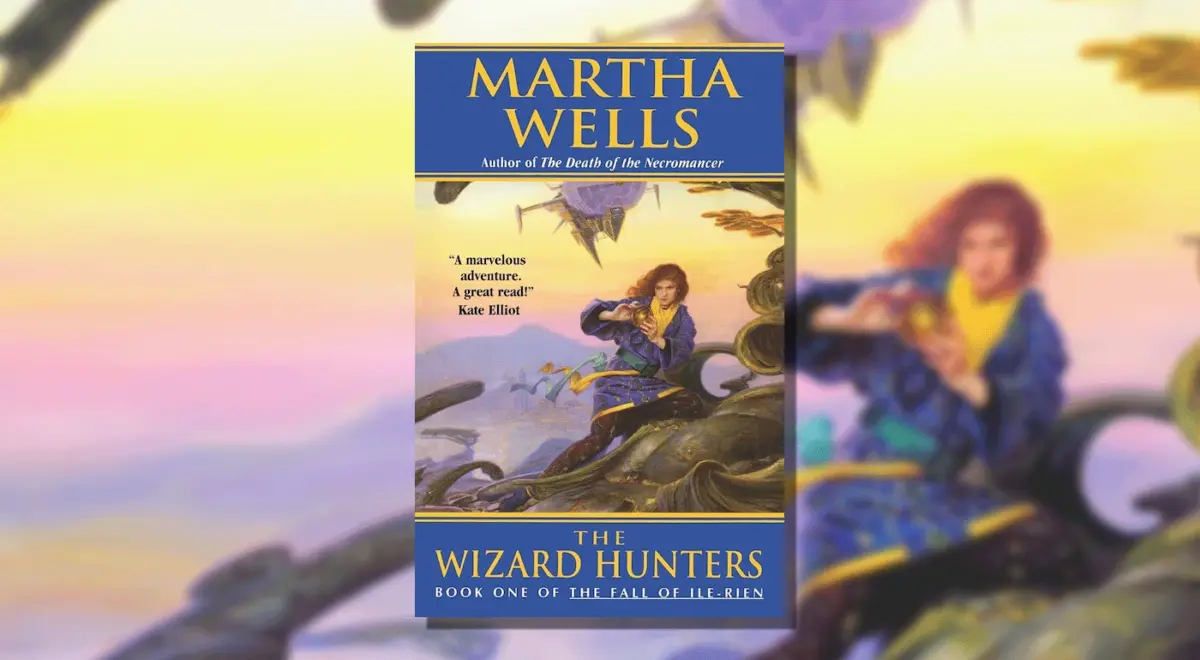
At the center of this ongoing literary retrospective is The Wizard Hunters, a pivotal novel that bridges the gap between classic swashbuckling fantasy and a harrowing, World War II-inflected war narrative. The realm of Ile-Rien stands on the precipice of total annihilation, locked in an existential conflict against a ruthless, technologically advanced imperial force known only as the Gardier. With neighboring countries already entirely depopulated and vanished without a trace, Ile-Rien’s survival hinges on desperate measures, unlikely alliances, and the traversal of dimensional boundaries.
This critical review explores the structural mechanics, thematic resonance, character dynamics, and multiverse implications of The Wizard Hunters. By following the intersecting paths of Tremaine—a war-weary survivor carrying a profound personal legacy—and Ilias, a Bronze Age islander fighting for his people’s survival, Wells crafts a narrative that is as morally complex as it is gripping. Furthermore, this analysis examines the audiobook adaptation, the evolving queer representation within Wells’ bibliography, and the tantalizing connections that span her entire literary corpus, setting the stage for the next installment in the series, The Ships of Air.
Read Also
Detailed Chronology and Narrative Mechanics
The Fall of Ile-Rien and the Gardier Threat
The socio-political reality of Ile-Rien at the outset of The Wizard Hunters is one of terminal decline. The nation is locked in a desperate, asymmetric war against the Gardier—an inscrutable empire driven solely by territorial conquest and backed by terrifyingly advanced warfare technology. Other nations in this shared world have already fallen, their populations wiped out or completely vanished under the yoke of the invaders.
The historical weight of this struggle is deeply personal for the novel’s protagonist, Tremaine. As the daughter of Madeline and Nicholas—beloved figures from Wells’ earlier work, The Death of the Necromancer—Tremaine bears the invisible scars of a ruined legacy. Madeline is dead; Nicholas and Arisilde are missing, presumed dead following a catastrophic incident involving one of the volatile alchemical spheres created by "Uncle Ari" years prior.
The progression of the Ile-Rien setting across Wells’ bibliography mirrors human technological history: The Element of Fire evoked a 17th-century France aesthetic, while later installments shifted toward the late 19th and early 20th centuries. The Wizard Hunters shifts tones once more, operating as a dark, striking parallel for World War II, with the Gardier stepping seamlessly into the role of totalitarian conquerors.
The Spark of Resistance and Dimensional Transgression
Worn down by relentless conflict and personal loss, Tremaine is initially characterized by a heavy, palpable weariness, teetering on the edge of suicidal ideation. Yet, before she can determine her own exit, she is abruptly summoned to resistance headquarters. A clandestine, high-stakes plot to strike directly at the heart of the Gardier war machine is underway.
Naturally, things go catastrophically awry. The botched operation plunges Tremaine, a wizard named Florian, and several resistance operatives across dimensional boundaries, stranding them in an entirely separate world—the homeland of Ilias.
Concurrently, Ilias and his closest companion, Giliead, are fighting a desperate battle of their own to save their people from the encroaching Gardier. Culturally analogous to a Bronze Age Celtic society, Ilias’s people are viewed by the Gardier as little more than primitive beings fit only for manual labor. To the citizens of Ile-Rien, conversely, they are romanticized as "noble savages."
While Tremaine and Florian treat the islanders closer to equals, their perspective is still subtly skewed, viewing their own culture as the civilized center and Ilias’s society as a charming deviation. Nevertheless, this second world is far from a simple pastoral idyll; it is just as messy, politically fractured, and culturally complex as Ile-Rien itself.

The Staging Ground and the Arisilde Spheres
It soon becomes apparent that the Gardier have been utilizing Ilias’s island chain as a strategic staging ground for their ongoing assault on Ile-Rien, exploiting magic to cross freely between dimensions. For Tremaine and Ilias, interdimensional transit relies on a dwindling, precious resource: the last remaining Arisilde sphere.
Much of the novel’s narrative momentum is driven by our protagonists traversing back and forth between the two worlds. They engage in perilous infiltration and escape missions centered around a sprawling cave system where the Gardier have holed up, enslaving captives harvested from both realms. Within these dark depths, the narrative uncovers a horrifying revelation regarding the fate of magic-wielding individuals captured by the Gardier—a dark discovery that simultaneously offers crucial clues about the long-lost Arisilde. The novel culminates not in a definitive victory, but in a temporary, hard-fought setback for the Gardier, leaving the overarching war raging on.
Supporting Context, Character Dynamics, and Adaptations
Character Evolution: Gender Dynamics and Representation
One of the most striking evolutionary leaps in The Wizard Hunters compared to its predecessors is its handling of protagonist agency. Earlier entries in the sequence occasionally suffered from centering mediocre male protagonists while sidelining far more dynamic, capable women. The Wizard Hunters permanently corrects this imbalance.
Tremaine is an exceptionally written protagonist—brash, deeply flawed, emotionally battered, and fiercely competent. Ilias matches her intensity, avoiding the lazy trope of being a primary character purely by virtue of his gender; Wells forces him to earn every ounce of his narrative weight. Their relationship develops on solid, refreshing platonic grounds, avoiding rushed romantic entanglements in favor of deep mutual respect and camaraderie.
The Audiobook Experience
The audiobook adaptation, narrated by Talmadge Ragan, delivers a mixed yet ultimately successful listening experience. While Ragan’s pacing and atmospheric tone capture the gravity of Wells’ prose, the production’s primary shortcoming lies in its character voice differentiation. Because the vocal distinctions between members of Wells’ expansive cast list are occasionally flat and uniform, listeners can occasionally find it challenging to track who is speaking during crowded dialogue scenes. However, the underlying strength of the plot, the vivid worldbuilding, and the compelling character interactions easily compensate for this hurdle, ensuring that the listener remains fully engaged through the trilogy’s conclusion.
Queer Representation and Literary Persistence
A vital contextual element enriching the appreciation of The Wizard Hunters is the ongoing evolution of LGBTQ+ representation in Martha Wells’ bibliography. This is powerfully illustrated through the character of Reynard.
As detailed in Wells’ 2011 essay, “Don’t Let Them Take Your Reynards,” a copy editor once attempted to excise all mentions of Reynard from an early draft of The Wizard Hunters after it became clear the character was gay. Wells steadfastly pushed back against this editorial overreach, preserving the character’s integrity. Looking back, this defense highlights Wells’ pioneering commitment to inclusive speculative fiction—a commitment that has only deepened throughout her celebrated career.
Intertextual Connections and the Martha Wells Multiverse
Reading the breadth of Martha Wells’ collected works reveals a web of thematic and structural crossovers that suggest a grand, unifying creative ecosystem—an unofficial "Martha Wells Multiverse" akin to Brandon Sanderson’s Cosmere.
- The Rising World Parallels: The Gardier share striking institutional and tactical similarities with the Hierarchs from the Rising World series. The rebellions led by characters attempting to dismantle the Hierarchs mirror the revolutionary mechanics found in the team-ups between Tremaine and Ilias.
- The Emilie Adventures Blueprint: The Wizard Hunters clearly laid structural groundwork for the Emilie Adventures duology. Elements such as airships, aether technology, cross-dimensional migration for political support, and the pairing of a resourceful, overlooked woman with an out-of-his-depth traveler are all present here.
- Archetypal Echoes: Tremaine carries distinct character DNA reminiscent of Mensah from The Murderbot Diaries, while Ilias shares emotional and cultural touchstones with Jade (Books of the Raksura), Kennar (Emilie Adventures), and Ziede (Rising World). While these connections exist largely in the realm of enthusiastic fan headcanon, they underscore the consistency of Wells’ core thematic fascinations: autonomy, systemic oppression, and resilient human (and non-human) agency.
Future Outlook: Entering The Ships of Air
As the dust settles on the immediate skirmishes of The Wizard Hunters, the overarching conflict in Ile-Rien remains unresolved, and the shadow of the Gardier looms larger than ever. The saga of Ile-Rien continues with the second book in the sequence, The Ships of Air.
Approaching this next installment with a completely clean slate—eschewing jacket copy, promotional synopses, and pre-release reviews—promises an unadulterated narrative experience. Whether the narrative will maintain its dual focus on Tremaine and Ilias or expand its horizons into entirely new theaters of war remains to be seen. What is certain, however, is that Martha Wells has constructed a masterclass in cross-genre speculative fiction, proving that even in the face of insurmountable odds, the human spirit—complex, scarred, and relentlessly defiant—refuses to vanish quietly into the dark.


Comments
Facebook App ID not configured. Please add it in the Customizer.