
Executive Overview
For nearly thirty years, Audible has stood as the undisputed titan of the audiobook industry, transforming how humanity consumes literature. From the early days of bulky cassette tapes and compact discs to the frictionless ubiquity of cloud-based streaming and mobile apps, the company has continuously redefined what it means to "read" with one’s ears. Yet, despite monumental leaps in mobile technology and high-definition audio codecs, the core mechanic of audiobook consumption has remained fundamentally unchanged: a passive, linear stream of sound played through headphones or speakers.
That paradigm is now shifting dramatically.
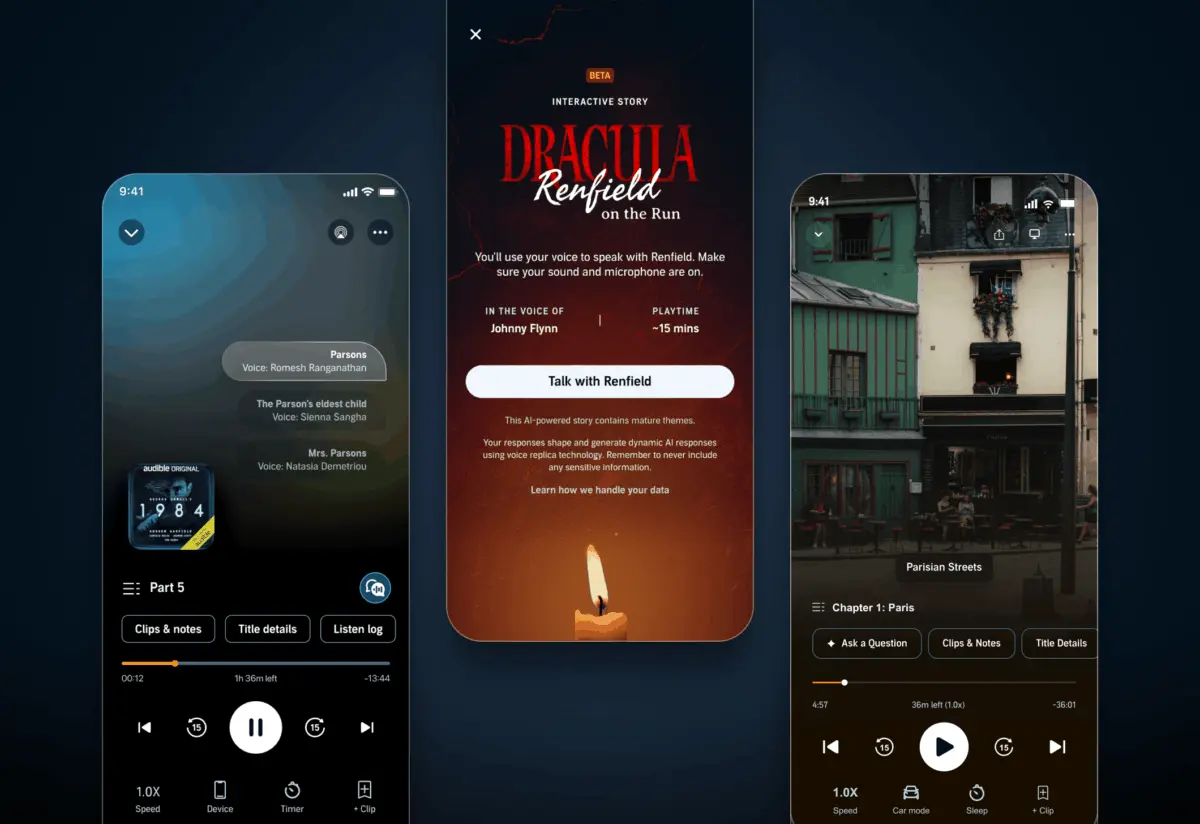
In a move that signals the next evolutionary phase of digital publishing, Audible has announced a suite of three groundbreaking, artificial intelligence-powered features designed to drag the traditional audiobook out of the passive listening era and into an interactive, multimedia dimension. Rolling out initially as a limited beta for users in the United States and the United Kingdom, these new additions—Character Guide, Interactive Stories, and Visual Explorer—allow listeners to untangle complex casts of characters, hold real-time conversations with fictional personas, and visually traverse the geographical and historical landscapes of the stories they consume.
Read Also
Developed in close collaboration with authors, narrators, and creators, these AI-driven tools represent a strategic balancing act. On one hand, Audible is leaning aggressively into cutting-edge technology to capture the shifting consumption habits of younger, digitally native demographics who crave gamification and deep immersion. On the other hand, company executives are taking pains to emphasize that these features are meant to complement, rather than replace, the human artistry of the narrator.
As this limited beta rolls out, the broader publishing and tech industries are watching closely. Will these tools unlock unprecedented levels of engagement, or will they distract from the pure, unadulterated intimacy of the spoken word? To understand the magnitude of this shift, one must examine the architecture of these new features, the strategic motivations driving Audible’s leadership, and the broader implications for the future of literary storytelling.
Detailed Chronology & Feature Breakdown: What’s New in the Audible Ecosystem
The announcement of Audible’s new features did not happen in a vacuum; it is the culmination of years of quiet research into machine learning, natural language processing, and generative AI audio models. By integrating these technologies directly into the user interface of its mobile application, Audible is transforming its software from a simple media player into a dynamic, context-aware reading companion.
Here is a detailed breakdown of the three features anchoring this new rollout:
1. Character Guide: Untangling Complex Casts
Every avid reader of sprawling fantasy epics, dense historical non-fiction, or labyrinthine Russian literature knows the frustration of losing track of a character who suddenly reappears three chapters later. In traditional audiobooks, resolving this confusion requires frantic rewinding or consulting external Wikis.
Audible’s new Character Guide solves this friction point directly within the app. Powered by AI that analyzes the text and dialogue cues of a book, the Character Guide provides listeners with an interactive roster. When activated, the interface can display who is currently speaking, offer brief background biographies, and map out relational dynamics between different figures in the narrative. For works featuring massive ensembles—such as George R.R. Martin’s Westeros or Leo Tolstoy’s War and Peace—this feature acts as an intelligent, real-time index that eliminates cognitive fatigue and keeps the listener anchored in the narrative flow.
2. Interactive Stories: Dialogue with Darkness (and Beyond)
Perhaps the most radical—and bound to be the most debated—of the three features is Interactive Stories. Moving far beyond static playback, this tool introduces conversational AI capabilities that allow listeners to literally talk with characters in real time.
During the beta rollout, Audible has showcased this feature using classic texts, notably Bram Stoker’s Dracula. Through the app interface, users can step outside the linear narrative boundaries to converse with characters about their motivations, fears, or the unfolding plot events. Using advanced conversational models trained on the specific tone, voice, and historical context of the text, these interactive characters respond dynamically to user prompts.
For younger demographics and fans of interactive fiction—such as Choose Your Own Adventure novels or text-based RPGs—this transforms the audiobook from a broadcast medium into a participatory sandbox. It bridges the gap between traditional reading and modern gaming, inviting audiences to inhabit the psychological space of the literary world rather than merely observing it from the outside.
3. Visual Explorer: Mapping the World Behind the Story
Literature is inherently spatial. Whether it is a meticulous mapping of Middle-earth, the foggy streets of Victorian London, or the sun-drenched boulevards of a Parisian crime thriller, settings are characters unto themselves. Yet, audiobook listeners have historically been deprived of the cartographic and photographic aids often printed on the endpapers of physical books.
The Visual Explorer redresses this imbalance by systematically surfacing maps, historical imagery, architectural blueprints, and photographic context directly within the app interface as the story progresses. If a chapter transports the listener to a specific street corner in Paris during a specific decade, Visual Explorer pulls relevant, era-appropriate imagery and layout maps into a sleek, dark-mode-compatible side panel. By synchronizing visual metadata with audio timestamps, Audible is creating a multi-sensory environment that honors the rich world-building efforts of authors.
Supporting Context & Strategic Metrics: Why Now?
To fully grasp the timing and intent behind Audible’s announcement, one must analyze the broader macroeconomic and demographic shifts currently reshaping the entertainment and publishing sectors.

For the past decade, the audiobook market has enjoyed uninterrupted, explosive growth. According to industry tracking by the Audio Publishers Association (APA), audiobook sales in the United States alone have consistently posted double-digit year-over-year gains, making audio one of the few bright spots in traditional publishing revenue models. However, this growth has brought new challenges. The market is increasingly saturated, and consumer attention spans are fiercely contested by a panoply of digital diversions: podcasts, short-form video apps like TikTok, subscription video-on-demand services, and immersive video games.
Audible’s parent company, Amazon, recognizes that maintaining market dominance requires capturing the attention of Gen Z and younger millennial cohorts. These demographics consume media differently than previous generations; they expect interactivity, personalization, and multi-platform integration.
Furthermore, the integration of artificial intelligence into creative industries has been a fraught, highly contentious topic. Creators—including authors, voice actors, and translators—have expressed legitimate fears regarding AI voice cloning, copyright infringement, and the devaluation of human labor. By explicitly framing these three new features as collaborative tools built with creators rather than against them, Audible is attempting to chart a diplomatic course through the AI revolution.
By grounding the AI in structural metadata, character definitions, and supplementary visuals rather than wholesale synthetic voice generation for entire books, Audible is carefully avoiding the landmines of the voice-cloning debate. Instead, they are positioning AI not as a replacement for the narrator, but as a sophisticated digital docent guiding the listener through the author’s universe.
Official Statements: The Visionaries Speak
Leadership at Audible has been vocal about the philosophical and strategic foundations underpinning this release. The company is framing the rollout not merely as a software update, but as a philosophical milestone in a nearly thirty-year corporate history.
Rachel Ghiazza, Chief Content Officer at Audible, emphasized the experiential leap these features represent:
"These new features invite listeners into a story in ways that simply weren’t possible before, marking the latest step in our nearly 30-year journey to push audio storytelling forward. We’re excited to build on these while working hand in hand with creators, because we know that more time spent with stories benefits everyone who helps bring them to life."
Ghiazza’s emphasis on creator collaboration is a calculated and necessary reassurance. As publishers grapple with how generative AI will alter the landscape of copyright and compensation, ensuring that authors and rights-holders see tangible value—and perhaps eventually, expanded licensing opportunities—from interactive adaptations will be crucial for long-term adoption.
Echoing these sentiments from a product and engineering perspective, Andy Tsao, Chief Product and Analytics Officer at Audible, pointed directly to shifting consumer habits and the demands of modern media consumption:
"Audible continues to be the premier destination for audio storytelling. We are always innovating new ways to deepen customers’ engagement as they listen. In this case, AI is allowing us to create new interactive experiences that today’s listeners, especially younger audiences, are craving."
Tsao’s comments lay bare the core commercial imperative: survival and growth in an attention economy require evolution. By marrying the timeless intimacy of spoken-word performance with the dynamic responsiveness of artificial intelligence, Audible is betting that the future of reading is not a choice between text, audio, and software, but a seamless convergence of all three.
Future Outlook: Challenges and Horizons Ahead
As Audible’s limited beta rolls out to select users across the U.S. and U.K., the immediate future will be defined by iteration, observation, and rigorous testing. The company has explicitly stated that the features will evolve based on feedback from both customers and creators. This iterative approach is wise, given the uncharted waters of interactive audiobooks.
Several critical questions remain for the months ahead:
- Creator Buy-In and Compensation: While Audible has emphasized collaboration, the financial and creative terms for authors whose works are adapted into interactive AI environments remain to be fully detailed. Will authors have editorial control over how their characters converse via the Interactive Stories feature? Will they receive additional royalties for interactive engagement?
- Purist Resistance vs. Mass Adoption: The traditional audiobook community is notoriously passionate and protective of the medium’s purity. Many listeners cherish audiobooks precisely because they offer an escape from screens, notifications, and interactive clutter. Features like Visual Explorer and Interactive Stories—which inherently encourage screen-checking and active typing—may face pushback from purists who prefer the traditional, eyes-closed listening experience. Audible will need to ensure these features remain strictly opt-in and non-intrusive.
- Technical Scalability and Accuracy: Generating real-time conversational models that accurately reflect the intricate psychology and voice of complex literary characters without hallucinating plot points or breaking historical immersion is a monumental engineering challenge. How Audible scales these features across millions of titles—beyond public domain classics like Dracula—will test the limits of their underlying machine learning architecture.
Despite these hurdles, the release of Character Guide, Interactive Stories, and Visual Explorer marks a watershed moment for the audiobook industry. Audible is no longer content to simply digitize the printed page into an audio file. By harnessing the power of artificial intelligence, they are beginning to construct living, breathing literary ecosystems where listeners can look behind the curtain, converse with the cast, and explore the geography of human imagination in real time.
As the beta feedback trickles in and the technology matures, one thing is certain: the way humanity interacts with stories will never be the same.





Comments
Facebook App ID not configured. Please add it in the Customizer.