The rapid, unbridled democratization of generative artificial intelligence has fundamentally altered the landscape of digital media, giving rise to an insidious epidemic of non-consensual sexualized imagery that disproportionately targets women. This dark frontier of technological advancement recently ensnared prominent Indian cinematic actor Janhvi Kapoor, whose likeness from the 2024 blockbuster Devara: Part 1 was weaponized into a sexually explicit deepfake video. The manipulated clip, which rapidly cascaded across unregulated social media networks, has catalyzed a fierce reckoning within the South Asian entertainment sector regarding the absolute necessity of robust legal safeguards, corporate accountability, and fundamental ethical boundaries in the age of synthetic media.
In a powerful and searing public statement released via her Instagram platform, Kapoor moved past the immediate injury to herself, framing the incident not merely as an isolated act of cyber-harassment, but as a symptom of a much deeper, systemic rot. She underscored that the unauthorized manipulation of a woman’s physical likeness via digital algorithms constitutes a profound violation, one that borders dangerously on sexual assault. By drawing a direct line between physical bodily autonomy and its digital corollary, Kapoor has re-ignited a global discourse on the weaponization of technology against women.
Her public condemnation was met with solidarity from key figures within the industry, most notably her Devara co-star, Tollywood megastar Jr NTR, who pledged aggressive legal remediation against the creators and distributors of the fabricated material. However, beyond the specifics of the Kapoor controversy lies an ominous portent: as neural network tools become increasingly sophisticated, cheaper, and more accessible to the general public, the digital sphere is transforming into an unregulated panopticon where women’s bodily autonomy is systematically dissolved by lines of code. This report offers an exhaustive examination of the incident, the broader socio-technological implications of AI abuse, the failure of existing legislative frameworks, and the urgent imperatives required to secure the digital frontier against systemic exploitation.
Detailed Chronology: The Devara Manipulation and Digital Cascade
The genesis of the controversy traces back to the theatrical and digital run of Devara: Part 1, an epic action drama starring Jr NTR and Janhvi Kapoor. The film’s chart-topping musical track, Chuttamalle, achieved viral ubiquity across the Indian subcontinent and global diaspora markets, accumulating hundreds of millions of views. Kapoor’s visual presentation in the song—characterized by vibrant choreography and traditional styling—became deeply embedded in popular culture, inadvertently priming her likeness to be harvested by bad actors utilizing advanced generative models.
Sometime prior to Kapoor’s public intervention, an anonymous actor utilizing open-source or commercial deepfake software extracted high-definition video frames of Kapoor from Chuttamalle. Utilizing deep-learning algorithms—specifically architectures like face-swapping generative adversarial networks (GANs)—the perpetrators mapped Kapoor’s facial features onto explicit, non-consensual pornographic source material. This synthetically generated video was then systematically injected into digital circulation channels, traversing fringe forums before leaking into mainstream messaging apps and algorithmic social media feeds.
The velocity of the video’s dissemination highlights the structural vulnerabilities of modern content platforms. Unlike traditional media, which moves through verified editorial choke points, deepfake media leverages platform algorithms optimized for high engagement, shock value, and emotional outrage. The illicit clip quickly garnered thousands of views, shares, and commentary loops before digital rights monitors and fans flagged the material.
Upon becoming aware of the digital forgery, Kapoor did not remain silent. Opting for a direct, unmediated communication strategy, she published a comprehensive statement on her verified social media channels. Breaking her silence, Kapoor articulated the visceral terror and psychological trauma associated with having one’s identity misappropriated for sexual gratification. Her intervention shifted the narrative from a localized celebrity gossip item to a systemic institutional failure.
Shortly after Kapoor’s statement resonated across digital ecosystems, Jr NTR stepped forward to denounce the fabrication. Breaking ranks with a historically silent male-dominated cadre in Indian cinema, Jr NTR not only issued a scathing condemnation of the perpetrators but actively committed his legal and institutional resources to track down, unmask, and prosecute those responsible for generating and amplifying the deepfake. This rare display of cross-gender industry solidarity provided crucial momentum, compelling regulatory bodies, fan clubs, and digital platforms to temporarily stem the flow of the illicit material. Yet, security experts note that the decentralized nature of the internet ensures that once digital media is seeded, eradication is practically impossible—leaving the victim to grapple with permanent digital shadow-boxing.
Supporting Context & Metrics: The Global and Regional Deepfake Epidemic
To fully comprehend the gravity of Janhvi Kapoor’s ordeal, one must contextualize it within the grim statistical reality of the global deepfake phenomenon. While synthetic media encompasses benign applications in entertainment, marketing, and education, its darker iteration—Non-Consensual Sexual Imagery (NCSI)—has experienced exponential, unchecked growth over the past half-decade.
The Statistics of Digital Violence
Exponential Growth in Volume: According to leading cyber-intelligence and digital forensics firms, the volume of online deepfake pornography grew by an estimated 550% globally between 2019 and 2024. Platforms specializing in hosting AI-generated pornography routinely log tens of millions of visits monthly.
Disproportionate Gender Impact: Research conducted by digital safety coalitions indicates that an overwhelming majority—approximately 96% to 99%—of all deepfake pornography targets women. The primary victims are not merely high-profile celebrities like politicians, musicians, and actors, but increasingly private citizens, journalists, and students targeted through peer-to-peer harassment.
The Celebrity Target Matrix: In the Indian entertainment industry, female actors have become prime targets for malicious AI manipulation due to their hyper-visible public profiles, which provide millions of high-resolution image frames necessary for training deep-learning models. Previous high-profile incidents involving actors such as Rashmika Mandanna, Katrina Kaif, and Priyanka Chopra demonstrate that Kapoor’s experience is part of an organized, systemic assault on women in the public eye.
[Deepfake Victim Demographics Breakdown]
├── Female Celebrities & Public Figures: ~65%
├── Private Citizens (Non-consensual revenge porn/harassment): ~31%
└── Male Public Figures / Others: <4%
The Technological Enablers
The democratization of AI tools has lowered the technical barrier to entry from a high-level computer science discipline to a consumer-grade hobby. Open-source repositories on platforms like GitHub provide turnkey scripts that allow individuals with rudimentary technical literacy to synthesize hyper-realistic video and audio for minimal financial cost. Cloud-based GPU (Graphics Processing Unit) rentals enable bad actors to render complex face-swaps in a matter of hours, bypassing the need for expensive, specialized hardware.
Furthermore, social media business models inadvertently incentivize the proliferation of such content. Algorithms designed to maximize user retention and engagement frequently promote controversial, sensational, or shocking media, allowing deepfakes to spread virally before automated moderation tools can intervene. By the time platforms execute content-removal protocols, the damage to the victim’s psychological well-being, reputation, and personal boundaries has already been permanently inflicted.
Official Statements and Industry Reactions
The fallout from the Devara footage manipulation has galvanized various stakeholders across the Indian film fraternity, legal domains, and civil society, drawing sharp commentary on the inadequacy of current institutional protections.
Janhvi Kapoor’s Manifesto on Bodily Autonomy
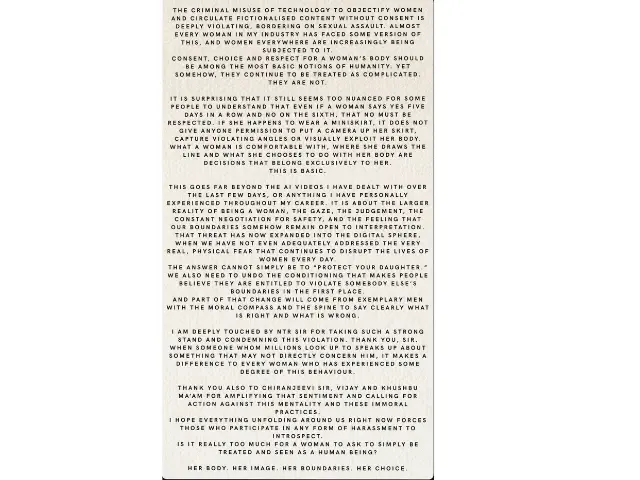
In her widely circulated Instagram statement, Kapoor articulated a profound philosophical and sociological critique of the digital age. Her words serve as an authoritative benchmark for how victims of algorithmic abuse view their predicament:
"The criminal misuse of technology to objectify women and circulating fictionalised content without consent is deeply violating, bordering on sexual assault. Almost every woman in my industry has faced some version of this. And women everywhere are increasingly being subjected to it."
Kapoor decisively dismantled the victim-blaming narratives that often plague discussions of digital harassment. She stressed that consent is absolute, non-negotiable, and entirely divorced from a woman’s career choices, sartorial selections, or public presence:
"It is about the larger reality of being a woman. The gaze, the judgement, the constant negotiation for safety and the feelings that our boundaries somehow remain open to interpretation. That threat has now expanded into the digital sphere."
Concluding her address with an urgent plea for introspection, Kapoor challenged both perpetrators and passive consumers of illicit media to re-evaluate their fundamental conception of human dignity:
"I hope everything unfolding around us right now forces those who participate in any form of harassment to introspect. Is it really too much for a woman to ask to simply be treated and seen as a human being? Her body, her image, her boundaries, her choice."
Industry Solidarity and Legal Mobilization
The intervention of Jr NTR marked a crucial departure from past industry norms, where victims of harassment were often advised by public relations teams to maintain silence to avoid drawing further attention to illicit material. By publicly committing to criminal prosecution, Jr NTR established a vital precedent:
"This is not merely a technical glitch or an internet prank; it is a malicious criminal act designed to violate and intimidate. We will pursue every legal avenue available under the law to ensure that those who create, distribute, and consume this garbage face the full force of judicial consequences."
Legal experts and cyber-crime units across India have praised this assertive posture, noting that swift legal action is the only immediate deterrent capable of checking the otherwise unbridled momentum of generative AI abuse. Industry guilds, including the Producers Guild of India and various actors’ associations, have subsequently convened emergency panels to draft comprehensive digital safety protocols, establish dedicated legal task forces, and lobby government ministries for structural legislative interventions.
Future Outlook: Securing the Digital Frontier
As artificial intelligence continues its relentless march toward artificial general intelligence (AGI), the incident involving Janhvi Kapoor must be treated as a watershed moment rather than an isolated anomaly. Safeguarding human dignity, privacy, and bodily autonomy in the digital era will require a multi-pronged, uncompromising strategy spanning legislative reform, technological innovation, and cultural re-education.
1. Legislative Overhauls and Strict Enforcement
Existing legal frameworks—both in India (such as the Information Technology Act and the Bharatiya Nyaya Sanhita) and internationally—are often too reactive, fragmented, and ill-equipped to address the nuanced velocities of generative AI. Jurisdictions must enact specific, stringent legislation criminalizing the creation, distribution, and monetization of non-consensual deepfake pornography with mandatory, non-bailable custodial sentences. Furthermore, liability must be extended beyond the primary creators to include platforms that fail to implement proactive, real-time filtering mechanisms.
2. Technological Countermeasures and Watermarking
Tech conglomerates and AI developers bear a profound ethical obligation to build safety guardrails directly into their foundational models. The implementation of cryptographic watermarking, provenance tracking (such as C2PA standards), and mandatory biometric friction checks can trace digital media back to its verified source. Open-source developers must be held to ethical standards that restrict the deployment of face-swapping and nudity-generation modules without verified, cryptographic consent tokens from all depicted individuals.
3. Platform Accountability and Algorithmic Reform
Social media giants and hosting services must transition from passive intermediaries to active guardians of public safety. This entails abandoning business models that profit from outrage-driven engagement metrics. Platforms must invest heavily in advanced neural moderation tools capable of detecting synthetic media anomalies within seconds of upload, coupled with zero-tolerance enforcement policies that permanently ban repeat offenders and IP addresses associated with the production of abusive content.
4. Cultural Re-Education and Societal Introspection
Ultimately, as Kapoor eloquently noted, technology is merely a mirror reflecting the underlying pathologies of human society. The deepfake crisis cannot be solved by code alone; it requires a generational shift in how consent, respect, and human boundaries are understood. Educational curricula must integrate digital literacy and cyber-ethics from an early age, teaching young minds that digital spaces are extensions of physical reality where harassment, objectification, and the violation of personal autonomy carry profound, real-world consequences.
The digital exploitation of Janhvi Kapoor is a stark reminder that the frontier of technological progress is fraught with moral peril. If society fails to establish impenetrable legal, ethical, and technical boundaries today, the virtual domain will permanently devolve into a lawless wasteland where no individual—regardless of fame, power, or privilege—can claim ownership over their own identity, body, or life.






Comments
Facebook App ID not configured. Please add it in the Customizer.