
Executive Overview
In the heart of Albania’s capital, amid the smoldering wreckage of tear gas canisters, shattered glass, and the lingering acrid scent of Molotov cocktails, a single abandoned shoe has become the most potent symbol of civil unrest in the Balkans. The poem "I Am a Sneaker Left Behind in the Protest Square," penned and translated by dissident Albanian writer Arlinda Guma, captures the brutal realities of the ongoing street battles in Tirana. Published in October 2026, the work has transcended its literary origins to function as an international manifesto against systemic corruption, unbridled crony capitalism, and severe state-sanctioned violence.
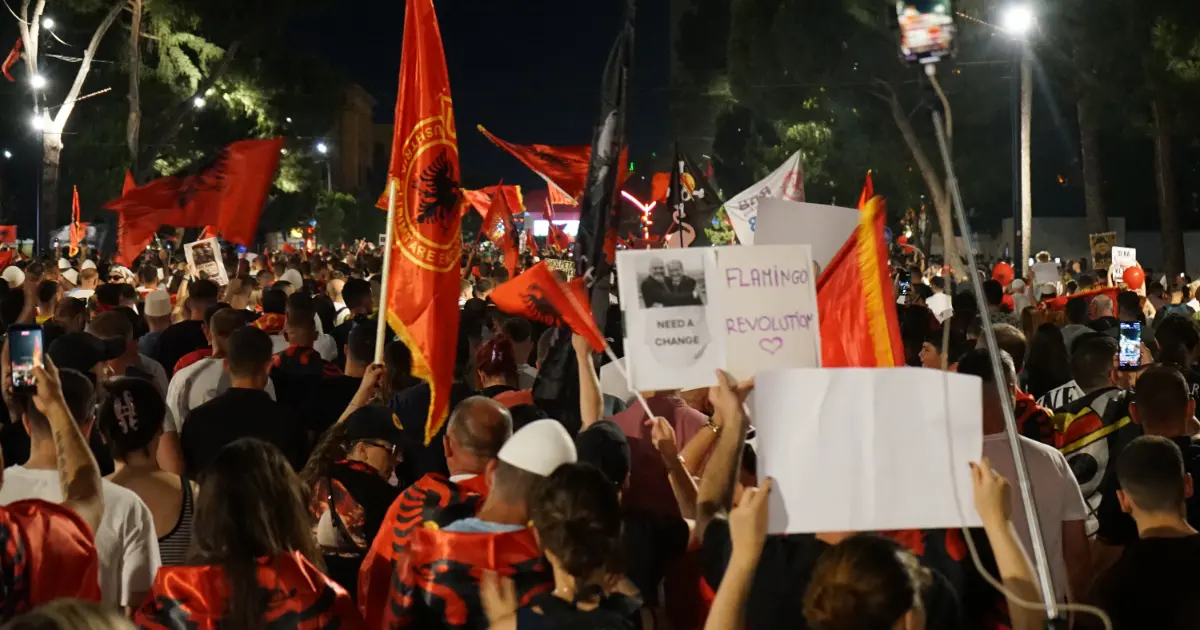
The protests—colloquially dubbed the "Flamingo Revolution"—began as an environmental and anti-corruption movement sparked by the controversial privatization and handover of a protected ecological sanctuary to foreign commercial developers. What started as months of disciplined, peaceful civil disobedience has devolved into intense urban warfare. The catalyst for this escalation was the government’s uncompromising refusal to address public grievances, culminating in severe police crackdowns that have left dozens hospitalized, journalists targeted, and fundamental democratic norms suspended.
Through the lens of Guma’s allegorical poem—read aloud in its native Albanian and shared across digital platforms worldwide—this report examines the deep-seated socioeconomic grievances fueling the unrest in Tirana. It investigates the catalyst events involving high-profile foreign investments, details the brutal escalation of state force, and analyzes the broader implications of a government turning its security apparatus against its own citizenry.
Read Also
Detailed Chronology: From Ecological Sanctuary to Urban Battlefield
To understand the current state of siege in Tirana, one must trace the timeline of civil discontent that transformed a quiet conservation area into a front line of resistance.
Phase 1: The Seizure of the Sanctuary (Early 2026)
The seeds of the Flamingo Revolution were sown months prior to the autumn street clashes. Public outrage erupted when the administration of Prime Minister Edi Rama finalized a controversial deal transferring a pristine island and ecologically vital lagoon—historically protected as a natural reserve and a critical sanctuary for migratory flamingos—to high-profile foreign developers, notably linked to American investor Jared Kushner.
Local landowners and environmental advocates immediately contested the legality of the transfer. When rightful landowners attempted to access and defend their ancestral properties, they were physically removed and dragged away by private security forces operating with apparent impunity and state backing. For many Albanians, this was not merely an environmental loss, but a stark illustration of elite kleptocracy: public resources traded away to enrich foreign interests and domestic power-brokers, bypassing democratic oversight entirely.
Phase 2: Months of Peaceful Disillusionment
Initially, the opposition organized under the banner of the Flamingo Revolution channeled public anger into structured, peaceful demonstrations. For weeks, thousands of citizens gathered outside the Prime Minister’s office in central Tirana. They carried banners, chanted slogans, and utilized artistic and peaceful forms of civil disobedience.
Despite the massive turnout and the disciplined nature of the gatherings, the government maintained a posture of stone-walled silence. Official channels rebuffed petitions, dismissed investigative reports regarding the land transfer, and refused to engage in dialogue. By late summer, the realization that peaceful appeals to a consolidated administration yielded "zero results" created a volatile vacuum of despair and radicalized segments of the populace.
Phase 3: The Breaking Point and Urban Clashes (October 2026)
By October, the atmosphere in Tirana shifted irrevocably. Frustrated by months of institutional stone-walling, a fraction of the protests—predominantly desperate teenagers and radicalized youth—abandoned peaceful tactics. Paving stones were ripped from the streets to target the Prime Minister’s office, and municipal trash bins were set ablaze.
The state’s reaction was disproportionate and immediate. Riot police deployed tear gas, concussion grenades, and rubber bullets, turning central Tirana into an active conflict zone. As Guma’s poem vividly recounts, the violence did not discriminate between active combatants and bystanders: protesters were beaten into comas, police officers succumbed to exhaustion and hunger while operating under relentless stress, and ambulances transported injured citizens and wounded law enforcement personnel side-by-side.
Supporting Context & Metrics: The Anatomy of Crisis
The unrest in Tirana cannot be understood in a vacuum; it is the product of converging economic, political, and social pressures that have hollowed out the Albanian middle class.
Economic Disparities and the "Triumph" of Capitalism
Guma’s poem draws a direct line between the globalized supply chain of consumer goods and local political oppression. The sneaker left behind in the square was manufactured by underpaid women working in precarious sweatshops on daily wages, only to be marketed in luxury boutiques situated within tax-evading commercial towers.
Albania’s economic landscape has long been characterized by stark income inequality. While high-rise construction booms in Tirana—often fueled by questionable capital inflows and real estate money laundering—the average worker struggles with inflation, stagnant wages, and limited social mobility. The "curve of capitalist triumph" referenced in the text highlights a system where economic growth benefits a hyper-wealthy political elite while the working class is priced out of their own country, driving high rates of youth emigration.
The Erosion of Civic Space and Press Freedom
The crackdown extends far beyond physical violence in the streets. Author Arlinda Guma notes in her personal testimony that her name has been effectively scrubbed or excluded from official cultural directories due to her vocal dissent against the administration. This bureaucratic censorship reflects a broader trend of democratic regression in Albania.
- Media Control: Independent journalists covering the Flamingo Revolution have faced intimidation, physical obstruction by law enforcement, and targeted smear campaigns by pro-government media outlets.
- Civil Liberties: The right to peaceful assembly, guaranteed under the Albanian constitution, has been systematically undermined through preemptive police blockades, arbitrary detentions, and the militarization of public squares.
- Environmental Degradation: The fast-tracking of luxury tourism projects in protected zones demonstrates a systematic bypassing of environmental impact assessments and public consultations.
Official Statements and Institutional Responses
As the images of burning barricades and abandoned footwear circulate globally, the domestic and international reactions reveal a deep chasm between official narratives and ground-level realities.
The Government Narrative
Prime Minister Edi Rama’s administration has consistently characterized the protesters not as legitimate citizens airing grievances, but as "hooligans," "vandals," and political agitators manipulated by opposition parties seeking to destabilize the state. Official press releases emphasize the rule of law, condemning the destruction of public property and the use of violence against law enforcement officers.
Government spokespersons have defended the foreign investment deals, such as the lagoon development project, by framing them as essential drivers of economic modernization and tourism revenue that will place Albania on the international luxury map. Regarding allegations of excessive police force, the Ministry of the Interior maintains that security personnel acted with professional restraint under extreme provocation from rioters.
Independent Oversight and Civil Society Outcry
In stark contrast, human rights organizations, legal watchdogs, and international literary bodies have condemned the state’s heavy-handed tactics.
- Amnesty International and Local Monitors: Reports highlight numerous instances of arbitrary arrests, the use of expired or excessive tear gas in densely populated urban residential zones, and cases of detainees suffering physical abuse while in police custody.
- The Cultural Community: Writers’ associations across Europe have rallied behind Arlinda Guma and other silenced Albanian intellectuals. By transforming the physical debris of the protests—such as an abandoned sneaker—into a conceptual "art installation curated by history," the cultural vanguard has successfully reframed the uprising from a localized riot into an existential struggle for the soul of the nation.
Future Outlook: Whither the Flamingo Revolution?
As the smoke clears temporarily over Tirana, the long-term trajectory of the country remains precarious. Several critical indicators will determine whether Albania descends further into authoritarian containment or shifts toward democratic reform:
- The Sustainability of Resistance: The radicalization of the protests indicates that younger generations are losing faith in traditional, institutional opposition politics. Without genuine government concessions regarding environmental protections and anti-corruption measures, sporadic urban clashes are likely to persist.
- International Pressure: The involvement of high-profile foreign investors places Western allies—particularly the European Union, which assesses Albania’s accession progress—in a delicate diplomatic position. Continued reports of democratic backsliding and police brutality may force international bodies to tie financial aid and integration milestones more strictly to human rights performance.
- The Role of Culture and Dissident Voices: Works like Guma’s poem demonstrate that physical crackdowns cannot easily silence digital and artistic resistance. As long as the administration attempts to govern through intimidation and asset sell-offs, civil society will continue to find innovative ways to "throw poetry straight at the face of the world."
The sneaker left behind in the protest square stands as an enduring monument to this turbulent era—a silent, visceral witness to a nation caught between the machinery of global capital and the unyielding resilience of its people.



Comments
Facebook App ID not configured. Please add it in the Customizer.