
Executive Overview
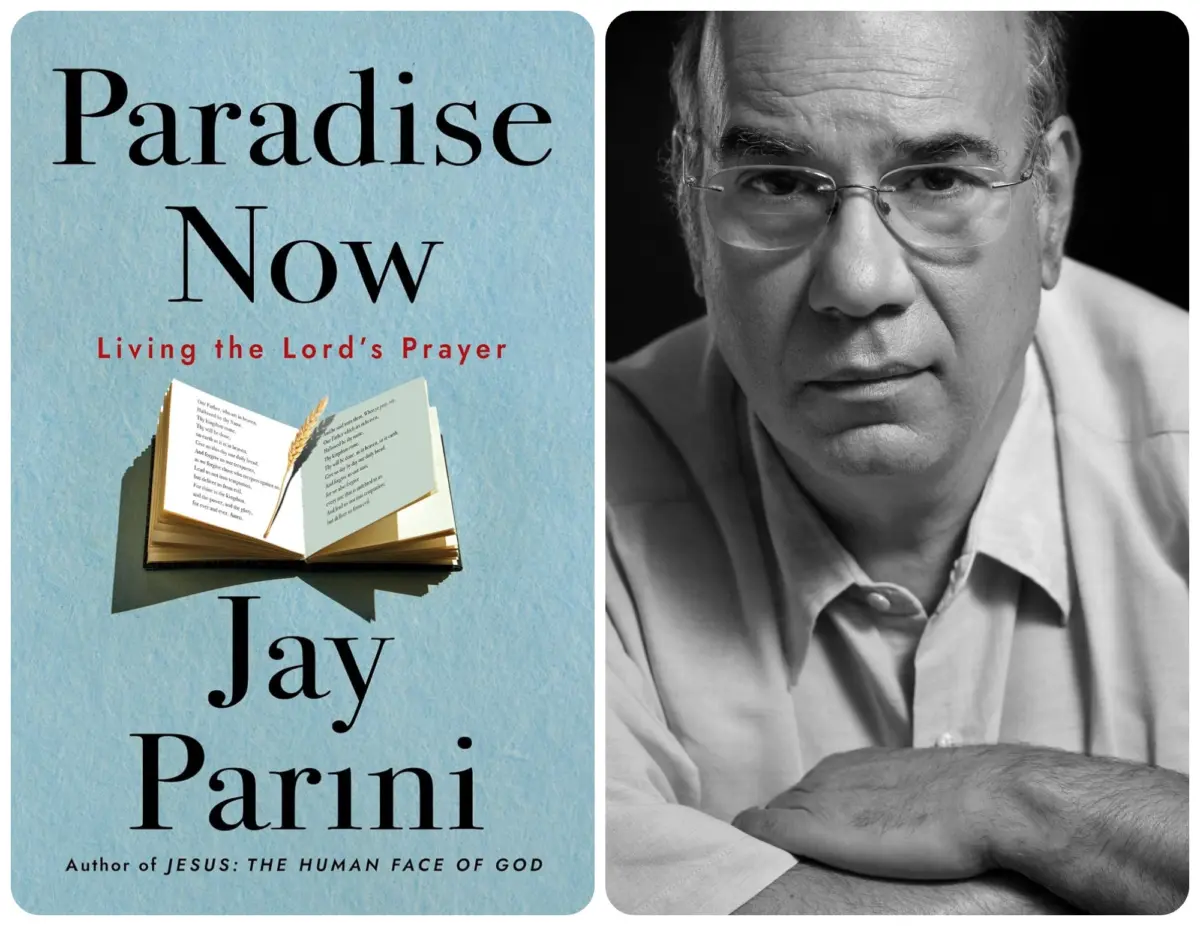
For half a century, acclaimed biographer, novelist, and poet Jay Parini has occupied a distinguished space in American letters. Best known for his deeply researched and critically lauded biographical fiction mapping the lives of literary and historical giants—including Gore Vidal, Leo Tolstoy, and Jesus of Nazareth—Parini has spent decades interpreting the complexities of the human spirit. Now, drawing from a rich well of fifty years dedicated to reading, writing, and teaching literature at elite institutions like Dartmouth College and Middlebury College, Parini is turning his formidable intellect toward a singular, foundational text of Western civilization: the Lord’s Prayer.
His new book, Paradise Now: Living the Lord’s Prayer (Morehouse, October), is not a work of dry theological scholarship or academic dogmatism. Instead, it is an intimate, expansive meditation that slows down a familiar, often-recited text to an almost microscopic degree. Utilizing a unique "collage-like" methodology, Parini weaves personal reflection with an eclectic chorus of voices drawn from the breadth of human thought, incorporating passages from literary titans and thinkers like William Shakespeare, poet Mary Oliver, and psychoanalyst Carl Jung.
In Paradise Now, Parini confronts a paradox at the heart of modern religious life: how a prayer repeated by millions across the globe daily can become so stripped of its vitality through rote memorization that its profound metaphysical and ethical depths are completely overlooked. By taking readers on a line-by-line tour through his own intellectual and spiritual journey, Parini aims to de-literalize antiquated religious dogmas and present the Lord’s Prayer not merely as a Christian liturgical formula, but as a universal, life-changing human text capable of speaking to believers, seekers, and even atheists alike.
Read Also
Detailed Chronology & Genesis of the Project
The conceptual roots of Paradise Now extend far beyond the immediate publishing cycle, stretching back across a decade of quiet intellectual labor. For ten years, the project sat quietly in the back of Parini’s mind, a persistent whisper that manifested as sporadic marginalia, notebooks filled with hasty observations, and cross-references scribbled during quiet moments of academic life.
The immediate catalyst for the book, however, arose from an uncomfortable personal realization about the nature of habit. Like countless individuals raised within the Christian tradition, Parini caught himself reciting the Lord’s Prayer on autopilot. The cadence of the words had become so deeply embedded in his muscular memory that he could rattle them off without engaging his cognitive faculties or his spiritual depth.
"I realized I was saying the prayer so quickly that I never really stopped to think about it," Parini reflects. "I would say it in a kind of rote fashion. So, I’m going to slow this down to an insane degree. It just shows you the levels of depth in that prayer."
By deliberately slowing down the recitation of the prayer—dragging out phrases that typically take mere seconds to utter into hours of contemplation—Parini opened up subterranean layers of meaning. This methodology mirrors his lifelong approach to literature. Just as a close reading of a Shakespearean sonnet or a Tolstoy novel yields new insights upon repeated visits, Parini discovered that Jesus’s foundational prayer possessed an infinite elasticity.
Over the decade-long gestation period, these notes accumulated into a substantial body of work. Parini did not set out to write a prescriptive guide or a polemical theological treatise. Rather, he allowed his decades of academic immersion in English literature, poetry, and theology to bleed into his meditations. The result is a text that developed organically over ten years, mirroring the slow, unhurried maturation of a scholar looking back over a lifetime of deep reading.
Supporting Context & Intellectual Influences
To understand the architecture of Paradise Now, one must examine the vast and varied intellectual landscape that Parini has inhabited for the past fifty years. His life as a reader has been intensely rigorous, marked by a ceaseless intellectual migration across historical eras, philosophical traditions, and religious boundaries.
At the core of Parini’s spiritual and literary framework are the foundational texts of Western monotheism. He speaks fluently of his continuous return to Saint Augustine’s introspective brilliance, the canonical scriptures of the Hebrew Bible and the New Testament, and the scholastic philosophy of Thomas Aquinas. Yet, Parini’s curiosity is not bounded by medieval orthodoxy. He bridges the ancient world with modern theology, drawing heavily upon the existential anxieties and insights of thinkers such as Søren Kierkegaard, the liberal Protestant theology of Paul Tillich, and the contemporary pastoral wisdom of former Archbishop of Canterbury Rowan Williams.
This academic pedigree is paired with a half-century career as an educator and practicing poet. Having taught English literature first at Dartmouth College and subsequently at Middlebury College, Parini has spent decades teaching students how to unpack ambiguity, metaphor, and subtext in language. This professional muscle memory directly informs his approach to the Lord’s Prayer. He views the prayer not as a set of rigid metaphysical claims to be accepted or rejected, but as a "superstructure" or scaffolding—a sturdy, elegant framework within which the human soul can safely wander, question, and reflect.
Crucially, Parini’s worldview has been shaped by an evolution away from literalism toward a deeply figurative, mature appreciation of spiritual language. Reflecting on his own spiritual biography, he recalls struggling as a teenager to reconcile the literal Sunday-school imagery of heaven—a physical place "somewhere over the rainbow" governed by an anthropomorphic deity sitting on a golden throne—with intellectual reality.
"I would like to think of myself as a mature Christian, and part of the process of maturation involves a de-literalization of the concepts," Parini explains. "When kids think of heaven as a golden place above the clouds, with God with a long white beard on a throne, that’s obviously a kind of cartoon, a literal vision. As we spend decades praying, thinking, reading the scriptures, and reading the theological tradition, we begin to broaden our sense of the literal and make that journey from the literal to the figurative."
This transition from the cartoonish literal to the rich figurative realm is what allowed Parini to construct Paradise Now as a "collage-like" experience. By refusing to construct a linear argument, he invites readers into a space where poetry, psychology, and theology intersect seamlessly.
Official Insights & Thematic Frameworks
In discussions surrounding the release of Paradise Now, Parini has emphasized that the book possesses "no argument at all." It purposefully eschews the polemics, dogmatic assertions, and systematic theology that often characterize modern religious publishing. Instead, Parini describes the work as an uninhibited tour through his own mind—what he affectionately terms a "well-furnished brain."
The Universal Prayer
One of the most striking realizations Parini arrived at during his deep dive into the text was its radical inclusivity. While the Lord’s Prayer is historically and distinctively Christian, its core ethical and existential petitions transcend sectarian boundaries. Parini argues that the petitions embedded within the prayer—asking for daily sustenance, extending radical forgiveness to others, and seeking protection from moral failure and existential harm—speak to the universal human condition.
"This is a central prayer of Christianity. It is also an essential prayer of Judaism. There’s nothing in this prayer that’s not in the essential prayer of a Muslim," Parini observes. He points to the core tenets of the text: "Forgive others as we wish to be forgiven; thank you for our daily bread; keep us out of evil’s way."
Asking rhetorically whether anyone, regardless of their theological orientation, could find these sentiments objectionable, Parini arrives at a bold conclusion: "I realized even an atheist could read this prayer and find it absolutely life-changing. This prayer is, in many ways, the universal prayer."
The Collage Methodology
By bringing together disparate voices—pairing the ancient words of Jesus with the psychological insights of Carl Jung, the lyrical precision of Mary Oliver, and the dramatic genius of William Shakespeare—Parini constructs a literary mosaic. This collage-like mode allows the text to breathe. Rather than telling the reader what to think about a specific line of the prayer, Parini models how to think about it, letting ideas collide, resonate, and illuminate one another organically.
This approach reflects Parini’s overarching philosophy on prayer and meditation: it is not a mechanical transaction or a performance of ritualistic piety, but an encounter with the eternal spirit that resides within human consciousness.
Future Outlook & Practical Implications
As Paradise Now: Living the Lord’s Prayer reaches bookstore shelves this October via Morehouse Publishing, its release arrives at a cultural moment marked by profound spiritual fragmentation, institutional religious decline, and a simultaneous, desperate hunger for authentic interior life. In an era where organized religion frequently finds itself bogged down by political polarization and cultural dogmatism, Parini’s work offers a refreshing, contemplative alternative.
The book challenges both secular and religious readers to reconsider the mechanics of their daily routines. Parini’s primary invitation to his readers is deceptively simple: pause. In a hyper-connected, fast-paced world dominated by digital noise and perpetual urgency, the act of slowing down to meditate on a single, ancient text serves as a revolutionary act of mental and spiritual reclamation.
What can readers realistically expect to change by spending time with Paradise Now? According to its author, the transformation is immediate and internal.
"I want them to discover that, in meditation and prayer, you encounter the eternal spirit," Parini says. "This rises from within you. If you just pause for a few minutes every day, you’ll see: ‘I’m living in paradise. Right here, right now.’"
By stripping away the calcified layers of religious rote and opening the doors of a well-furnished mind, Parini’s latest work promises to redefine how a new generation of readers engages with spiritual literature. Paradise Now suggests that paradise is not a distant geographical coordinate to be reached after death, nor a childish cartoon above the clouds, but an immediate, awakened reality accessible to anyone willing to slow down, reflect, and truly listen.





Comments
Facebook App ID not configured. Please add it in the Customizer.