
Executive Overview
For decades, the name Stephen Dixon has occupied a distinct, almost mythic space within contemporary American fiction. To his devoted circle of readers, students, and peers, the late author was a peerless stylist—a literary force whose prose defied easy categorization. Yet, despite writing 14 novels, including the 1991 National Book Award finalist Frog, and more than 700 short stories, Dixon has largely remained a writer’s writer: revered by those intimately familiar with his work, but frequently sidelined by the mainstream commercial literary apparatus.
That dynamic is poised to change dramatically. This fall, the San Francisco-based independent publisher McSweeney’s will launch a comprehensive, multi-year publishing initiative dedicated to preserving, expanding, and reintroducing Dixon’s enigmatic oeuvre to a new generation of readers. The ambitious campaign, realized in partnership with the Dennis & Victoria Ross Foundation and Dixon’s literary estate, kicks off this October with the release of Goodbye to Goodbye—the author’s first major short fiction collection in over 30 years.
Beyond this long-awaited anthology, the multi-year rollout will feature previously unpublished works, including the novel Half Stories, Full Novel and the short story collection Out of Time, alongside strategic reissues of major touchstones from his career such as Frog, Interstate, and I.. By pairing these texts with a coordinated wave of paperback editions, striking visual art, and commemorative events—beginning with a September 17 launch party in Manhattan—McSweeney’s is offering both lifelong devotees and curious newcomers a definitive portal into one of the most singular minds in modern literature.
Read Also
Detailed Chronology: The Life, Art, and Evolution of Stephen Dixon
To understand the scale of McSweeney’s upcoming revival, one must first examine the trajectory of Stephen Dixon’s career. Born in New York City in 1936, Dixon did not follow a conventional or expedited path to literary renown. Before establishing himself as a fixture of American fiction, he worked a mosaic of jobs—including a stint as a teacher, a deckhand, and a public relations writer—before fully committing to his craft in his thirties.
When his work finally began to find a home in print, it did so with an intensity and volume that startled the literary establishment. Dixon published hundreds of short stories across prominent literary magazines and independent presses, establishing a rhythmic, relentless output. His sentence-level construction quickly became his signature. To read Dixon was to enter a claustrophobic, hyper-attentive stream of consciousness where ordinary domestic situations—marriages, illnesses, everyday anxieties—unspooled with relentless psychological precision.
In 1991, Dixon achieved a major breakthrough when his sprawling, 860-page novel Frog was named a finalist for the National Book Award. Hailed by critics as a "Joycean monolith," Frog cemented his reputation as an uncompromising formalist. However, it also highlighted the paradox of his reception: reviewers were often divided over whether his unbroken, cascading paragraphs were "run-on" liabilities or "unstoppable" masterclasses in momentum.
Throughout his decades-long tenure as a professor in the Johns Hopkins creative writing program, Dixon shaped the minds of countless emerging writers, imparting an ethos of radical stylistic freedom. Authors who studied under him frequently noted that while his work was filed under academic labels like "postmodern" or "experimental," it lacked the coldness, aridity, and academic distance often associated with those terms. Instead, Dixon’s writing was visceral, deeply human, and fiercely emotional.
Following his passing in 2019, the literary community paused to reckon with the sheer breadth of his contributions. Yet, as the years immediately following his death demonstrated, works by writers of Dixon’s idiosyncratic genius run the risk of drifting out of print and fading from public consciousness. The forthcoming McSweeney’s publishing program acts as a direct counter-offensive against that institutional amnesia.
Supporting Context & Metrics: Navigating the Dixon Canon
The numbers behind Stephen Dixon’s literary footprint are as staggering as they are intimidating for the uninitiated. Spanning over a half-century of continuous creation, his bibliography encompasses:
- 14 Published Novels: Including landmark works such as Frog (1991), Interstate (1995), and I. (2002).
- 700+ Short Stories: A vast ocean of short fiction scattered across independent journals, university presses, and retrospective collections.
- 30+ Years: The span since Dixon last published a major, wide-reaching collection of short fiction, a drought finally broken by the forthcoming Goodbye to Goodbye.
Navigating this dense literary forest requires an appreciation for Dixon’s unique structural mechanics. Matt Petti, Dixon’s biographer, notes that the author’s primary artistic project was simply exploring the contents of his own mind. For some readers, this inward-looking focus could prove overwhelming. Yet, it is precisely this uncompromising interiority that earned Dixon his fiercely loyal cult following.
The partnership between McSweeney’s and the Dixon estate represents a masterclass in independent publishing logistics. Rather than dropping a single comprehensive box set—which risk overwhelming both bookstores and casual readers—the publisher has orchestrated a paced, multi-year rollout:
- Fall 2024: Launch of Goodbye to Goodbye, accompanied by paperbacks of I. and End of I..
- October 2027: Publication of the previously unreleased novel Half Stories, Full Novel alongside a major reissue of Frog.
- October 2028: Release of the archival short story collection Out of Time paired with a reissue of Interstate.
This methodical pacing ensures that each title receives individual critical attention, allowing literary critics, booksellers, and scholars to digest the expansive scope of Dixon’s genius piece by piece.
Official Statements and Editorial Vision
The genesis of this massive archival project lies in a shared passion among independent literary advocates. Amanda Uhle, publisher and executive director of McSweeney’s, emphasized the profound emotional resonance of the endeavor in statements released regarding the multi-year program.
"Dixon’s work is profound and beautiful and wildly underappreciated," Uhle noted, reflecting on the coalition formed between McSweeney’s, the Dennis & Victoria Ross Foundation, and the Dixon estate. "It’s an incredible gift to be in the position to introduce his work to more readers."
Uhle also highlighted the natural synergy between Dixon’s aesthetic and McSweeney’s institutional identity. Though Dixon published across various houses throughout his career, his rebellious approach to form made him an ideological sibling to the press founded by Dave Eggers. McSweeney’s, which oversees an annual literary award named in Dixon’s honor to recognize innovative short fiction writers, has long championed work that breaks conventional molds.
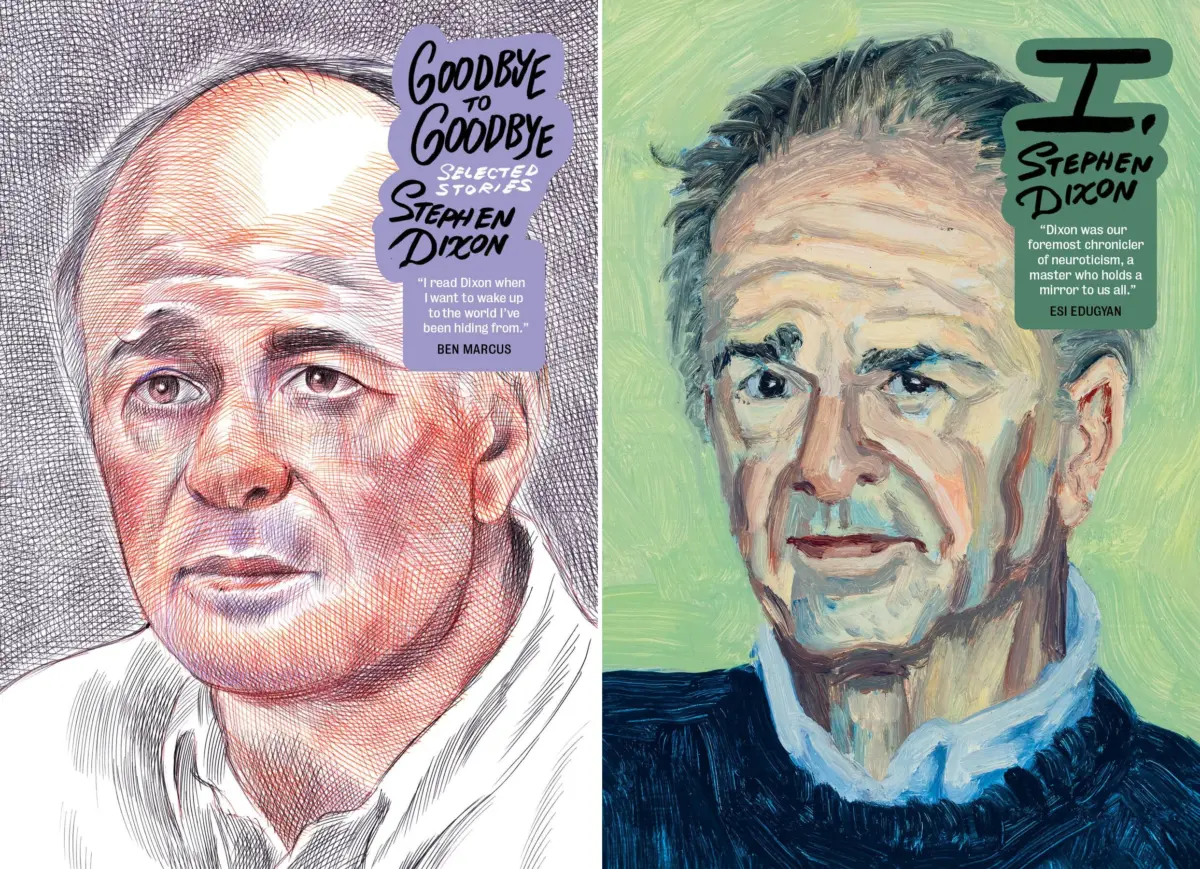
The physical design of the new book series serves as a testament to this collaborative spirit. Each volume in the upcoming program features an original illustration of Stephen Dixon on its cover, created by a different artist. All participating illustrators were given the exact same source photograph to work from, resulting in a mesmerizing suite of covers where Dixon appears to shape-shift from fluorescent to impressionistic renderings.
"It’s the sort of formalist experiment that I think he would have been really excited by," Uhle remarked.
Biographer Matt Petti echoed these sentiments, pointing out the deeply personal nature of Dixon’s appeal. When asked by critics to pinpoint what makes Dixon’s prose so enduringly magnetic, Petti admitted to the difficulty of translation. "How do you describe when a writer just gets to you? I don’t even know how to understand that," he said. Yet, he remains steadfast in his belief that the project will serve as a vital anchor for the author’s admirers.
Future Outlook: Preserving a Legacy for the 21st Century
As the literary landscape continues to grapple with shifting consumer habits, algorithmic curation, and the consolidation of major publishing houses, the revitalization of Stephen Dixon’s catalog stands as a beacon of independent literary stewardship.
The initiative is not merely a commercial exercise in selling backlist titles; it is an active preservation effort designed to cement Dixon’s rightful place in the canon of American modernism. By rescuing unpublished manuscripts like Half Stories, Full Novel and Out of Time from the archives, McSweeney’s is ensuring that the boundaries of Dixon’s literary imagination have not yet been fully mapped.
For current fans, the campaign provides a long-overdue celebration of a writer who never compromised his voice for commercial ease. For younger writers and readers discovering his cascading sentences for the first time, it offers an exhilarating masterclass in psychological depth and formal daring.
The festivities begin in earnest on September 17 with a celebratory gathering in Manhattan honoring Dixon’s life, work, and enduring influence. From there, as the books roll out across bookstore shelves through 2028, the literary world will once again be forced to reckon with the unstoppable, brilliant mind of Stephen Dixon—proving that true literary art, no matter how idiosyncratic, ultimately finds its way home.





Comments
Facebook App ID not configured. Please add it in the Customizer.