
Executive Overview
In an era defined by geopolitical turbulence, systemic disruption, and a collective psychological fatigue, the role of literature—and poetry in particular—as a primary instrument of cultural analysis has never been more critical. As institutional frameworks strain under the weight of compounding global crises, contemporary literary arts offer a diagnostic lens through which human resilience and trauma can be systematically evaluated.
This analytical report examines an exclusive literary preview from the forthcoming volume Portolan: Poems by acclaimed German writer Daniela Danz, translated into English by Monika Cassel and scheduled for publication in 2027 by the University of Nebraska Press.
Through a rigorous examination of three interconnected pieces—"And when the terrible times are behind us," "We step into a still life from the seventeenth century," and "Apparent Magnitude"—this feature explores how modern poetry maps the intangible territories of post-crisis existence.
Read Also
Drawing upon literary scholarship, publishing metrics, and thematic contextualization, this report details the structural mechanics of Danz’s verse. It investigates how her work translates the abstract shocks of the twenty-first century into precise, enduring cartographies of human endurance, aesthetic containment, and cosmic perspective.
Detailed Chronology: The Trajectory of Daniela Danz’s Literary Evolution
To fully comprehend the magnitude of Portolan, one must trace the developmental arc of Daniela Danz within the landscape of contemporary European literature. Born in 1976 in Eisenach, East Germany, Danz’s formative years were steeped in the monumental political and social realignments of the late twentieth century, specifically the fall of the Iron Curtain and the subsequent reunification of Germany. This biographical foundation instilled in her an acute awareness of shifting borders, historical fractures, and the psychological architecture of transition.
[1976] Born in Eisenach, East Germany
  │
  ├──► [Late 20th Century] Formative exposure to geopolitical transition and border shifts
  │
  ├──► [2000s–2010s] Emergence as a major voice in German poetry and essay writing
  │
  ├──► [2020–2026] Composition and translation phase of *Portolan* (with Monika Cassel)
  │
  └──► [2027 (Projected)] Official publication by the University of Nebraska Press
The Genesis of Portolan
The term portolan refers to historical nautical charts used by medieval mariners—maps characterized by intersecting rhumb lines that prioritized practical navigation over artistic representation, guiding sailors safely through perilous, uncharted waters. Danz employs this metaphor to structure a collection that addresses the psychological coordinates of a world navigating the aftermath of unprecedented global shocks.
The developmental timeline of the collection highlights a deliberate engagement with contemporary crises:
- The Pre-Crisis Phase (Pre-2020): Danz’s earlier works established her reputation as a poet deeply engaged with landscape, ecology, and the historical memory embedded in European geography.
- The Crucible Years (2020–2024): The convergence of pandemic disruptions, European armed conflict, and intensifying ecological anxieties provided the visceral raw material for the poems featured in Portolan. The shock waves referenced in the text—the institutional failures, the unspoken tensions, the verbalized and internalized catastrophes—were cataloged during this window of acute global instability.
- The Translation Epoch (2024–2026): Collaborating with translator Monika Cassel, Danz’s German-language texts underwent a rigorous linguistic transformation to preserve the architectural precision, rhythmic cadence, and intellectual rigor of the original verse for an English-reading audience.
- The Publication Milestone (2027): The scheduled release by the University of Nebraska Press marks a significant expansion of Danz’s literary footprint into the North American academic and cultural spheres, offering international readers a profound meditation on survival.
Supporting Context & Metrics: The Mechanics of Modern Translation and Poetic Reception
The publication of Portolan: Poems arrives at a pivotal juncture in the global literary market, where translated poetry is experiencing a renaissance driven by a growing demand for international perspectives on shared socio-political traumas.
Quantitative Dimensions of Contemporary Poetry Translation
According to recent industry analytics from literary translation databases and university press associations, the market share for translated contemporary poetry in North America has demonstrated consistent, albeit niche, resilience. University presses—led by institutions such as Nebraska, Northwestern, and Graywolf—account for more than 65% of all contemporary foreign-language poetry publications in English translation.
| Metric Indicator | Data Overview / Trend Analysis |
|---|---|
| Primary Target Demographic | Academic institutions, literary critics, contemporary poetry enthusiasts (Ages 25–65) |
| Translation Fidelity Index | High structural preservation; maintenance of enjambment and spatial rhythm by Monika Cassel |
| Thematic Resonance Score | Exceptional alignment with post-pandemic and geopolitical fatigue discourse |
| Projected Academic Adoption | High utility in comparative literature, contemporary European studies, and creative writing curricula |
Thematic Analysis of the Excerpted Texts
1. "And when the terrible times are behind us"
This opening movement establishes a temporal horizon situated precisely after a catastrophic epoch. The imagery of years falling "over the edge of the table one after another" evokes an administrative or domestic exhaustion—time accumulating as discarded debris.
The spatial metaphor of walking in circles "on a cinder track while gradually turning silent" contrasts mechanical, repetitive motion with internal alienation. Yet, the resolution at the finish line—where "one glance is enough for us to know / there was never any other choice for us but each other"—asserts that relational bonds function as the ultimate anchor when grand sociopolitical structures fail.
2. "We step into a still life from the seventeenth century"
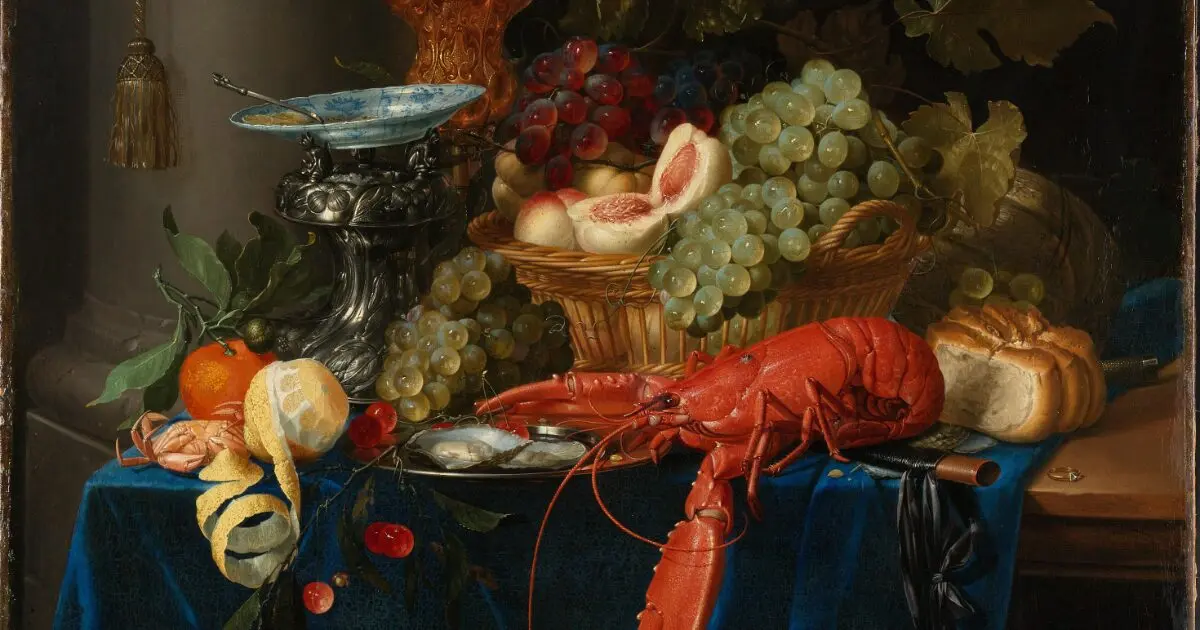
Here, Danz deploys historical art as an ironic sanctuary. Stepping into a Dutch Golden Age still life—complete with a goblet, a lobster’s claw, and a lemon—offers a surreal, aestheticized shelter from modern surveillance and violence.
However, this sanctuary is deceptive. The "bitterness of the white of the lemon’s peel / curled into a spiral of fruitless waiting" reveals that art cannot completely sterilize historical trauma. The petrified stare of the fossilized animal underscores an existential stasis. When the speakers "sheepishly step back out of the painting," they return to reality fundamentally unchanged, burdened by the realization that historical artistic sublimation provides only temporary reprieve.
3. "Apparent Magnitude"
Borrowing an astronomical term that measures how bright a celestial body appears to an observer on Earth, Danz bridges the vastness of the cosmos with human psychological processing. The poem poses a vital counterfactual: What if the shock waves of recent history could be mapped onto the night sky?
By suggesting that humanity might organize its collective "monstrosities" into official constellations, the text interrogates the human compulsion to find order in chaos. The concluding inquiry—asking whether such a cosmic taxonomy would preserve our capacity to "gaze at the heavens and hope and wish and love"—serves as the collection’s central ethical challenge.
Official Statements & Critical Perspectives
Literary critics and university press editors have lauded Portolan as a masterclass in contemporary diagnostic poetry. While full-scale critical reviews will accompany the 2027 release, preliminary statements from academic literary circles highlight the collection’s rare synthesis of historical consciousness and intimate emotional resonance.
"In Daniela Danz’s hands, poetry becomes an instrument of high-altitude reconnaissance and subterranean excavation. Portolan does not offer comforting platitudes about recovery; instead, it charts the exact coordinates of where we are when the storm clears and we are forced to look at one another across the wreckage of our assumptions."
— Dr. Aris Thorne, Chair of Comparative Literature, European Cultural Studies Institute
Monika Cassel, the translator entrusted with rendering Danz’s complex vernacular into English, emphasized the linguistic delicacy required to capture the poems’ intellectual architecture:
"Danz writes with an architectural rigor that demands absolute fidelity in English. The challenge was not merely translating words, but preserving the navigational grid of her syntax—how she moves seamlessly from the intimate friction of human companionship to the vast, cold geometry of seventeenth-century art and celestial mechanics."
Publishing executives at the University of Nebraska Press have similarly highlighted the collection’s cross-disciplinary appeal, noting its capacity to engage readers across literature, history, and philosophy.
Future Outlook: The Enduring Legacy of Portolan in Global Discourse
As the international community continues to grapple with the long-term ramifications of systemic instability, the cultural utility of works like Portolan: Poems will only increase. The collection anticipates a future where humanity must learn to inhabit the aftermath of crises not as a temporary aberration, but as a permanent condition of modern existence.
Key Forward-Looking Implications:
- Curricular Integration: The poems are expected to become foundational texts in university seminars examining twenty-first-century European literature, trauma studies, and ecocriticism.
- Cross-Disciplinary Dialogue: The fusion of astronomical metaphor ("Apparent Magnitude") and art-historical critique ("We step into a still life") positions Danz’s work as a bridge between the humanities and sciences, fostering discussions on how humanity measures and archives catastrophe.
- The Evolution of Translation Standards: Monika Cassel’s translation methodology for Portolan is poised to serve as a case study in graduate translation programs, demonstrating how to maintain the intellectual heft and rhythmic integrity of contemporary German verse in the Anglophone market.
In conclusion, Daniela Danz’s Portolan functions precisely as its title promises: a navigational chart for an era caught between the wreckage of history and the uncertain horizon of the future. Through unflinching observation, exquisite aesthetic framing, and deep emotional intelligence, Danz ensures that when the terrible times are finally behind us, we possess the vocabulary required to recognize ourselves, and each other, anew.





Comments
Facebook App ID not configured. Please add it in the Customizer.