
Executive Overview
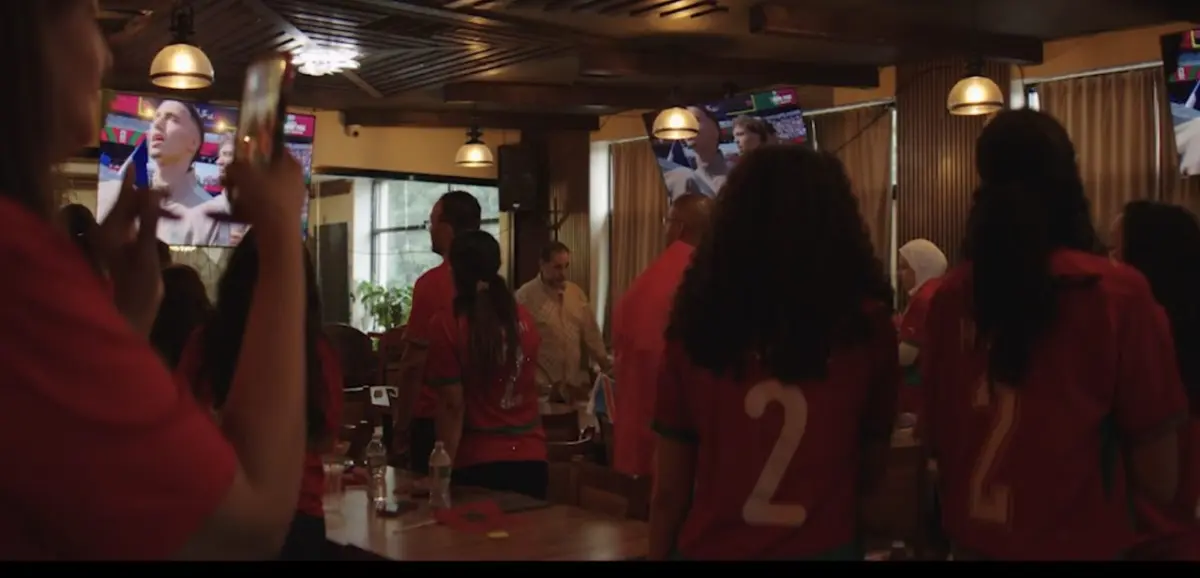
When the final penalty of a tense, grueling match against the Netherlands hit the back of the net in Monterrey, Mexico, the transformation inside Zikrayat—a bustling Middle Eastern restaurant and lounge in Astoria, Queens—was instantaneous. The room erupted into a deafening wall of sound: cheers, celebratory dances, and the high-pitched, howling trill of the zaghrouta piercing the humid New York air. Minutes earlier, a room packed with dozens of Morocco fans draped in red and green jerseys had braced themselves for a heartbreaking defeat. The North African side had trailed for much of the match until a miraculous equalizer in the ninetieth minute forced extra time, ultimately culminating in a nerve-wracking penalty shootout.
For the millions of Moroccans scattered across the globe, moments like this are much more than athletic spectacles. They serve as profound cultural touchstones that bridge the geographic and emotional chasms of the diaspora.
Yet, the meteoric rise of the Moroccan national football team—affectionately known as the Atlas Lions—occupies a complex, often contradictory space. The team’s modern success is inextricably linked to the global diaspora, mirroring the economic remittances that sustain the homeland and the sophisticated scouting networks that span European academies. Simultaneously, this triumphs unfold against a backdrop of deep domestic friction: economic disparity, political repression, youth-led protests, and contentious debates over national authenticity. This report provides an investigative and authoritative examination of the Atlas Lions’ journey, exploring how a football squad has come to embody the triumphs, contradictions, and melancholia of an entire nation.
Read Also
Detailed Chronology: From Astoria to Monterrey and the Path of the Atlas Lions
The summer tournament captured the imagination of expatriates and descendants worldwide, unfolding in a series of high-stakes encounters that tested the emotional resilience of fans from Rabat to Queens.
The Opening Wave on Steinway Street
Weeks before the climactic match against the Netherlands, the atmosphere along Steinway Street in Astoria—New York’s de facto "Little Morocco"—signaled the arrival of the global tournament. Hours before Morocco’s opening match against Brazil, the neighborhood began to hemorrhage red and green. Commuters stepping off the M60 bus were immediately greeted by sea of Moroccan jerseys bearing the name of star defender Achraf Hakimi.
Street vendors lined the sidewalks with folding tables, hawking flags and scarves while shouting "Dima Maghrib!" (“Always Morocco!”) at passing traffic. Inside cafes like Noisette, patrons packed closely around television screens, sipping mint tea, indulging in pastries, and conversing rapidly in Darija (Moroccan Arabic). Supporters traveled from as far as Philadelphia and New Jersey, bypassing high-cost stadium tickets at MetLife Stadium in favor of the communal warmth and electric camaraderie of Queens.
The Edge of Elimination: Morocco vs. Netherlands
On June 29, the stakes reached a fever pitch. Facing a formidable Dutch side, the Moroccan squad struggled for dominance. As the clock wound down toward regulation time, the North African team trailed, and despair gripped fans worldwide. However, a stunning, last-minute equalizer in the ninetieth minute breathed new life into the squad, forcing extra time and a dramatic penalty shootout.
As the shootout commenced, television cameras caught several Moroccan players gathered in a circle on the pitch, raising their hands in religious prayer. Inside Zikrayat, time stood still. Fans held their breath, lowering their heads in anxious anticipation. When Ismael Saibari’s penalty kick finally settled into the back of the net, pent-up anxiety dissolved into unbridled euphoria. Outside, impromptu fireworks lit up the Queens skyline, echoing the celebrations occurring concurrently in major European capitals and across Morocco.
The Quarterfinal Wall: Facing France
Following victories that carried the team deep into the tournament, Morocco once again squared off against their 2022 semifinal rivals: France. Unlike the fairy-tale run in Qatar two years prior, this encounter exposed the structural limitations and psychological fatigue of the squad. Despite heroic efforts from goalkeeper Yassine Bounou—often lauded for his steadfast performance—the Atlas Lions appeared uncharacteristically passive, failing to capitalize on rare scoring opportunities. France secured a 2–0 victory, bringing a sobering end to Morocco’s tournament run.
While defeat against a powerhouse like France is theoretically acceptable to seasoned supporters, the manner of the loss sparked fierce debate. Many fans struggled to reconcile the lack of fighting spirit on the pitch with the immense expectations now resting on the team’s shoulders. Reaching the quarterfinals no longer felt like a passive victory of participation; the diaspora and domestic population alike now demand competitive dominance.
Supporting Context & Metrics: Economics, Remittances, and the Diaspora
To understand the cultural resonance of the Atlas Lions, one must analyze the socio-economic structures binding Morocco to its diaspora. The national team is not merely a collection of athletes; it is a mirror reflecting the realities of migration, labor, and state investment.
The Remittance Economy
The financial lifeblood of Morocco is deeply intertwined with its emigrant population. According to recent economic data, Moroccans living abroad remit nearly $13 billion annually, accounting for roughly 8 percent of the country’s Gross Domestic Product (GDP). These funds directly support domestic households—covering rent, food, healthcare, and daily expenses—often rivaling the economic output of traditional domestic sectors.
Commenting on this dynamic, prominent Moroccan journalist and public intellectual Aboubakr Jamai noted:
"The team has become a metaphor for the Moroccan economy and Moroccan society. We rely heavily on our emigrants. Remittances play an enormous role in the country’s economy. Football tells a similar story."
This circular relationship—where individuals leave in search of economic opportunity, maintain deep cultural ties through dual nationality, and invest heavily back home—finds its exact parallel on the football pitch.
The European Scouting Infrastructure
The modern success of the Moroccan national team is the direct result of targeted institutional planning. Following years of underperformance, Moroccan sports authorities revamped their developmental pipelines. A pivotal figure in this transformation was Nasser Larguet, former director of Salé’s Mohammed VI Football Academy and subsequent technical director for the Royal Moroccan Football Federation (FRMF).
Larguet spearheaded the creation of a sophisticated overseas scouting network designed to identify, recruit, and integrate dual-national players born and raised in Europe. Consequently, the vast majority of the national squad—including stars like Achraf Hakimi (born in Madrid) and Sofyan Amrabat and Noussair Mazraoui (born in the Netherlands)—grew up outside of Morocco.
This strategy initially drew heavy criticism from domestic purists who questioned the loyalty and cultural connection of players who did not speak Arabic or grow up within the kingdom’s borders. However, these doubts dissipated as the team began delivering historic results, culminating in the historic 2022 World Cup semifinal run in Qatar—the first time an African or Arab nation achieved the feat.
Official Statements and Socio-Political Discourse
The triumph of the Atlas Lions has continually intersected with political realities, social unrest, and questions of state priorities.
Leadership and the "Parental" Mandate
During the historic 2022 World Cup campaign, manager Walid Regragui addressed the dual-national identity of his squad with a direct, emotionally charged motivational speech:
"You chose Morocco, why? For your parents! Don’t lie. You need to fight to the death [for them]."
By framing the players’ commitment as an act of filial duty to their immigrant parents, Regragui successfully unified a disparate group of European-trained professionals under a single, potent banner of national pride. The players became cultural ambassadors, bridging the gap between Westernized youth and their ancestral heritage.
Domestic Discontent and Sportswashing
Yet, the state’s massive financial investments in football infrastructure and prestige projects have occurred against a backdrop of severe domestic neglect. Last fall, widespread protests shook major Moroccan cities as Gen Z activists took to the streets, demanding that the state prioritize fundamental social welfare—specifically public healthcare, quality education, and employment opportunities for the youth—rather than sinking public funds into high-profile athletic hosting duties.
In an effort to manage public dissent ahead of major international fixtures, the state released a small group of jailed political protesters who had been convicted during the unrest. Despite these civil tensions, Morocco continues to press forward as an emerging regional sports superpower, securing co-hosting rights for the upcoming 2030 FIFA World Cup alongside Spain and Portugal.
This duality creates a profound sense of ambivalence among citizens and expatriates alike. The celebration of athletic dominance often exists in stark contrast to the socio-economic struggles faced by ordinary citizens within the country.
Future Outlook: The Identity of Modern Morocco
As the dust settles on the recent summer tournament cycle, the long-term trajectory of Moroccan football—and its relationship with the global diaspora—points toward institutional permanence rather than a fleeting sporting anomaly.
- Institutionalized Global Scouting: The FRMF’s blueprint of combining domestic academy development with aggressive European diaspora recruitment has become a benchmark for African and Asian football associations. Future squads will likely feature an even higher integration of transnational talent.
- Co-Hosting the 2030 World Cup: With Morocco slated as a co-host for the 2030 tournament, the nation faces unprecedented infrastructural and logistical demands. This milestone will test the government’s ability to balance international prestige projects with domestic demands for economic reform and social equity.
- The Evolving Diaspora Identity: For second- and third-generation descendants living in hubs like Astoria, Amsterdam, and Madrid, the national team serves as an anchor for cultural continuity. As younger generations navigate hybrid identities, the Atlas Lions provide an enduring, tangible connection to a homeland that is simultaneously distant and intimately felt.
Ultimately, the phenomenon of the Moroccan national team captures the dualities of the modern migrant experience: the melancholia of distance, the fierce pride of heritage, and the unifying power of sport. Whether celebrating on the pavements of Steinway Street or mourning a tactical defeat against European giants, the diaspora remains inextricably linked to the pulse of the kingdom—proving that for millions of fans, supporting the Atlas Lions is an act of preserving identity across borders.





Comments
Facebook App ID not configured. Please add it in the Customizer.