
Executive Overview
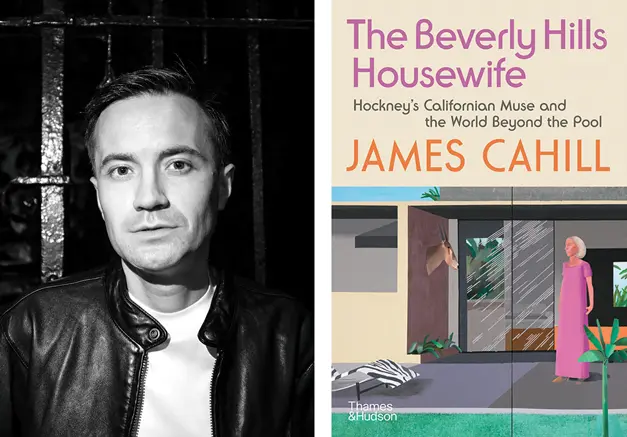
In the canon of modern art history, few visual dialogues are as instantly recognizable—or as psychologically resonant—as David Hockney’s mid-century chronicles of Southern California. Among them, his 1966 masterwork The Beverly Hills Housewife stands as a pivotal monument, bridging the gap between British expatriate wonder and the sun-bleached modernity of the American West. In a newly published critical exploration by acclaimed writer and art critic James Cahill, this iconic canvas is re-examined not merely as an aesthetic triumph, but as a complex psychological portrait of an era, an artist finding his footing, and an enigmatic art collector on the precipice of personal transformation.
This comprehensive feature explores Cahill’s deep-dive analysis into the painting, its subject—the legendary art patron Betty Freeman—and the unique socio-cultural alchemy of 1960s Los Angeles. Through an authoritative lens, we examine how Cahill’s relocation to the City of Angels catalyzed his understanding of Hockney’s vision, the fascinating interplay between British portrait traditions and unmapped Californian horizons, the mutual reinvention shared between a rising queer artist and an evolving female subject, and the structural freedoms of an art scene still drafting its own rules.
Drawing from extensive critical commentary and historical context, this article unpacks the layers of The Beverly Hills Housewife, offering a definitive look at a painting that continues to cast a long, crystalline shadow over contemporary art criticism.
Read Also
Detailed Chronology: From the Poolside to the Canvas
To fully grasp the magnitude of The Beverly Hills Housewife, one must trace the timeline of David Hockney’s early geographic and artistic migrations, alongside the concurrent life trajectory of Betty Freeman.
1964–1965: The Expatriate’s Arrival
David Hockney first touched down in Los Angeles in 1964, seduced by the imagery of pool culture, palm trees, and unapologetic hedonism he had seen in American physique magazines. Coming from the comparatively gray, tradition-bound atmosphere of Great Britain, Hockney viewed L.A. as an open-air theater. Unlike London, Paris, or New York—cities weighed down by centuries of artistic precedent and institutional ghosts—Los Angeles offered a tabula rasa. It was during these foundational years that Hockney began formulating the luminous, hard-edged figurative style that would define his early American period.
1966: The Commission and the Convergence
By 1966, Hockney’s social circle in Southern California had begun to expand, intersecting with a vibrant, tight-knit network of nascent collectors, gallerists, and avant-garde creators. It was within this milieu that he encountered Betty Freeman, a wealthy Boston-bred patron who had recently relocated to the West Coast. Freeman was navigating a turbulent period in her personal life: her marriage was quietly unraveling, and her long-term ambitions had yet to crystallize.
The convergence of Hockney’s artistic ambition and Freeman’s transitional state birthed The Beverly Hills Housewife. The painting portrays Freeman standing regally in a vibrant pink dress within the stark, geometric interior of her modernist home, looking out toward a sunlit exterior. It was not merely a commission; it was the genesis of Hockney’s celebrated portrait series, establishing a visual vocabulary that fused high-society documentation with private psychological inquiry.
1966–1967: The Unfolding of an Era
As Freeman stood for Hockney, she was literally and figuratively turning toward her future. Over the subsequent decades, Freeman would cement her legacy as one of the twentieth century’s most vital champions of avant-garde and minimalist music, befriending and funding composers like Philip Glass, Terry Riley, and John Adams. The painting captures her at the exact moment of becoming—a parallel journey to Hockney’s own artistic ascension as he cemented his status as the defining chronicler of the Californian dream.
Supporting Context & Metrics: Decoding The Beverly Hills Housewife
The Allure of the Crystalline Light
As James Cahill notes in his critical assessment, what immediately captivates the viewer upon encountering The Beverly Hills Housewife is its distinct stillness and crystalline light. Hockney’s mastery of acrylic paint—which he adopted precisely because it dried faster than oil, perfectly suited to the blazing, fast-paced L.A. climate—allows for planes of flat, saturated color that mimic the relentless glare of the California sun.
Yet, beneath the glossy, sun-drenched surface lies a profound sense of ambiguity. The title itself performs a double duty: it simultaneously classifies the subject within a domestic archetype while destabilizing that very definition, leaving the viewer to wonder who Betty Freeman truly was behind the poise and the semiformal posture.
The Charmed Outsider and the Ghostless City
Cahill offers a compelling perspective on Hockney’s status as a British artist working in America. Rather than losing his identity to his new environment, Hockney weaponized his "charmed outsider" status. He perceived Los Angeles as an entity that was still semi-formed, famously remarking that he could become the city’s Piranesi—the eighteenth-century Italian artist renowned for his dark, sprawling architectural etchings of Rome.
This was an extraordinary declaration of ambition. Hockney intended to map a city that believed it had no history, effectively inventing its visual mythology. Simultaneously, he maintained a deep, conscious dialogue with the centuries-old English portrait tradition. The monumental scale and dignified posture in The Beverly Hills Housewife echo British aristocratic portraiture, translated through the hyper-modern lens of mid-century Southern California.
Queer Kinship and the Glamorous Female Muse
Art history is replete with examples of queer male artists finding deep creative synergy with glamorous, formidable women—a dynamic often rooted in mutual empathy, shared marginalization, or an appreciation for self-invention. However, Cahill points out a crucial nuance in Hockney and Freeman’s relationship: unlike the cinematic sirens or aristocratic muses of other artists, Freeman was a personal, non-famous friend at the time the portrait was executed.
In 1966, Freeman’s dreams had not yet fully materialized. Her marriage was under strain, and she possessed a quiet, hard-to-read glamour. This vulnerability resonated deeply with Hockney, who was himself navigating a crucial period of personal and professional self-definition. While the broader cultural pattern of younger gay men drawing inspiration from older, assured, and beautiful women is well-documented, this specific collaboration was anchored in mutual existential transformation. They were two individuals actively constructing their own mythologies in a new world.
Official Statements & Critical Insights
In his recent analytical commentary, James Cahill expands upon the environmental and social conditions that made such an artistic partnership possible, reflecting on his own parallel experiences moving to Los Angeles.
"I found the stillness and crystalline light, combined with that poised, semiformal figure in the middle, very captivating," Cahill explains when discussing his initial encounter with the 1966 canvas. "And the title, ‘Beverly Hills Housewife,’ simultaneously defines its subject and leaves you with many questions about who she was. When was this? What was her relationship to Hockney? Also, on a more personal level, my getting to know this painting was concurrent with having just moved to Los Angeles and falling in love with the place, as Hockney had before."
Cahill elaborates on the absence of historical weight in the region during the 1960s, contrasting it with traditional cultural hubs like Boston, where Freeman spent her formative years:
"One has to be careful as a writer to not romanticize L.A., but back in the 1960s there was this real sense that the city itself was young and the contemporary art scene was relatively unformed. People moved about, and interacted with relative ease because the artistic circle was small. The lack of precedence, rules, or tradition—unlike in Boston, where Betty grew up—made such a friendship possible. One of the people I interviewed described how in L.A. everything tends towards the horizontal. I like to think of L.A. as still having something of that openness, freedom, and possibility."
This horizontal topography—both physical and social—allowed for cross-pollination between disciplines, visual artists, and patrons in a manner that would have been structurally impossible in the rigid, vertical hierarchies of New York or London art institutions.
Future Outlook: The Enduring Legacy of Hockney’s L.A.
As contemporary art criticism continues to re-evaluate the mid-century American landscape, works like The Beverly Hills Housewife serve as critical touchstones for understanding the intersection of biography, geography, and modernist aesthetics. James Cahill’s rigorous examination reminds us that paintings are not static relics of the past; they are active psychological documents that absorb the anxieties and aspirations of the people who created them.
Looking forward, the dialogue between British expatriate artists and the mythos of the American West will undoubtedly remain a fertile ground for scholarship. As Los Angeles continues to evolve into a dominant global capital for contemporary art, the foundational era documented by Hockney—characterized by openness, horizontal community structures, and a lack of historical "ghosts"—takes on an almost mythical status.
Cahill’s work ensures that figures like Betty Freeman are not lost to the footnotes of art history, but are instead recognized as active agents in the creation of a visual language that defined a generation. Through careful critical analysis, archival inquiry, and a deep appreciation for the Californian light, The Beverly Hills Housewife is restored to its rightful place: not merely a portrait of a woman in a pink dress, but a timeless monument to reinvention, friendship, and the eternal allure of the open horizon.



Comments
Facebook App ID not configured. Please add it in the Customizer.