
Executive Overview
In contemporary culture, artistic integrity is frequently measured by an creator’s willingness to follow an unconventional premise to its absolute logical extreme. Whether it is Andy Warhol obsessively cataloging Brillo boxes to interrogate the intersection of art and consumer capitalism, Danielewski forcing readers to navigate the labyrinthine typography of House of Leaves, or a theatrical production framing the apocalypse through the fractured recollection of a single episode of The Simpsons, the most enduring works are those defined by an uncompromising, singular vision.
In the modern media landscape, few creators have mastered this level of intense artistic commitment quite like Casper Kelly. A decade after sending shockwaves across the internet with his 11-minute surrealist Adult Swim broadcast Too Many Cooks, Kelly—alongside co-writer Jamie King—has returned with a feature-length cinematic endeavor titled Buddy.
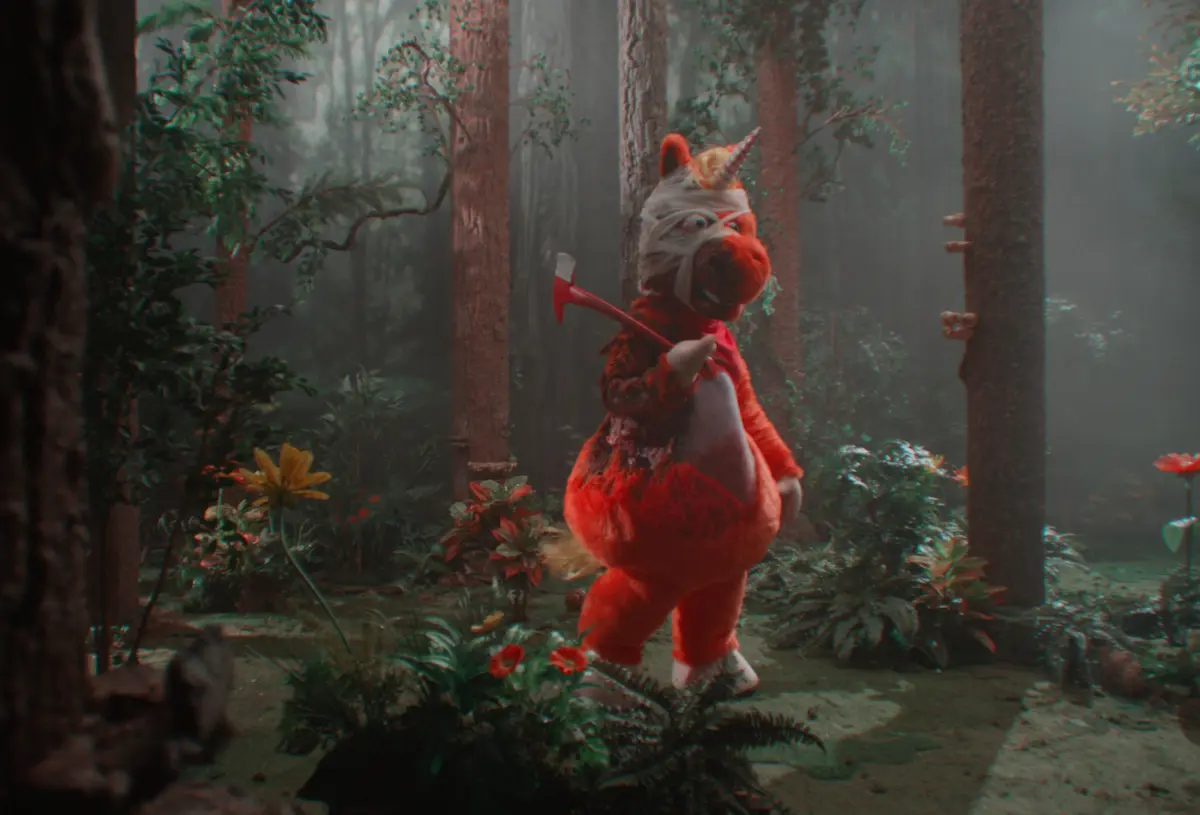
Moving away from the sprawling, channel-flipping pastiche of his previous viral masterwork, Buddy trains its satirical and terrifying lens on a specific, deeply unsettling epoch of media history: the hyper-lit, aggressively wholesome children’s edutainment programming of the 1990s. Evoking the DNA of iconic staples such as Dora the Explorer, Thomas the Tank Engine, Pee-wee’s Playhouse, and, most prominently, Barney & Friends, Buddy functions as both a nostalgic excavation and a visceral blood-soaked deconstruction. Featuring standout performances from Cristin Milioti, Keegan-Michael Key as the voice and "soul" of the titular plush antagonist, and a remarkably talented young ensemble cast, the film sits at the intersection of body horror, surrealist comedy, and cultural critique. This report provides an exhaustive investigation into the mechanics, thematic resonance, and cultural footprint of Buddy, framing it within a broader artistic movement of millennial trauma recovery and media subversion.
Read Also
Detailed Chronology: From Too Many Cooks to Buddy
To understand the architecture of Buddy, one must first examine the foundational blueprint laid down by Casper Kelly in late 2014. "Too Many Cooks" disrupted the digital zeitgeist by weaponizing television’s most benign structural device: the sitcom opening credits sequence.
The Blueprint: The Genesis of Modern Television Horror
Originally broadcast late at night on Adult Swim without traditional promotional fanfare, "Too Many Cooks" began as a pitch-perfect, oversaturated pastiche of 1990s TGIF sitcom tropes. It introduced the fictional "Cook family" under the harsh, migraine-inducing lighting characteristic of multi-camera studio setups of the era. Over the course of eleven relentless minutes, the sequence expanded its character roster exponentially, introducing chefs, a talking puppet cat named "Smarf," and nosy neighbors—until the veneer of wholesome family entertainment ruptured.
A leering murderer wielding a machete breached the frame, systematically stalking, killing, and consuming the cast across parodies of virtually every major television genre, from gritty police procedurals and medical dramas to gritty sci-fi dystopias. The sketch resonated because it tapped into a collective subconscious unease: the creeping realization that the aggressively cheerful spaces constructed for children on television were hollow, fragile, and fundamentally alienating.

Entering the Purgatory of Buddy
With Buddy, Kelly and Jamie King scale this conceptual terror up to feature-length dimensions. The film dispenses with preamble, dropping audiences directly into the claustrophobic jurisdiction of Buddy’s world. The setting is a hyper-stylized, fenced-in backyard complete with a suburban house, an interactive talking mailbox, a treehouse, a wishing well, a nurse’s office, and a jungle gym.
The structural rhythm initially mimics classic toddler edutainment: children gather in the sunlight, chanting, "Oh, Buddyyyy!" until a plush unicorn springs to life to arbitrate lessons on processing social anxiety, transforming mundane chores into games, or confronting fear. However, the uncanny valley effect is immediate and suffocating. The color saturation is sickly; the physical sets possess a flimsy, paper-mâché impermanence, as if the entire reality of the production could collapse under the weight of a firm breeze.
The narrative equilibrium shatters when a rebellious young boy named Josh (played by Luke Speakman) refuses to participate in the mandatory fun, opting instead to read a book. This single act of dissension acts as a fracture in the simulation. For its first third, Buddy traps the audience within this suffocating Purgatory, sustaining a tone of mounting dread.
Eventually, a secondary plot breaks through the pristine facade, pivoting the film into a picaresque adventure-horror. While this structural shift introduces a more conventional narrative trajectory, it serves a vital functional purpose: it provides an escape hatch from an otherwise relentlessly claustrophobic aesthetic, balancing the experimental purity of Kelly’s vision with a sustainable cinematic structure.
Supporting Context & Metrics: The Nostalgia Horror Wave
Buddy does not exist in a vacuum. It arrives at the crest of a massive cultural wave wherein creators and audiences alike are reckoning with the hidden darkness of their collective youth. The entertainment industry has increasingly turned its attention toward the subversion of childhood nostalgia, interrogating the synthetic wholesomeness marketed to late-millennial and Gen-Z generations.
The Landscape of 1990s Nostalgia Deconstruction
| Work / Media Project | Primary Visual/Cultural Reference | Core Thematic Focus |
|---|---|---|
| Buddy | Barney & Friends, Pee-wee’s Playhouse | Gaslighting, media dependency, and the horrors of forced positivity. |
| The Bone Temple | Teletubbies, archival cultural figures | Collective trauma and institutional decay masked by primary colors. |
| Teenage Sex and Death at Camp Miasma | 1980s/90s slasher tropes (Sleepaway Camp, The X-Files) | The intersection of adolescent awakening and visceral genre tropes. |
| Backrooms (Project Iterations) | Liminal commercial spaces, 90s aesthetic detritus | Existential isolation within endless, artificially lit environments. |
| Widow’s Bay / Obsession | Contemporary storytelling framed via retro disconnect | Modern psychological narratives stripped of social media and digital connectivity. |
This collective cultural exorcism speaks to a profound disillusionment with the media diets of the 1990s and early 2000s. Shows like Barney & Friends presented an unrelenting, almost totalitarian optimism that many modern adults now view through a lens of psychological distress. Buddy harnesses this specific cultural phobia, transforming the comforting purple dinosaur archetype into a blood-soaked manifestation of institutional gaslighting and forced emotional compliance.

Official Statements & Cast Performances
The success of Buddy hinges entirely on a cast willing to commit unreservedly to the tonal whiplash between saccharine children’s television performance art and abject terror.
Character Breakdown and Performances
- Keegan-Michael Key (The Voice and Soul of Buddy): Key delivers a masterclass in vocal modulation, balancing the high-pitched, nasal chirruping of a classic children’s television mascot with sudden, chilling drops into homicidal rage and existential panic. His performance anchors the film’s psychological core, capturing the terror of a manufactured entity watching its reality unravel.
- Cristin Milioti: Joining the ensemble as a co-star who is gradually drawn into the central narrative chaos, Milioti reinforces her status as one of the most versatile and grounded actors working in contemporary genre film and television.
- Sergey Zhuravsky and Johnathon Yurco: Tasked with embodying Buddy’s physical form, both actors communicate profound pathos and relentless menace through the awkward, lumbering mechanics of a bulky costume.
- The Young Ensemble Cast:
- Delaney Quinn stars as Freddy Gardner, the ostensible leader of the children, supported by her plucky, sentient backpack "Strappy" (voiced with characteristic wry energy by Patton Oswalt).
- Caleb Williams (Wade Lyons) and Tristan Broders (Oliver Brownlee) portray the initial skeptics who first realize the systemic rot underlying their sunny environment.
- Madison Skyy Polan (Hannah Hartbeck) and Tory Jacqui Malone (Tyler) represent later additions to the cast who must adapt at breakneck speed to the escalating violence.
- Luke Speakman anchors the film’s inciting conflict as Josh, the young reader whose refusal to engage with the prescribed script breaks the simulation.
According to early critical responses and production notes, the young actors were chosen for their ability to seamlessly transition from the exaggerated, snarky, yet vulnerable cadence of 1990s child actors into convincing portrayals of frightened, resourceful children navigating genuine peril. Their performances prevent the film from devolving into a one-note parody, anchoring the surrealism in emotional realism.
Future Outlook: The Legacy of Post-Irony Media Deconstruction
As Buddy continues its theatrical run, its reception signals a broader shift in how audiences consume high-concept genre cinema. The film proves that high-concept short-form viral phenomena—such as "Too Many Cooks"—can be successfully translated into feature-length narratives without losing their distinct edge, provided the creators maintain absolute fidelity to their artistic instincts.
Cultural Implications for Modern Filmmaking
- The Weaponization of Nostalgia: Buddy accelerates the trend of "nostalgia horror," moving past simple Easter-egg harvesting into deep psychological deconstruction. Future projects are likely to draw inspiration from an even broader array of corporate-sponsored children’s media properties.
- The Survival of the "Bit": In an era of algorithmically optimized content, works that commit obsessively to a singular, bizarre premise—refusing to pander to conventional demographic expectations—generate outsized cultural engagement.
- Cross-Generational Resonance: By targeting the specific aesthetic trauma of late-millennial childhood, films like Buddy create a shared communal viewing experience in theaters, trading isolated streaming consumption for rowdy, collective crowd reactions.
Ultimately, Buddy succeeds because it refuses to treat its premise as a disposable joke. Casper Kelly and Jamie King elevate a blood-soaked satire of children’s television into a nuanced exploration of media consumption, loneliness, gaslighting, and the human impulse to seek safety within stories—even when those stories turn out to be monsters.



Comments
Facebook App ID not configured. Please add it in the Customizer.