
Executive Overview
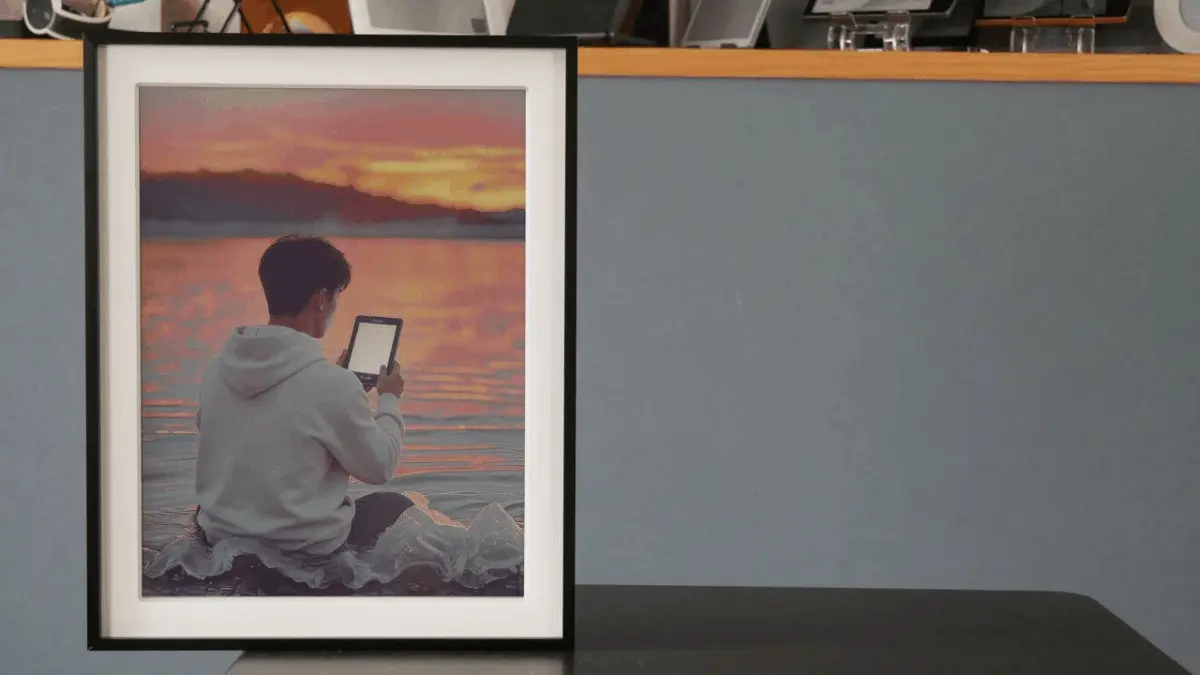
The consumer technology landscape has long pursued the holy grail of digital display frames: a screen that mimics paper so convincingly that it is indistinguishable from physical art. Enter the Bigme F13, a premium 13.3-inch smart E-Ink digital picture frame that leverages state-of-the-art Spectra 6 e-paper technology to deliver rich, highly saturated, glare-free, print-quality visuals. Priced at $269.99, this device targets design-conscious consumers looking for a decorative centerpiece that doubles as an efficient smart calendar hub for Google or Outlook ecosystems.
However, behind its sleek aluminum outer bezel and phenomenal battery longevity lies a deeply polarizing software ecosystem. Most notably, the Bigme F13 entirely eschews a dedicated companion smartphone application for local wireless image transfers—a glaring omission in the modern smart-home era. Instead, Bigme relies on an embedded AI voice-to-image assistant built for the Chinese domestic market and awkwardly marketed globally. While the frame boasts jaw-dropping hardware specs, including a colossal 18,000 mAh battery capable of lasting over two years on a single charge, its software idiosyncrasies, broken English voice assistant, and clumsy content-loading methods raise questions about its practical utility for the average consumer.
Detailed Chronology & Product Architecture
To understand how the Bigme F13 positions itself in the e-paper niche, one must examine its hardware engineering, operational methodology, and the friction points reported by early reviewers.
Read Also
The Hardware Leap: Spectra 6 and Display Fidelity
At its core, the Bigme F13 utilizes an advanced Spectra 6 color E-Ink panel, a major evolutionary step in electrophoretic display technology. Spectra 6 allows for a significantly wider color gamut and higher saturation levels than previous e-paper generations, pushing the boundaries of what electronic ink can achieve without a continuous electrical current.
- Resolution and Clarity: The 13.3-inch display features a resolution of 1200×1600 pixels, yielding approximately 150 pixels per inch (PPI). While this pixel density is standard for large-format e-readers and digital paper notebooks, it translates into a remarkably convincing, paper-like texture when displaying static artwork.
- Lighting and Glare: Thanks to the nature of E-Ink, the frame produces zero harsh blue light or screen glare, allowing it to reflect ambient light just like a physical painting or photograph.
- Battery Endurance: One of the F13’s most staggering engineering achievements is its 18,000 mAh battery. Because E-Ink technology only consumes power when the image on the screen changes, this massive battery capacity allows the frame to operate for over two years under normal usage conditions before requiring a recharge via its modern USB-C port.
The Software Paradox: Voice AI vs. Traditional Convenience
While the physical canvas is remarkably well-crafted, the user experience introduces significant hurdles. Unlike competing frames—such as the Bloomin8, which features a seamless, feature-rich companion app for wireless photo management—the Bigme F13 ships without an app to load your own content.
Instead, Bigme has anchored the device’s interactivity around an onboard AI voice assistant, equipped with an integrated microphone and speaker. Users can press a command or speak directly to the frame, saying prompts such as:
"Hey Bigme, make an image about a goat playing basketball."
Unfortunately, execution falls short of ambition. The AI engine’s underlying voice model speaks broken English—a byproduct of its primary design for the Chinese domestic market—and the images it generates on command are frequently low-quality, poorly composed, and unmistakably artificial.
Content Loading and Fallback Options
For users uninterested in generating bizarre AI art, loading personal photos requires jumping through structural hoops:
- Preloaded Masterpieces: To mitigate the lack of an easy setup process, Bigme preloads the frame with 1,000 world-famous paintings by legendary artists.
- SD Card Transfer: Users can physically transfer images via an SD card. However, the frame supports only a severely limited selection of file types, and the menu system for importing these files is clunky. Furthermore, in an era where cloud storage and smartphone apps dominate, relying on physical SD cards—and assuming consumers still own computers with functional SD card readers—feels antiquated.
Supporting Context & Metrics
Evaluating the Bigme F13 requires contextualizing its performance metrics against the broader digital photo frame market. The table below outlines its technical specifications, pricing, and usability metrics:

| Feature / Metric | Specification | Real-World Impact / Evaluation |
|---|---|---|
| Display Size & Tech | 13.3-inch Spectra 6 Color E-Ink | Delivers stunning, glare-free, print-quality art reproduction. |
| Resolution | 1200 x 1600 (150 PPI) | Crisp enough for paintings and calendar text, though lower than high-end LCD tablets. |
| Battery Capacity | 18,000 mAh | Eliminates unsightly power cords; lasts over two years on a single charge. |
| Connectivity & Apps | No companion app; USB-C & SD Card | Forces manual file transfers; lacks seamless wireless syncing for personal photos. |
| AI Assistant | Voice-to-image generator | Beset by broken English prompts and low-quality output. |
| MSRP Price | $269.99 (USD) | Competitively priced for a large E-Ink panel, but software limitations affect value. |
Market Positioning: Art Frame vs. Smart Hub
At $269.99, the Bigme F13 occupies a unique market slice. Standard LCD photo frames from brands like Skylight or Nixplay cost significantly less ($150–$200) and offer frictionless app integration, cloud sharing, and video playback. However, they look like glowing computer screens on a wall.
The Bigme F13, conversely, masquerades successfully as a framed canvas. Reviewers note that despite software and synchronization quirks, it functions exceptionally well as a decorative centerpiece. Beyond displaying art, it can pull double duty as an ambient smart-home hub, synchronizing seamlessly with Google Calendar or Outlook to keep track of family schedules without the distracting backlight of a traditional tablet or smart display.
Official Statements & Reviewer Consensus
Initial industry feedback from technology journalists, e-reader experts, and early adopters paints a complex picture of a device torn between brilliant hardware engineering and half-baked software localization.
Michael Kozlowski, editor-in-chief of Good e-Reader, highlighted the duality of the device during early evaluations:
"Reviewers praise its sleek aluminum outer bezel and an innovative AI voice-to-image assistant that generates custom artwork on command, though some note that the companion app currently lacks a built-in content discovery library. Despite minor software and synchronization quirks, it serves as an excellent decorative centerpiece that can seamlessly pull double duty as a smart Google or Outlook calendar hub."
Tech commentators have universally lauded the aesthetic upgrade provided by the Spectra 6 color palette. Earlier generations of color E-Ink (such as ACeP or Kaleido) often suffered from washed-out pastels or screen-door filter effects. Spectra 6 significantly deepens color saturation, making classic oil paintings look startlingly authentic when mounted on a living room wall.
Conversely, consumer advocacy and usability critics have lambasted the lack of a modern smartphone workflow. Without Wi-Fi cloud syncing or an intuitive iOS/Android app, the F13 alienates mainstream users who expect plug-and-play simplicity. The reliance on voice commands processed through an underdeveloped English-language model has been labeled by multiple reviewers as a "gimmick that actively detracts from the device’s core utility as a photo frame."
Future Outlook & Industry Implications
The release of the Bigme F13 signals an important trajectory for the consumer E-Ink market: manufacturers are no longer limiting electronic paper to monochrome e-readers and productivity notebooks. Large-format color e-paper is rapidly finding a home in home automation, digital signage, and interior design.
What Lies Ahead for E-Ink Home Decor?
- Software Refinement: For Bigme to capture a broader Western market, future firmware updates must bypass the clunky AI generation novelty and introduce robust cloud APIs (such as Google Photos or Apple Photos integration) alongside a dedicated companion app.
- Hardware Maturation: As Spectra technology continues to evolve, we can expect higher pixel densities, faster refresh rates, and lower manufacturing costs. This will likely drive down the price of large-format color frames below the current $270 threshold.
- The Battle for Convenience: The F13 serves as a cautionary tale for hardware manufacturers: exceptional industrial design and record-breaking battery life cannot completely override a frustrating user interface. Competitors who successfully marry Spectra 6 displays with frictionless, app-driven cloud syncing will ultimately capture the lion’s share of the digital frame market.
Final Verdict
The Bigme F13 is a magnificent piece of hardware trapped inside an unrefined software ecosystem. For tinkerers, tech enthusiasts, and lovers of classic art who do not mind loading images via SD card, its gorgeous 13.3-inch Spectra 6 display and multi-year battery life make it a fascinating wall ornament. However, consumers seeking an effortless way to display family photos captured on their smartphones may want to wait for future iterations—or competitors—that prioritize seamless wireless software architecture over gimmicky AI voice generators.


Comments
Facebook App ID not configured. Please add it in the Customizer.