
Executive Overview
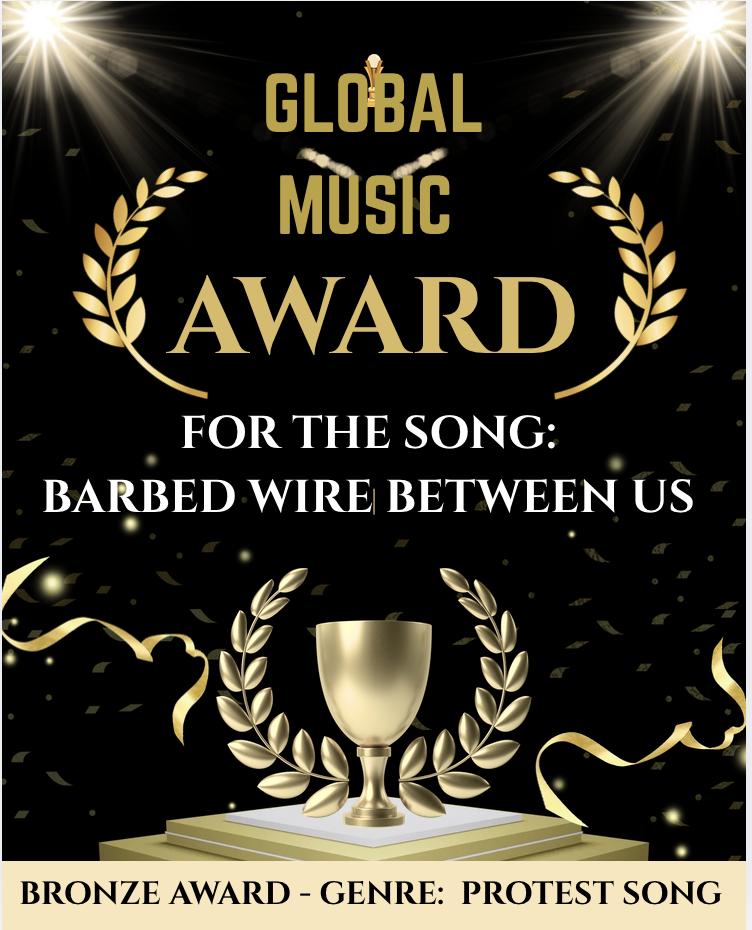
Art has long served as a mirror for society, reflecting our highest ideals as well as our most systemic failures. Rarely, however, does a single creative endeavor manage to bridge historical epochs with such profound precision and emotional resonance as Barbed Wire Between Us. Originally conceived as a groundbreaking reverso picture book written by Mia Wenjen and illustrated by Violeta Encarnación, the project has now expanded into a multi-disciplinary cultural touchstone. Most recently, its accompanying original song—composed and performed by Daria Marmaluk-Hajioannou of Daria World Music for Kids—was awarded a prestigious bronze honor in the protest song category at the Global Music Awards.
This recognition arrives at a critical juncture in contemporary socio-political discourse. Barbed Wire Between Us operates on a dual narrative structure, examining the parallels between the forced imprisonment of Japanese Americans in internment camps during World War II and the contemporary civil rights violations experienced by detained migrant children and families at the U.S. border. By juxtaposing these historical traumas through the vulnerable lens of youth, the book and its accompanying musical compositions challenge audiences to confront an unsettling question: Have we truly learned anything about how we treat the most defenseless among us over the past eighty years?
This report provides a comprehensive examination of the Barbed Wire Between Us phenomenon. It explores the mechanics of its reverso poetry, evaluates the cultural impact of its award-winning musical adaptation, details the critical acclaim it has garnered from major literary institutions, and outlines the broader educational and museum initiatives designed to carry its message forward into classrooms and communities nationwide.
Read Also
Detailed Chronology of a Cultural Milestone
The genesis and evolution of Barbed Wire Between Us represent a carefully coordinated convergence of historical research, poetic innovation, and activist art.

Conception and Literary Development
Mia Wenjen’s creation of Barbed Wire Between Us began with deep historical inquiry into the U.S. government’s internment of approximately 120,000 Japanese Americans during World War II. Recognizing structural similarities in how the state handles marginalized populations during times of manufactured crisis, Wenjen utilized the "reverso poem" format—a poetic form that reads forward to tell one story and backward to reveal an entirely different, yet inextricably linked, narrative.
Set within the physical confines of an internment camp in Oklahoma, the narrative initially follows a Japanese American girl during World War II. When the poem is read in reverse, the syntax and emotional beats recontextualize the text to tell the harrowing story of a Latina girl detained decades later under modern migrant family separation policies. This structural duality creates a haunting symmetry, suggesting that history does not merely rhyme; it repeats its structural injustices with chilling exactitude.

Publication and Critical Reception
Scheduled as one of the most anticipated children’s books of Spring 2026, Barbed Wire Between Us received extraordinary early praise from the literary establishment, securing starred reviews across the board:
- Publishers Weekly lauded the work as "A haunting dual narrative of imprisonment and family separation."
- Kirkus Reviews designated it as a "Significant portrayal of ongoing U.S. civil rights violations, exposed through the experiences of young children," naming it among the top anticipated releases of the season.
- School Library Journal emphasized its pedagogical value, calling it "A must-purchase for elementary poetry collections for its elegant combination of the seriousness of history repeating itself and the promise of a new tomorrow."
Musical Adaptation and Global Music Awards Success
Expanding the project beyond the printed page, Daria Marmaluk-Hajioannou (performing as Daria) crafted an original protest song titled Barbed Wire Between Us: A Song About Kids in Detention Camps. The composition translates the literary work’s heavy emotional weight into a resonant acoustic and vocal landscape.

In late 2026, this collaborative effort achieved international recognition when the track captured a bronze award in the protest song category at the Global Music Awards. This accolade validated the project’s cross-media strategy, proving that complex socio-political histories can be effectively communicated to younger audiences through the universal language of music.
Supporting Context, Metrics, and Artistic Mechanics
To fully appreciate the impact of Barbed Wire Between Us, one must examine the intersection of its poetic form, its musical composition, and the historical archives that inform its narrative.

The Power of the Reverso Poem
In children’s and young adult literature, addressing systemic state-sponsored cruelty presents a formidable pedagogical challenge. Authors must balance historical accuracy with emotional protection, ensuring young readers aged seven and up are equipped to process grief without experiencing despair. Wenjen achieves this balance through the strict geometric constraints of the reverso poem.
By showing that the exact same words, when reversed, can tell the story of a completely different child suffering decades apart, the form visually and structurally communicates the cyclical nature of xenophobia and state detention. It invites readers to become active participants in textual analysis, hunting for the pivots in tone and perspective that transform a wartime memory into a modern crisis.

[Forward Narrative]  --> A Japanese American girl in WWII Oklahoma camp
       │
       ▼ (Structural Pivot)
[Reverse Narrative]  --> A Latina girl in modern migrant detention camp
The Sonic Architecture of Protest
Daria’s award-winning song functions as an auditory companion piece to Violeta Encarnación’s striking illustrations. Utilizing minimal instrumentation that foregrounds lyrical storytelling, the song avoids sensationalism in favor of empathetic lamentation. By entering the Global Music Awards—a prestigious international organization that celebrates independent musicians—the track transcended children’s educational media, asserting itself within the broader canon of contemporary protest music.
Interdisciplinary Engagement Metrics
The project’s reach extends far beyond traditional book sales, supported by an ecosystem of digital and institutional resources:
- Museum Exhibitions: Featured prominently at cultural institutions such as the Japanese American National Museum.
- Educational Integration: Supported by a comprehensive, free downloadable Teacher’s Guide designed to facilitate classroom discussions on civil rights, constitutional law, and human dignity.
- Activist Handcrafts: Accompanied by cultural engagement activities, including step-by-step guides on folding origami cranes—a traditional symbol of hope, healing, and peace in Japanese culture.
Official Statements and Creator Insights
The collaborative forces behind Barbed Wire Between Us have consistently emphasized the urgency of keeping historical memory alive in an era marked by shifting political landscapes.
Mia Wenjen has frequently noted that the inspiration for her historical fiction and non-fiction works—ranging from Postcards from Malcolm X: How Yuri Kochiyama Became a Civil Rights Activist to Barbed Wire Between Us—stems from a desire to empower youth to recognize their place within the continuous struggle for civil liberties. By connecting the dots between Executive Order 9066 and modern immigration policies, Wenjen challenges readers to look beyond partisan rhetoric and examine the fundamental human rights of children caught in the machinery of the state.
Similarly, Daria Marmaluk-Hajioannou’s work with Daria World Music for Kids has long championed global citizenship, multicultural understanding, and peace through music. The bronze win at the Global Music Awards underscores the viability of creating art that is simultaneously accessible to children and uncompromising in its political and moral critique.
Reviewers from Publishers Weekly to Kirkus Reviews have echoed these sentiments, noting that books like Barbed Wire Between Us are indispensable tools for educators striving to cultivate critical thinking, empathy, and historical consciousness in the next generation.
Future Outlook and Ongoing Initiatives
As Barbed Wire Between Us firmly establishes itself as a defining literary and musical work of the mid-2020s, its creators and educational partners are rolling out a series of initiatives designed to maximize its civic impact.
Classroom and Community Expansion
The availability of the Barbed Wire Between Us Teacher’s Guide ensures that the book will find a permanent home in elementary and middle school curricula. Educators are increasingly utilizing the text alongside interdisciplinary units covering World War II history, civic responsibilities, poetry writing, and immigration studies. Furthermore, hands-on workshops incorporating origami crane-folding sessions provide students with a tangible, meditative outlet to process complex emotions regarding justice and empathy.
Museum and Archival Partnerships
Building on its presence at the Japanese American National Museum, the project is slated for additional educational exhibits and panel discussions nationwide. These events bring together historians, musicians, authors, and civil rights advocates to discuss the ongoing relevance of detention camp histories in contemporary policy debates.
Continued Creative Output
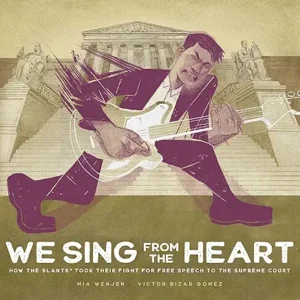
Mia Wenjen’s broader trajectory—encompassing works such as Fortune Cookies for Everyone! (Smithsonian), The Traveling Taco, and We Sing from the Heart: How the Slants® Took Their Fight for Free Speech to the Supreme Court—demonstrates a sustained commitment to illuminating marginalized histories and fights for social justice. As educators, librarians, and parents continue to seek out resources that foster difficult yet necessary conversations with young people, Barbed Wire Between Us stands out as a masterclass in how art can honor the past while fiercely demanding a more just future.

Comments
Facebook App ID not configured. Please add it in the Customizer.