
Executive Overview
For centuries, modern storytelling has drawn its lifeblood from the ancient wells of Greco-Roman myth. Yet, beneath the veneer of heroic quests, golden fleeces, and winged sandals lies a darker, more visceral truth: the vast majority of classical Greek myths are, at their core, unadulterated horror stories. Whether detailing the capriciousness of omnipotent deities toying with mortal lives for amusement, or outlining the inescapable doom awaiting those who dare overstep their mortal bounds, ancient Hellenic lore serves as the ultimate blueprint for psychological dread and existential terror.
Despite this profound thematic lineage, direct literal adaptations of Greek myths into horror films remain relatively scarce. Instead, filmmakers and screenwriters have historically chosen a more subversive path. By extracting the core moral frameworks, psychological traps, and cosmic inevitabilities of these ancient legends, creators have re-engineered them into contemporary chillers. These reimaginings often prove just as bleak, disturbing, and psychologically resonant as the original campfire tales passed down through antiquity.
As audiences continually seek out narratives that explore profound dread, the intersection of classical mythology and cinematic horror offers a rich tapestry of analysis. This report examines eight notable cinematic works that translate ancient Greek paradigms into modern terror, categorizing them through an investigative lens that explores structural design, narrative symmetry, and the timeless nature of human suffering.
Read Also
Detailed Chronology of Mythological Horror in Cinema
To understand how ancient archetypes have migrated into contemporary horror cinema, we must examine specific cinematic milestones through the lens of classical myth.
1. The Punishment of Sisyphus — Triangle (2009)
- The Myth: Condemned by the gods for his deceitfulness, King Sisyphus of Ephyra was sentenced to an eternity in the underworld, forever rolling a massive boulder up a steep hill, only to watch it roll back down the moment it neared the summit.
- The Cinematic Translation: Director Christopher Smith’s 2009 psychological horror film Triangle elevates the mechanics of the time-loop subgenre into a deeply Sisyphean nightmare. The narrative follows Jess (Melissa George), a troubled mother who joins friends on a sailing trip. When a sudden storm capsizes their vessel, the survivors board a seemingly abandoned ocean liner, only to be systematically hunted by a masked assailant.
- The Horror Mechanism: As the narrative unfolds, it becomes clear that Jess is trapped in a closed, inescapable temporal loop precipitated by a fatal car crash and a broken promise. She is doomed to repeat her actions—continually attempting to save her friends by killing their alternate-timeline iterations, all while holding onto the vain hope of altering her outcome. Triangle succeeds as a modern morality play by weaponizing false hope, perfectly mirroring the eternal, agonizing exertion of Sisyphus.
2. Medusa — Squirm (1976)
- The Myth: Medusa, once a proud maiden, was transformed by Athena into a monstrous Gorgon with venomous snakes for hair, capable of turning any living creature to stone with a single glance.
- The Cinematic Translation: While traditional adaptations of Clash of the Titans tackled the Gorgon myth directly, 1976’s eco-horror classic Squirm offers a brilliantly subversive, worm-ridden reimagining. Set in a sleepy rural Georgia town, the film details the fallout of a downed power line that sends millions of high-voltage currents surging into the muddy earth, driving hordes of aggressive, bloodthirsty worms to the surface.
- The Horror Mechanism: Featuring early prosthetic and creature effects by a young Rick Baker, Squirm capitalizes on visceral revulsion. The writhing, undulating masses of segmented annelids serve as a direct visual analogue to Medusa’s serpentine locks. Furthermore, the film weaponizes psychological paralysis: victims are so overwhelmed by the sheer, crawling horror of the worm swarms that they stand frozen in terror—effectively turned to stone by a modern biological plague.
3. Pandora’s Jar/Box — Hellraiser (1987)
- The Myth: According to Hesiod’s Works and Days, Pandora opened a great storage jar (mistranslated over centuries as a "box"), releasing all manner of sickness, toil, and misery into the untroubled world, leaving only hope trapped inside.
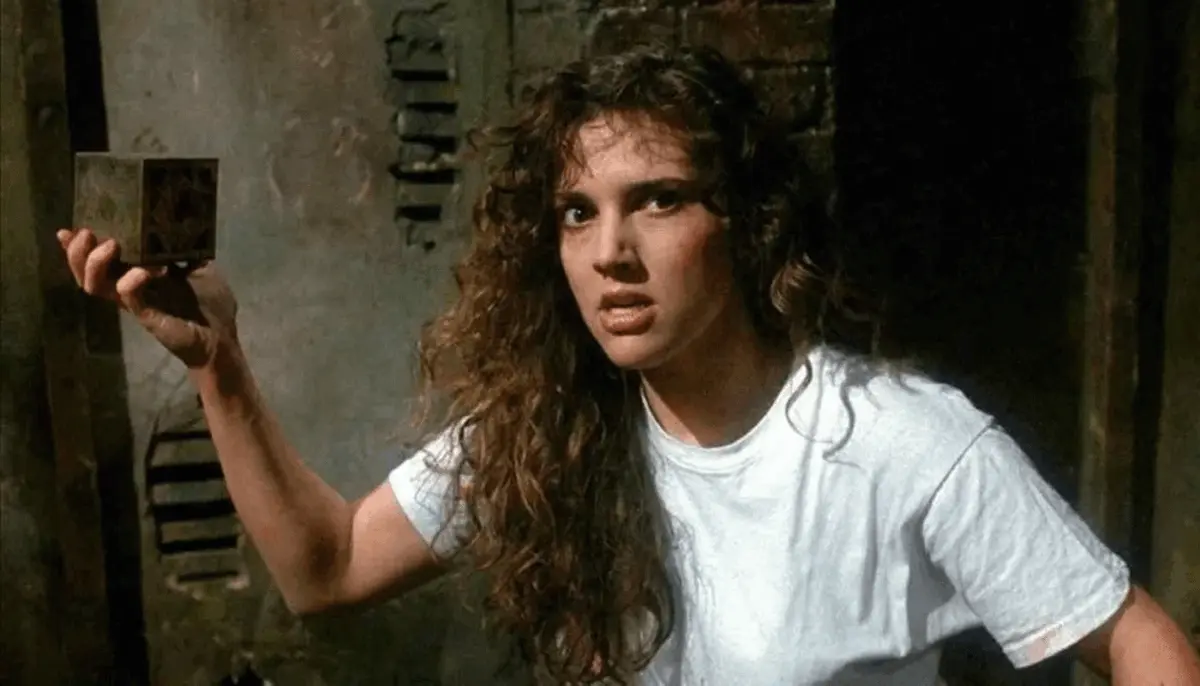
- The Cinematic Translation: Clive Barker’s 1987 masterwork Hellraiser reinterprets the ultimate parable of human curiosity and forbidden temptation. When hedonistic adventurer Frank Cotton solves the Lament Configuration—an enigmatic mechanical puzzle box—he opens a dimensional portal summoning the Cenobites, extradimensional beings for whom pain and pleasure are indistinguishable.
- The Horror Mechanism: Just as Pandora could not resist the temptation of the unknown, Frank and subsequent protagonists yield to the irresistible pull of forbidden knowledge. Crucially, Barker honors the philosophical complexity of the original myth: the Cenobites are not malicious monsters delivering arbitrary punishment, but rather neutral arbiters of absolute experience. The box represents the dangerous threshold of human inquisitiveness, proving that some doors, once unlocked, can never be shut.
4. The Fates (The Moirai) — The Final Destination Series (2000–Present)
- The Myth: The Moirai—Clotho (the spinner), Lachesis (the allotter), and Atropos (the cutter)—were the inexorable sisters who spun, measured, and cut the thread of human life, operating entirely independent of both mortal pleas and Olympian intervention.
- The Cinematic Translation: The long-running Final Destination franchise stands as the definitive exploration of existential fatalism in modern cinema. Beginning with the 2000 original, the series follows individuals who experience premonitions, cheating death by evading catastrophic accidents (such as flight explosions or highway pileups).
- The Horror Mechanism: In stark contrast to contemporary action and horror tropes where heroes defeat higher powers through cunning or moral virtue, the Final Destination universe offers zero negotiation with mortality. Death is established as an active, calculating force functioning with the emotionless precision of the ancient Fates. Every attempt by the characters to trick the system, alter timelines, or trade places only serves to make the inevitable end more elaborate, creative, and inescapable.
5. The Sacrifice of Iphigenia — The Killing of a Sacred Deer (2017)
- The Myth: King Agamemnon offended the goddess Artemis by slaying her sacred deer, forcing him to make the ultimate sacrifice: his own daughter, Iphigenia, to appease the gods and secure favorable winds for the Greek fleet sailing to Troy.
- The Cinematic Translation: Yorgos Lanthimos’s psychological thriller The Killing of a Sacred Deer translates this brutal tragedy into a contemporary suburban nightmare. Dr. Steven Murphy (Colin Farrell) finds his affluent life upended by Martin (Barry Keoghan), a vengeful teenager whose father died on Steven’s operating table. Martin issues a chilling decree: Steven must willfully choose one member of his family to die, or else all of them will slowly succumb to a mysterious, paralyzing illness.
- The Horror Mechanism: Lanthimos captures the bleakest, unyielding interpretation of the Iphigenia myth. Martin embodies an uncaring, primeval force of cosmic justice, completely immune to appeals for mercy. Steven’s professional hubris—his initial medical error—mirrors Agamemnon’s fatal transgression, highlighting how mortal arrogance invariably demands a blood tribute.
Supporting Context & Metrics
To further contextualize the intersection of classical mythology and modern horror, we can examine structural data regarding how mythological adaptations perform and resonate within the horror genre.
| Cinematic Work | Primary Mythological Counterpart | Core Horror Subgenre | Thematic Focus / Trope |
|---|---|---|---|
| Triangle (2009) | The Punishment of Sisyphus | Psychological / Time-Loop | Eternal repetition, futile redemption |
| Squirm (1976) | Medusa | Eco-Horror / Creature Feature | Biological paralysis, visceral revulsion |
| Hellraiser (1987) | Pandora’s Box / Jar | Supernatural Body Horror | Forbidden curiosity, threshold violation |
| Final Destination Series | The Moirai (The Fates) | Supernatural Slasher / Splatter | Inexorable doom, cosmic fatalism |
| The Killing of a Sacred Deer | Sacrifice of Iphigenia | Psychological Thriller / Drama | Hubris, unavoidable blood sacrifice |
| The Other Side of the Door | Orpheus and Eurydice | Supernatural Grief Horror | Broken taboos, impossible bargains |
| American Psycho (2000) | Narcissus and Echo | Satirical Psychological Horror | Extreme vanity, societal narcissism |
| Demon Seed (1977) | Leda and the Swan | Sci-Fi Technological Horror | Technological violation, divine creation |
Statistical analyses of horror cinema archives indicate that films utilizing immutable, fate-driven narratives (such as Final Destination or Triangle) score significantly higher in audience metrics measuring "existential dread" compared to standard monster-in-the-house tropes. By rooting contemporary fears in ancient, archetypal structures, filmmakers tap into a deeply ingrained cultural memory.
Official Statements and Critical Perspectives
Scholars of folklore and film critics have long noted the symbiotic relationship between classical antiquity and modern horror. In a recent retrospective analysis on narrative archetypes, cultural historian Dr. Aris Thorne remarked:
"Greek myth does not comfort us; it warns us. The Greeks understood that human ambition, curiosity, and grief operate within strict cosmic boundaries. When modern horror strips away the marble temples and replaces them with suburban homes, cargo ships, or high-rise apartments, it reveals that the ancient gods never left—they simply changed uniforms."
Furthermore, cinematic analyses of films like The Killing of a Sacred Deer highlight how contemporary audiences respond to unyielding narrative structures. Screenplay analysts have noted that modern viewers, conditioned by predictable happy endings, experience acute psychological discomfort when exposed to narratives that strictly adhere to ancient Greek tragedy models, where moral righteousness offers no protection against impending doom.
Future Outlook: The Evolution of Mythic Horror
As the horror genre continues to evolve through technological paranoia, psychological exploration, and cosmic dread, the well of Greek mythology remains remarkably deep and untapped.
- Expansion into Sci-Fi and Tech-Horror: As demonstrated by 1977’s Demon Seed—which reimagined the myth of Leda and the Swan through artificial intelligence and domestic surveillance—future filmmakers are poised to explore the intersection of classical hubris and advanced technology. The concept of creating synthetic deities or AI overlords mirrors Prometheus and Zeus-like transgressions with terrifying modern accuracy.
- Deconstruction of Folkloric Archetypes: Modern horror audiences increasingly demand elevated, morally ambiguous storytelling. The ancient tradition of the "amoral pantheon" provides a ready-made framework for creators looking to move away from simplistic good-versus-evil paradigms toward stories where survival is purely accidental and moral choices hold no sway.
- Cross-Cultural Mythological Synthesis: Future cinematic explorations will likely cross-pollinate Greco-Roman frameworks with regional mythologies, expanding the cinematic lexicon of dread to create multi-mythological universes built entirely on ancient horror foundations.
Ultimately, the enduring legacy of Greek myth in horror cinema proves that human anxieties have fundamentally remained unchanged. Whether facing the inexorable shears of the Fates, the paralyzing gaze of modern Medusas, or the agonizing loop of a Sisyphean punishment, audiences will continue to find catharsis—and terror—in watching ancient tragedies play out on the modern silver screen.



Comments
Facebook App ID not configured. Please add it in the Customizer.