
Executive Overview
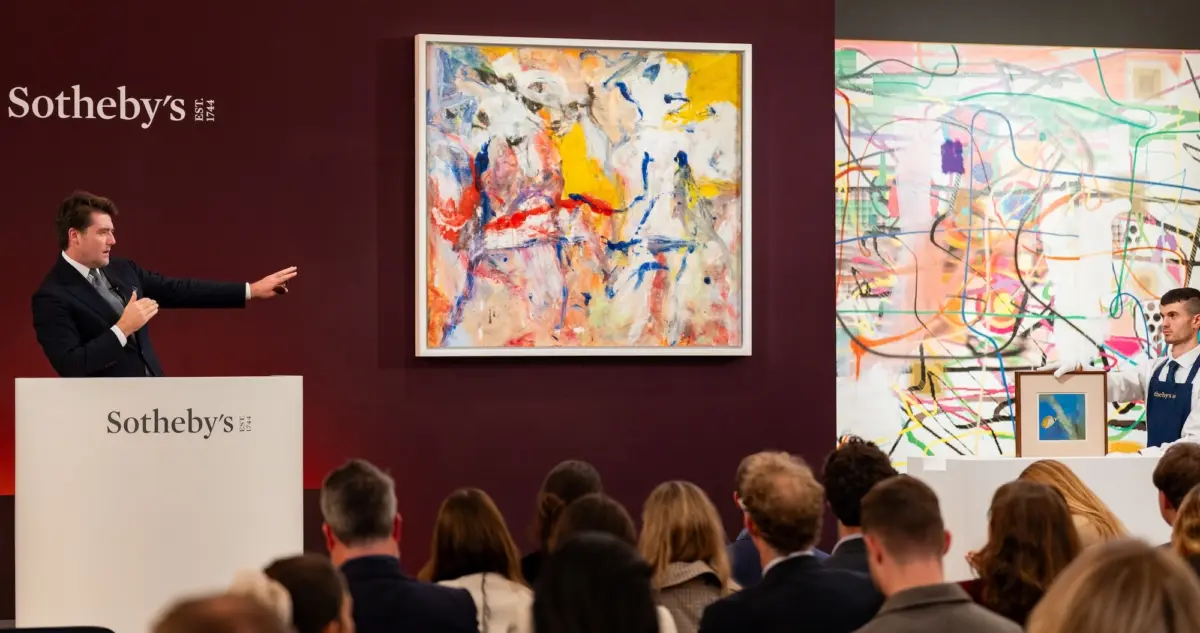
Against a backdrop of silent moments, anxious pauses, and an atmosphere more akin to a courtroom than a celebratory auction house, Sotheby’s London executed a steady, tightly curated contemporary art sale on Thursday evening. Pulling in a grand total of £46.1 million ($61.1 million), the event unfolded before a packed saleroom where every breath seemed magnified and all eyes remained fixed on auctioneer Tom Eddison.
The auction was designed to be lean, clocking in at just over an hour with a total of 34 lots. However, the economic realities of a cautious global art market quickly made themselves felt. The evening’s hammer total reached £36.9 million before the house’s buyer’s fees, falling just shy of the pre-sale low estimate of £41.7 million (overall estimates ranged from £41.7 million to £58.6 million, or $55.3 million to $77.8 million).
While bellwether masterpieces by Willem de Kooning and Gerhard Richter managed to anchor the night, the undercurrent of the evening was undeniably one of careful selectivity. Ten lots bore financial guarantees to secure baseline interest, yet three high-profile works—by Damien Hirst, Anselm Kiefer, and Leon Kossoff—were unceremoniously withdrawn before the bidding even began. Furthermore, prominent canvases and works on paper by blue-chip and breakout names alike, including Banksy, Georg Baselitz, Jadé Fadojutimi, Lucian Freud, Gerhard Richter, and Lynette Yiadom-Boakye, failed to find buyers.
Read Also
The event took place during London’s bustling Frieze Week, hot on the heels of a robust, albeit safe, evening at rival auction house Christie’s, which raked in a combined £218.6 million ($289.4 million) across two sales the night before. Yet, despite the macroeconomic friction and palpable buyer hesitation, Sotheby’s leadership and art market experts alike framed the evening as a testament to resilience. It was a clear indication that while capital remains plentiful, collectors are no longer willing to throw money at everything; instead, they are hunting selectively for absolute quality, historical provenance, and local resonance.
Detailed Chronology: Inside the Saleroom
The mood in the Sotheby’s London headquarters on Thursday evening was set long before Tom Eddison took to the podium. The saleroom was packed to capacity, filled with international dealers, private collectors, and museum advisors who had spent the day walking the aisles of Frieze London. Yet, the energy lacked the speculative frenzy of peak market cycles. Instead, an expectant hush fell over the room as the first lot was introduced.
Operating at a brisk, controlled pace, auctioneer Tom Eddison guided the room through 34 streamlined lots over the course of an hour. The auction began with measured caution. Early lots met with slow, deliberate bidding increments, punctuated by long, anxious pauses that left auction watchers holding their breath.

The evening’s top lot arrived in the form of an untitled, highly expressive Willem de Kooning abstraction from 1977. Estimated conservatively between £8 million and £12 million ($10.6 million to $15.9 million), the 5-foot-wide canvas embodied the raw energy that collectors covet from the artist’s later years. Bidding was steady rather than explosive. The hammer ultimately dropped at £8.2 million, bringing the total price with fees to £9.8 million ($12.9 million) and clinching the night’s highest single result. For market historians, the sale offered an interesting proof of value: the exact same painting had last crossed the auction block at Sotheby’s New York in 2015, where it fetched a modest $6.1 million.
As the sale progressed into its middle tiers, the tension in the room occasionally gave way to unexpected triumphs. One of the undisputed narrative highlights of the night was the fierce competition sparked by Michael Andrews’s 1978 work on paper, Butterfly Fish. Estimated at a high of £120,000, the delicate depiction of the titular marine animal triggered an extended, high-stakes bidding war. When the hammer finally fell at £550,000—pushing the final realized price with fees to £704,000 ($933,117)—it established a striking new auction high for a work on paper by the British artist.
Conversely, some of the evening’s most anticipated blue-chip lots experienced a more subdued reception. Gerhard Richter’s imposing, 8-foot-wide Abstraktes Bild (1992), estimated at £6 million to £8 million, hammered below expectations at £5.4 million, ultimately realizing £6.7 million ($8.9 million) with fees. Similarly, a dark, atmospheric, untitled Mark Rothko abstract from 1969 squeezed past its low estimate to fetch £3.8 million ($5 million) with fees.
As the final lots cleared, the tally rested at 28 successful sales out of 34 offerings—a healthy completion rate, even if the overall monetary totals reflected a marketplace walking on eggshells.
Supporting Context & Metrics: Market Climate and Comparative Data
To fully understand Sotheby’s Thursday evening sale, one must examine it within the broader ecosystem of London’s Frieze Week. The auction arrived exactly 24 hours after Christie’s dominated the headlines with a massive £218.6 million ($289.4 million) across a double-header contemporary and post-war art evening. While Christie’s total was more than double its performance from the previous year, industry insiders noted that the offerings there leaned heavily on safety, reliance on third-party guarantees, and established institutional blue-chip names.
By comparison, Sotheby’s £46.1 million ($61.1 million) total represented a slight dip from last year’s equivalent contemporary sale, which brought in £47.6 million ($63.3 million)—a night famously anchored by a Francis Bacon triptych that alone commanded £13 million ($17.5 million).

Market analysts point out that current conditions are shaped by a complex mix of geopolitical uncertainty, inflationary pressures, and a recalibration of valuations following the post-pandemic speculative boom. Ivana Miloradovic, a prominent art historian and consultant observing the sale from the room, captured the prevailing sentiment:
"I would say the market is very cautious. Most of the lots either underperformed or were at the lower end."
This cautious posture was further evidenced by the composition of the catalogue. Ten of the 34 lots featured financial guarantees, a risk-mitigation strategy deployed by auction houses to ensure works find a buyer via third-party backing. Furthermore, the withdrawal of three major works prior to the sale—specifically pieces by Damien Hirst, Anselm Kiefer, and Leon Kossoff—signaled that consigners and auction houses were unwilling to risk public buy-ins for properties that lacked immediate, aggressive demand.
Despite these headwinds, pockets of intense liquidity remained visible, particularly when works possessed impeccable domestic pedigree. The performance of British and School of London artists underscored a distinct "home-field advantage." As Miloradovic noted regarding the enthusiastic local bidding for David Hockney’s 10th–22nd June 2021, Water Lilies in the Pond with Pots of Flowers (2021) and Michael Andrews’s Butterfly Fish:
"British sales on British soil are always joyous. Everybody knows the artist, the gossip, and the history. It was a homey atmosphere."
Younger, contemporary market darlings experienced a bifurcated reality. Emerging and mid-career stars saw mixed results. Louis Fratino’s intimate canvas Kissing Couple (2019) met expectations by bringing in a solid £320,000 ($424,144), aided no doubt by the artist’s concurrent sold-out solo exhibition at David Zwirner’s London gallery. Adrian Ghenie’s The Wall (2019) similarly performed steadily, realizing £640,000 ($848,288). However, works by high-flying younger talents like Jadé Fadojutimi and Lynette Yiadom-Boakye failed to clear reserves, demonstrating that collectors are no longer willing to acquire secondary-market material blindly based solely on current critical hype.

Official Statements and Industry Perspectives
Post-sale press briefings provided a vital window into how the major auction houses are reading the tea leaves of the current economic cycle. Rather than viewing the sluggish hammer totals and withdrawn lots as a sign of weakness, Sotheby’s executives emphasized the structural strength of a selective, disciplined market.
Ottilie Windsor, Head of Contemporary Art at Sotheby’s London, offered an upbeat assessment of the evening’s metrics during a post-sale interview with ARTnews. Defending the 82% sell-through rate, Windsor drew a direct parallel to the commercial realities of the concurrent art fairs:
"Any dealer at the [Frieze] fair would be thrilled to sell nearly 30 secondary market lots."
Windsor acknowledged that the composition of the secondary market has shifted, particularly regarding scarce historical material. Discussing the runaway success of Michael Andrews’s Butterfly Fish, she highlighted the unique structural dynamics that govern the School of London market:
"The paintings that he did make were often bought as they were being made by a group of collectors who followed his work really closely. Those collectors have never really needed to sell, and so we get a very, very low supply of his work to the market; when they do come up, they really do very well."
This scarcity mindset echoes the historical reverence held by Andrews’s peers. Fellow painter Frank Auerbach once remarked of Andrews’s immaculate output: "Mike is so economical. He paints only masterpieces." That scarcity-driven premium proved to be one of the few absolute certainties of an evening otherwise characterized by hesitant bidding.

Windsor concluded by summarizing the psychological state of today’s high-net-worth buyers:
"There is both interest and money in the market, but the market continues to be selective and continues to surprise us with what it’s looking for."
Future Outlook: Navigating the New Normal in the Art Market
As the dust settles on Frieze Week and London’s autumn auction season, Sotheby’s £46.1 million contemporary sale serves as a valuable bellwether for the remainder of the 2026 art market calendar. The overarching takeaway is clear: the era of unbridled, speculative over-exuberance has definitively given way to a disciplined, highly discerning era of connoisseurship.
For consigners, auction houses, and galleries alike, the writing is on the wall. Estimates must be grounded in realistic, transparent valuations rather than inflated pandemic-era peaks. Works that carry ironclad provenance, museum-quality execution, or deep local historical resonance—such as the blue-chip anchors provided by Willem de Kooning, Gerhard Richter, and the localized reverence for Michael Andrews—will continue to command fierce, albeit deliberate, competition.
Conversely, speculative flipping and over-hyped secondary market entries for ultra-contemporary names face an increasingly unforgiving landscape. As collectors and investors grow more defensive with their capital, the art market is undergoing a necessary purge of excess.
Looking ahead to the upcoming marquee sales in New York and Hong Kong, auction houses will undoubtedly apply the lessons learned in London. Curatorial precision, conservative estimating, and transparent pricing will be the mandatory tools of survival. The market is far from dead—millions of dollars are still actively changing hands—but it has matured. In this new normal, only the most compelling works will survive the silent courtroom scrutiny of the modern saleroom.





Comments
Facebook App ID not configured. Please add it in the Customizer.