
Executive Overview
In an era dominated by digital isolation, algorithmic echo chambers, and the receding frontiers of civic third spaces, an unlikely renaissance is quietly unfolding over pints of stout and plates of pub fare in Cambridge, Massachusetts. The Plough and Stars—a storied, unpretentious institution nestled in the heart of academia-adjacent Cambridge—has launched a series of events dubbed “Philosophy Nights,” and the cultural response has surpassed even the most optimistic projections of its organizers.
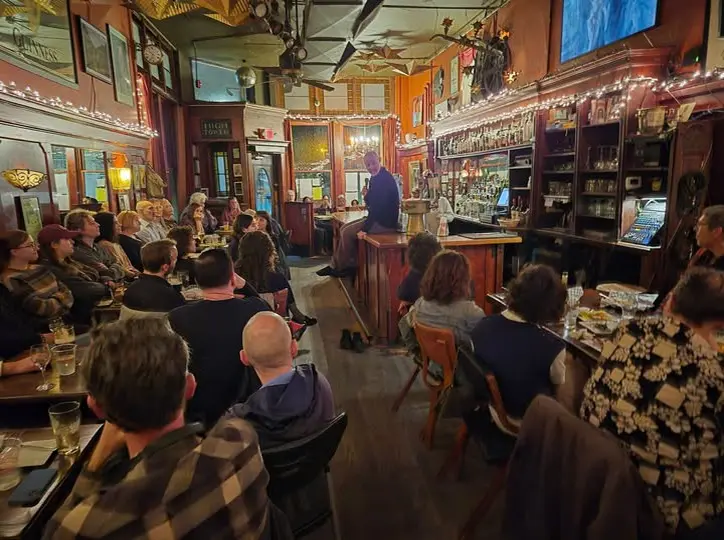
What began as an experimental fusion of casual dining and rigorous academic inquiry has rapidly metastasized into one of the city’s hottest tickets. Last month, patrons packed the venue to capacity, trading the ambient clatter of cutlery for deep intellectual contemplation as MIT philosopher Agustín Rayo took the floor to lecture on the intricate intersections of mathematics and human certainty. The appetite for these discussions is not merely robust; it is insatiable. Looking ahead to later this month, Wellesley College philosopher Helena de Bres is scheduled to take the stage to unpack the perennial human question: "What is meaning in life?" The response? A staggering backlog of approximately 120 people currently languishing on the event’s waitlist.
This phenomenon captures a broader, subterranean cultural hunger. While the Boston and Cambridge metropolitan areas boast an extraordinarily high concentration of elite academic institutions, scholars, and intellectually curious laypeople, the success of the Plough and Stars points to a deeper longing for accessible public philosophy. Across the globe, forward-thinking dining establishments and watering holes are rediscovering the ancient lineage of the tavern as a crucible for democratic discourse.
Read Also
This report investigates the mechanics of the Plough and Stars phenomenon, examines the operational reality of public philosophy in local establishments, and issues a call to action for communities worldwide to bring high-level thought back to where the people are: over a glass and across a table.
Detailed Chronology: From Concept to Cultural Phenomenon
To understand how a neighborhood pub became an epicenter for contemporary metaphysical and epistemological debate, one must trace the deliberate, step-by-step evolution of the Plough and Stars’ programming. The initiative did not emerge overnight; rather, it represents the convergence of community stewardship, academic accessibility, and the timeless appeal of the neighborhood pub.
Phase One: Conceived in the Booths
For decades, The Plough and Stars has functioned as a cultural anchor in Cambridge. Known for hosting live traditional Irish music, political discussions, and local writers, the venue has always prioritized community dialogue. However, conceptualizing a dedicated "Philosophy Night" required bridging the often-impenetrable gap between university lecture halls and the public square.
Organizers recognized that while the Boston area is practically saturated with world-class universities—including Harvard, MIT, and Wellesley—the intellectual output of these institutions is too frequently sequestered behind paywalls, journal subscriptions, and intimidating campus gates. The initial blueprint was simple: strip away the PowerPoint decks, lower the academic jargon to a conversational hum, and place a leading thinker in a room full of engaged citizens with a beverage in hand.
Phase Two: Agustín Rayo and the Mathematics of Certainty
The inaugural test of this hypothesis arrived last month. The venue filled to absolute capacity as patrons piled into the establishment, seamlessly blending the sensory experiences of a bustling restaurant with the intellectual rigor of a university seminar room.
Agustín Rayo, a prominent professor of philosophy at the Massachusetts Institute of Technology (MIT), took center stage to deliver a lecture examining math and certainty. Rather than retreating into dry formal logic, Rayo’s presentation invited the audience to interrogate the very foundations of how humans assign truth to numbers and mathematical constructs. The dialogue was characterized not by passive listening, but by active, animated interruptions, rigorous questioning, and cross-table debates that persisted long after the formal presentation concluded. The event proved conclusively that everyday patrons—ranging from undergraduate students and software engineers to retirees and local tradespeople—were deeply hungry for substantive intellectual engagement.
Phase Three: The Helena de Bres Phenomenon and the 120-Person Waitlist
Riding the momentum of its initial success, the program’s organizers immediately planned their next installment. Later this month, Helena de Bres, a distinguished scholar of philosophy from Wellesley College, is slated to speak on one of the most existentially heavy topics imaginable: "What is meaning in life?"
The reaction to the announcement exposed the sheer scale of the public’s appetite for these gatherings. Within days of opening registrations, the event maxed out its physical capacity. Currently, the waitlist hovers around an astonishing 120 people—a metric that would be impressive for a touring musical act or a major literary reading, let alone a lecture on existential philosophy inside a pub. This bottleneck has forced organizers and venue operators to urgently rethink their logistical frameworks, exploring methods to scale capacity without sacrificing the intimate, conversational atmosphere that made the original nights so successful.
Supporting Context & Metrics: The State of Public Philosophy
The success of the Plough and Stars does not exist in a vacuum. It sits at the intersection of several critical contemporary cultural and economic trends: the revival of physical third spaces, the democratization of higher education, and the reinvention of the modern hospitality industry.
The Geography of Intellect: Why Cambridge?
It is impossible to discuss the Plough and Stars without acknowledging its geographic coordinates. Greater Boston is arguably the intellectual capital of the Western Hemisphere. The density of brainpower per square mile is staggering. Yet, historically, this intellectual capital has suffered from a severe distribution problem. Ideas generated within the cloistered quadrangles of Kendall Square or Harvard Yard rarely bled organically into the commercial establishments lining Massachusetts Avenue.
By dragging philosophy out of the ivory tower and into a room smelling of draft beer and roasted pub food, the Plough and Stars has effectively flattened the hierarchy of knowledge. It posits that a bartender, a structural engineer, and a tenured professor of epistemology are equally qualified to ponder the nature of existence—provided they are given a shared conversational framework.
Global Counterparts: Where Else Does the Pint Meet the Mind?
While Cambridge provides a fertile, almost idealized testing ground for public philosophy, the movement is international in scope. Across the globe, independent dining establishments and bars are increasingly serving as modern-day agoras:
- Café Philo (France): Originating in Paris in the early 1990s, the Café Philosophique movement pioneered the concept of gathering ordinary citizens in cafés to discuss philosophical issues under the guidance of a facilitator. Today, variations of these gatherings persist across French cities, keeping the Cartesian spirit alive over espresso and wine.
- Philosophy in Pubs (United Kingdom): Established in the UK in the mid-1990s, this grassroots network promotes philosophical inquiry in local pubs, aiming to make philosophy accessible to everyone regardless of formal educational background. These sessions operate on the radical premise that philosophical thinking is a natural human capacity, not an exclusive academic discipline.
- Death Cafes and Science Pubs: While distinct from formal philosophy, the global explosion of "Science Cafes" and "Death Cafes"—where people meet in restaurants to discuss mortality or quantum mechanics—demonstrates a universal craving for curated, deep-dive conversations in non-institutional settings.
The Metrics of Engagement
To quantify the impact of these initiatives, one must look beyond ticket sales and waitlist numbers. The metrics of public philosophy are qualitative:
[Academic Isolation] ──(Plough & Stars Model)──> [Democratized Discourse]
         │                                              │
  - Paywalled Journals                          - 120+ Waitlist
  - Campus Gates                                - Interdisciplinary Audiences
  - Hierarchical Lectures                       - Egalitarian Pub Debates
As the data from Cambridge indicates, when barriers to entry are removed and settings are rendered comfortable, public demand for high-level cognitive engagement is virtually limitless. The 120-person waitlist for Helena de Bres’s talk serves as a quantitative indictment of the traditional, exclusionary models of intellectual dissemination.
Official Statements & Community Perspectives
The resonance of the Plough and Stars initiative has reverberated through academic corridors and neighborhood associations alike, eliciting enthusiastic responses from scholars, venue operators, and patrons.
Reflections from the Academic Frontline
Speaking on the philosophy of public engagement, participating academics have expressed profound appreciation for the shift in venue dynamics. Participating scholars note that lecturing in a pub strips away the performative pressures of academic grading and tenure reviews, replacing them with a raw, unpredictable, and ultimately more rewarding form of intellectual combat.
"When you present an idea to a university lecture hall, you are interacting with an audience conditioned to nod politely, take notes, and regurgitate concepts on an exam," noted one local academic observer familiar with the Cambridge lecture circuit. "When you present that same idea in a pub, surrounded by clinking glasses and ambient chatter, you have to earn every single second of attention. If your argument has a flaw, someone across the sticky wooden table will point it out. It forces philosophers to be better, clearer, and more human."
The Venue Perspective
For hospitality operators navigating a post-pandemic economic landscape marked by rising overhead costs and shifting consumer habits, cultural programming represents an innovative survival strategy. Traditional restaurants and bars are discovering that experiential hospitality—offering patrons intellectual nourishment alongside physical sustenance—creates deep brand loyalty.
Patrons attending the Plough and Stars philosophy nights are not merely dropping in for a quick pint and leaving; they are arriving early for dinner, ordering multiple rounds, and staying hours after the formal Q&A session has concluded. The financial metrics mirror the intellectual ones: community-driven educational events translate directly into sustained economic viability for neighborhood anchors.
The Voice of the Public
Interviews with attendees waiting in line or lingering outside the venue reveal a common refrain: a deep exhaustion with superficial digital discourse.
"We spend all day staring at screens, scrolling through polarized comment sections, and consuming bite-sized, weaponized information," said one Cambridge resident who attended the inaugural session with Agustín Rayo. "To come into a room filled with real human beings, listen to someone talk deeply about the nature of certainty, and then argue about it with a stranger over a plate of fish and chips? That feels like an act of cultural reclamation. It makes you feel human again."
Future Outlook: The Scaling of Public Philosophy
As the success of the Plough and Stars reverberates across the broader cultural landscape, the immediate future of public philosophy looks both promising and structurally challenging.
Overcoming Logistical Bottlenecks
The most urgent hurdle facing the Plough and Stars is scale. A 120-person waitlist for a single event signals that the current venue size is inadequate for the surging demand. Organizers are currently wrestling with a delicate balancing act: how to expand capacity without diluting the cozy, egalitarian atmosphere that defines the experience. Moving to a larger auditorium or a sterile university lecture hall would instantly kill the very magic that drew people in the first place. The solution likely lies in replicating the model—encouraging other pubs, cafes, and neighborhood spots across the Boston metropolitan area to launch their own independent philosophy nights.
A Call to Action for Global Communities
The phenomenon in Cambridge serves as a proof-of-concept for a global cultural intervention. In every city, town, and neighborhood, there are empty booths in local pubs, underutilized back rooms in bistros, and a desperate public starving for substantive discourse.
The Plough and Stars has demonstrated that people do not need to be talked down to; they do not require simplified, dumbed-down entertainment. Given the right environment, the right facilitator, and an accessible topic, ordinary citizens are more than ready to grapple with the deep questions of mathematics, morality, and the meaning of life.
As public philosophy continues to find its footing in the dining rooms and taverns of the world, it issues a standing invitation to readers everywhere: look to the local establishments in your own neck of the woods. Pull up a chair, order a drink, and start asking the big questions. The world outside is noisy and uncertain, but over a pint and a philosophical premise, we just might find a way to make sense of it all together.



Comments
Facebook App ID not configured. Please add it in the Customizer.