The 1-54 Contemporary African Art Fair has officially launched its highly anticipated 14th London edition at the historic Somerset House, reaffirming its status as the premier international platform for contemporary art from Africa and its global diaspora. Running through Sunday, this year’s iteration marks a significant milestone in the fair’s history. Beyond showcasing the cutting-edge practices of today’s leading and emerging artists, the 2026 edition introduces a groundbreaking, dedicated section exploring the profound historical roots of African modernism.
Curated by esteemed art historian Nancy Dantas and titled “West Wind,” this new curatorial framework directly responds to structural shifts within the broader international art market. Notably, the section steps into the institutional void left by the closure of Sotheby’s dedicated African modernism department in 2025. By exhibiting museum-quality mid-20th-century masterpieces alongside daring contemporary installations, the 14th edition of 1-54 bridges historical legacies with contemporary expressions of political and aesthetic liberation.
Featuring major presentations from global galleries, vibrant live performances in the Somerset House courtyard, and a rigorous critical discourse through its parallel programming, this year’s fair is a masterclass in contextualizing the African continent’s rich, multifaceted artistic heritage. This comprehensive report explores the fair’s thematic innovations, historical significance, market positioning, and the standout presentations defining this year’s landmark event.
Detailed Chronology: From Genesis to the 2026 Landmark Edition
The Evolution of 1-54: A Decade-Plus of Market Transformation
Founded in 2013 by Touria El Glaoui, the 1-54 Contemporary African Art Fair was born out of an urgent necessity: to carve out a dedicated, institutional-grade commercial and critical platform for artists from Africa and its diaspora, who had long suffered from systemic underrepresentation in Western-dominated art markets. Named after the 54 countries of the African continent, the fair broke new ground by emphasizing geographical and cultural diversity, resisting reductive, monolithic narratives of "African art."
Over the past fourteen years, 1-54 has expanded its footprint globally, establishing annual editions in London, New York, and Marrakech, alongside strategic pop-up iterations in Paris and other international cultural capitals. The fair has transformed from a pioneering niche initiative into an indispensable anchor of the global contemporary art calendar. It has fundamentally altered the commercial viability of African artists, driving institutional acquisitions, museum retrospectives, and robust primary- and secondary-market valuations.
The 2026 Edition: The Birth of "West Wind"
The narrative arc of the 2026 London edition is defined by the launch of “West Wind,” a special sector curated by Nancy Dantas. The genesis of this section is deeply rooted in the geopolitical and aesthetic shifts of the mid-20th century. Taking its title from Miriam Makeba’s iconic 1966 anthem of unity, resistance, and liberation, “West Wind” serves as a visual and ideological bridge connecting the post-independence era of African nation-building with contemporary global struggles for self-determination.
The introduction of this modernist focus is timely. In 2025, auction giant Sotheby’s shuttered its dedicated African modernism department, raising widespread concerns among scholars, curators, and collectors regarding the institutional stewardship and commercial advocacy of 20th-century African masterworks. Stepping into this breach, 1-54 has utilized its immense platform to champion mid-century pioneers. By placing figures like Ibrahim El-Salahi, Bertina Lopes, and Seyni Awa Camara in direct conversation with contemporary practitioners, the fair creates an intergenerational dialogue that honors the intellectual and aesthetic labor of the past while illuminating the lineage of today’s avant-garde.
Somerset House as a Stage
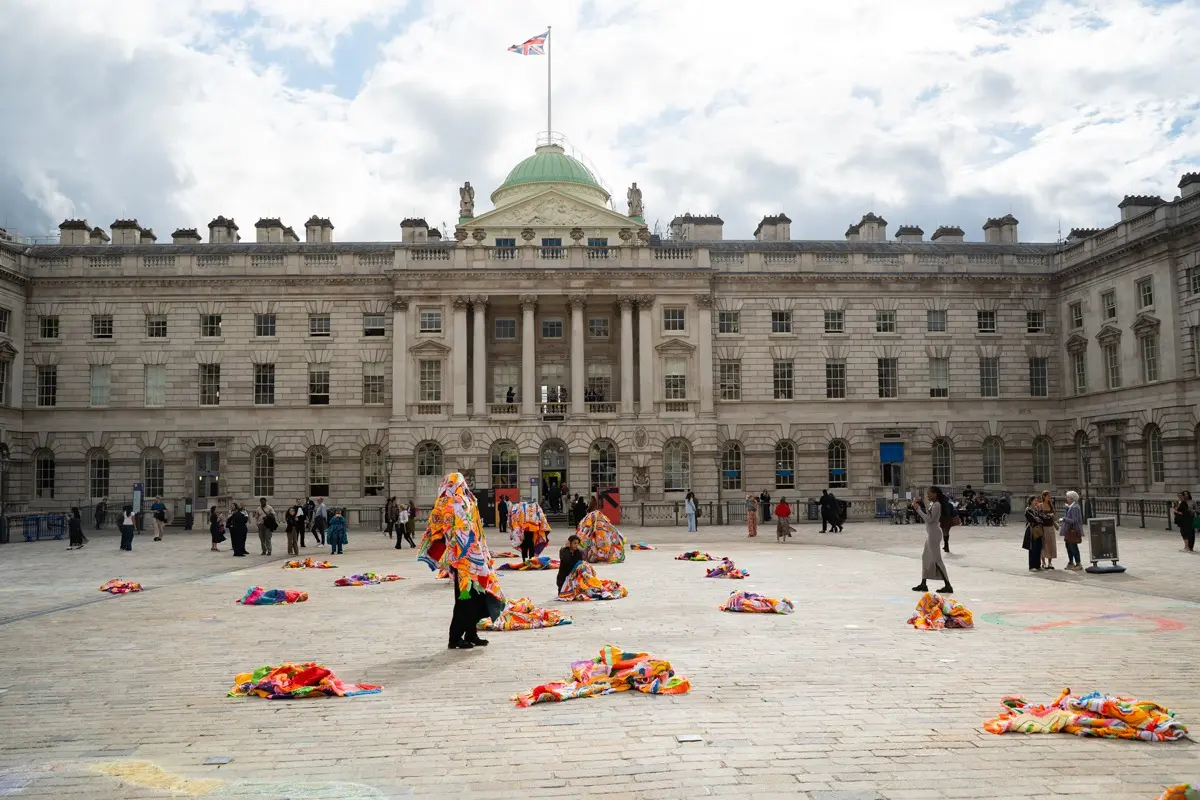
Set against the neoclassical backdrop of Somerset House, the 14th London edition activates both the grand interior galleries and the sprawling open-air plaza. Performances—such as the striking opening presentations featuring participants draped in vibrant, cascading fabrics—have transformed the public spaces into dynamic stages of embodied culture. These ephemeral interventions disrupt the traditional, static viewing experience of the white-cube model, reinforcing the fair’s commitment to multidisciplinary, immersive, and community-engaged art forms.
Supporting Context & Metrics: The State of the African Art Market
Filling the Institutional Vacuum
The timing of Nancy Dantas’s "West Wind" curation highlights a critical inflection point in the art economy. For decades, the global art market marginalized the contributions of mid-20th-century African modernists, categorizing them separately from the canonical narratives of Western modernism. Although the late 2010s and early 2020s saw a surge of corrective institutional exhibitions—such as the landmark School of Paris and various museum retrospectives dedicated to the Khartoum School and the Zaria Rebels—commercial infrastructure remained fragile.
When Sotheby’s dissolved its dedicated African modernism department in 2025, it sent shockwaves through the collecting community, threatening to halt the momentum gained by historical African masters in the secondary market. By integrating a rigorous modernist section into an established contemporary fair, 1-54 has demonstrated a resilient alternative model. Galleries specializing in secondary-market works can now leverage the foot traffic and collector base of a major contemporary fair, ensuring that historical works receive the commercial validation and scholarly attention they deserve.
Economic Impact and Global Collector Demographics
The 1-54 Contemporary African Art Fair continues to serve as an economic barometer for the African art market. Over its fourteen-year run, the fair has contributed to a dramatic increase in auction records for both modern and contemporary African artists.
Key economic indicators at the 2026 London edition include:
International Gallery Participation: Over 40 international galleries representing more than 20 countries, spanning Africa, Europe, North America, and the Middle East.
Institutional Acquisition Funds: An increase in the presence of acquisitions curators from major global institutions, including Tate Modern, the Museum of Modern Art (MoMA), the Centre Pompidou, and the Smithsonian National Museum of African Art.
Collector Base Diversification: A noticeable shift in buyer demographics, featuring a rising cohort of African and diaspora collectors acquiring works for both private collections and nascent philanthropic museums across the continent, alongside traditional institutional buyers from the West.
Official Statements and Curatorial Vision
Touria El Glaoui on the Evolution of the Fair
Reflecting on the milestone 14th edition, fair founder and director Touria El Glaoui emphasized the necessity of continuous adaptation and historical reclamation:
"When we launched 1-54 fourteen years ago, our primary goal was to carve out a permanent, undeniable space for contemporary artists from Africa and its diaspora within the global conversation. Today, as we witness the maturation of our market, it is equally vital that we look backward to look forward. The introduction of ‘West Wind’ allows us to honor the intellectual giants of mid-century modernism who laid the groundwork for the freedoms our contemporary artists enjoy today. We are not just presenting a market; we are building an enduring historical record."
Nancy Dantas on "West Wind" and Miriam Makeba’s Legacy
Curator Nancy Dantas expanded on the conceptual framework driving the modernist showcase, drawing a direct line between post-independence optimism and current artistic output:
"Miriam Makeba’s 1966 anthem ‘West Wind’ was a call for cultural and political unification across a decolonizing world. In curating this section, I wanted to channel that exact spirit of urgency and liberation. The closure of institutional departments elsewhere in the market made it imperative for platforms like 1-54 to step up. By exhibiting masters such as Ibrahim El-Salahi, Bertina Lopes, and Seyni Awa Camara, we are reminding the global art community that African modernism was not a peripheral movement, but a central, vibrant pillar of 20th-century avant-garde art history. These works possess a profound visual resonance that speaks directly to the concerns of contemporary makers."
Future Outlook: The Trajectory of African Modernism and Contemporary Art
As the 14th edition of the 1-54 Contemporary African Art Fair draws to its close at Somerset House, the broader implications of its programming will undoubtedly ripple through the international art world for months to come. The success of the "West Wind" sector proves that there is a voracious, economically viable, and intellectually engaged appetite for the intersection of African modernism and contemporary art.
Looking ahead, the fair’s blueprint offers several key takeaways for the future of the art market:
The Rise of Cross-Generational Booths: Commercial galleries are increasingly recognizing the power of pairing historical masters with contemporary voices. This curatorial strategy not only educates collectors but also contextualizes contemporary practices within a deep, unbroken historical lineage.
Decentralization of Art History: The proactive stance taken by independent fairs in the wake of corporate restructuring (such as Sotheby’s 2025 department closure) demonstrates that the preservation and promotion of art history can no longer rely solely on legacy auction houses. Independent fairs, grassroots institutions, and specialized galleries are taking ownership of the art historical canon.
Infrastructure Growth Across the Continent: With the continued proliferation of private museums, residency programs, and independent art spaces in cities like Lagos, Dakar, Marrakech, Johannesburg, and Nairobi, the dependency on Western validation is steadily diminishing. Fairs like 1-54 act as vital bridges connecting these thriving local ecosystems with global capital and institutional networks.
Ultimately, 1-54 London has cemented its role as much more than a commercial marketplace. It has evolved into an essential cultural institution—a space where history is preserved, contemporary boundaries are pushed, and the multifaceted narratives of Africa and its diaspora are told on their own terms.




Comments
Facebook App ID not configured. Please add it in the Customizer.