For well over a century, art history has largely relegated Eva Gonzalès to a historical footnote—remembered primarily as Édouard Manet’s sole formal pupil, the subject of a famous monumental portrait, or as a peripheral figure hovering in the brilliant orbit of late 19th-century French painting. But a landmark exhibition at Paris’s Petit Palais is aggressively upending that narrative. Titled "Eva Gonzalès (1847–1883): A Free-Spirited Artist’s Journey" and running through January, the comprehensive retrospective gathers some 70 works by Gonzalès alongside key pieces from her contemporaries, mounting a rigorous, long-overdue defense of her independent artistic identity.
Originally planned for 2020 as part of the Normandie Impressionniste festival by the Château-Musée de Dieppe, the exhibition was shelved by the onset of the global pandemic. Yet, this six-year delay proved fortuitous. It allowed the curatorial team—co-curator Stéphanie Cantarutti and conservator Marianne Mathieu—to secure loans that would have otherwise been out of reach, including Manet’s 1870 Portrait of Eva Gonzalès from the National Gallery in London, Gonzalès’s Une loge aux Italiens (ca. 1874) from the Musée d’Orsay, and the long-lost Le Moineau (ca. 1865–70), a delicate pastel portrait of a young girl with a sparrow whose whereabouts had remained a mystery for decades.
Beyond assembling a breathtaking visual survey, the exhibition delivers groundbreaking art-historical revelations. Through meticulous archival work, the curators discovered a misread digit on her birth certificate, correcting her birth year from 1849 to 1847. Furthermore, extensive technical and historical research led to the redating and renaming of multiple canvases. Crucially, the retrospective makes a bold curatorial departure: it entirely rejects the label of "Impressionism," positioning Gonzalès not as a stray member of the avant-garde cooperative, but as a fiercely independent Salon painter who forged her own unique path under the controversial aegis of Manet.
The path to rescuing Eva Gonzalès from historical obscurity began with the ink on a 19th-century document. As co-curator Stéphanie Cantarutti explained, the breakthrough came from a microscopic re-examination of the artist’s birth records. "What tipped us off was the way the date was written on the birth certificate," Cantarutti noted. "After taking a closer look at the document, we realized that she had been born in 1847, not 1849." This two-year correction shifts our understanding of her developmental timeline, compressing her remarkably productive career into a tragically truncated 36 years.
This archival rigor extended directly to the cataloging of her oeuvre. The curatorial team deployed advanced stylistic analysis and provenance tracking to re-examine key pieces, resulting in significant shifts in titles and dates. For instance, La Fenêtre (1869–70) was properly renamed Le Catéchisme, while La Psyché was redated to 1868–69, moving it back from its previously assigned 1869–70 window.
Gonzalès’s pedagogical lineage was similarly complex. Initially, she studied under Charles Chaplin, an instructor who notoriously believed that female artists had no business maintaining independent studios. Restless under such limitations, Gonzalès left Chaplin’s studio in 1868 and, after meeting Manet at the salon of painter Alfred Stevens in 1869, became his sole formal pupil.
Yet, navigating the Parisian art world required strategic maneuvering. When Gonzalès submitted work to the 1870 Salon, she officially registered as a pupil of Chaplin—perhaps hedging her bets against Manet’s notorious reputation among conservative Salon juries. However, her accepted painting, Enfant de troupe (1869–70), which depicted a young boy in a military uniform holding a bugle against a dark ground, bore the unmistakable stylistic DNA of Manet’s Le Fifre (1866). Enfant de troupe achieved the distinction of being her only work acquired by the French state during her lifetime, though the acquisition was likely greased by the considerable literary and political connections of her father, the prominent writer Emmanuel Gonzalès.
The professional and personal entanglements deepened when Manet exhibited his 6.25-foot-tall Portrait d’Eva Gonzalès at that same 1870 Salon. While immortalizing her in art history, the portrait drew heavy fire from critics; family friend and journalist Armand Lapointe publicly dismissed the painting as a failure and reproached Gonzalès for agreeing to sit for it. Ironically, by 1874—the first year she officially registered as Manet’s pupil at the Salon—her submission, Une loge aux Italiens, was abruptly rejected by the jury.
Supporting Context and Art-Historical Metrics
To fully grasp Gonzalès’s unique standing in 19th-century French art, curators at the Petit Palais emphasize the divergence between her career strategy and that of her female contemporary, Berthe Morisot. Both women came from privileged bourgeois families, faced biting criticism for their independence, frequently used their sisters as models, retained their maiden names after marriage, and maintained deep ties to Manet.
However, their professional trajectories diverged sharply. Morisot, acting against Manet’s direct counsel, ultimately turned her back on the conservative Salon system to join the cooperative society of artists who would become known as the Impressionists. Furthermore, Morisot fought bitterly against Manet’s artistic dominance—particularly after Manet took a brush to one of her canvases and substantially retouched it in 1870.
Gonzalès took the opposite route. She embraced Manet’s guidance and deliberately targeted the official Salon. "Her strategy was, like Manet’s, to establish herself at the Salon," conservator Marianne Mathieu observed. "Morisot sought to emancipate herself from the very idea of artistic affiliation, even if that meant becoming part of an emerging avant-garde. Gonzalès, by contrast, boldly claimed her allegiance to Manet, who was a controversial figure at the time."
Because Gonzalès never exhibited with the Impressionists, the Petit Palais took the bold step of purging the word "Impressionism" from all exhibition materials. This curatorial stance corrects a century-old misclassification that began in 1904, when critic Camille Laurent Mauclair first lumped her into the Impressionist camp—an association cemented by a 1993 exhibition at Paris’s Musée Marmottan Monet that grouped her alongside Morisot and Mary Cassatt.
Stylistically, Gonzalès’s work reflects the tightrope walked by female artists of her era. Confined largely to subjects deemed socially acceptable—domestic scenes, family portraits, leisure activities, and still lifes—she utilized these intimate themes to build a respectable reputation without provoking immediate moral outrage. Yet, beneath the veneer of bourgeois decorum lay a fiery execution. As critic Jean-Marie Tasset remarked, "Behind her intimate scenes and landscapes lies a fierce energy, a blazing fire that reveals itself as soon as Eva sets her brush to canvas. All the dark magic of the blue note."
Her later works, such as Miss et Bébé (1877–78) and the fragile Pommes d’Api (owned by the Minneapolis Institute of Art), demonstrate a distinct evolution away from the smooth, porcelain-like finishes of her early Chaplin-esque period toward high-chroma palettes, bolder color contrasts, and increasingly spontaneous brushwork.
Official Statements and Curatorial Vision
The exhibition’s success is a testament to years of quiet detective work and institutional persistence. Reflecting on the six-year delay caused by the pandemic, co-curator Stéphanie Cantarutti noted the silver lining:
"In the end, time worked in our favor. Now, Manet’s Portrait of Eva Gonzalès from the National Gallery and Gonzalès’s Une loge aux Italiens from the Musée d’Orsay can be included, as can Gonzalès’s Le Moineau, which the curatorial team managed to track down after decades of its whereabouts being unknown."
Addressing the persistent mislabeling of the artist’s output, Cantarutti was uncompromising in her rejection of historical shorthand:
"I am personally opposed to this affiliation. I fought to ensure that the term ‘Impressionism’ would not appear in any communication materials. The exhibition in no way presents her as an Impressionist."
The narrative at the Petit Palais also explores her personal life, including her romance with Henri Guérard, a talented engraver who collaborated with Manet, Cézanne, Pissarro, and Dr. Gachet. Married in 1879, their partnership was cut short by Gonzalès’s sudden death in 1883. In a twist stranger than fiction, Guérard later married Gonzalès’s sister and favorite model, Jeanne—an outcome that Gonzalès appears to have eerily foreshadowed in Une loge aux Italiens, where the man and woman depicted in the theater box are, in fact, Guérard and Jeanne.
"There is material for a great movie scenario, for sure," Cantarutti laughed. "We, however, chose to stick to the facts."
Future Outlook and Legacy
Why did Eva Gonzalès fade so completely from the mainstream historical canon while her contemporaries secured household-name status? Cantarutti points to two primary factors. First, the burden of maintaining her legacy fell almost entirely on her son, Jean-Raimond Guérard. Unlike Berthe Morisot, whose daughter Julie Manet was surrounded by cultural titans like Stéphane Mallarmé, Claude Monet, and Edgar Degas—and whose son-in-law Ernest Rouart actively campaigned for the family’s artistic legacy—Gonzalès lacked a robust institutional echo chamber.
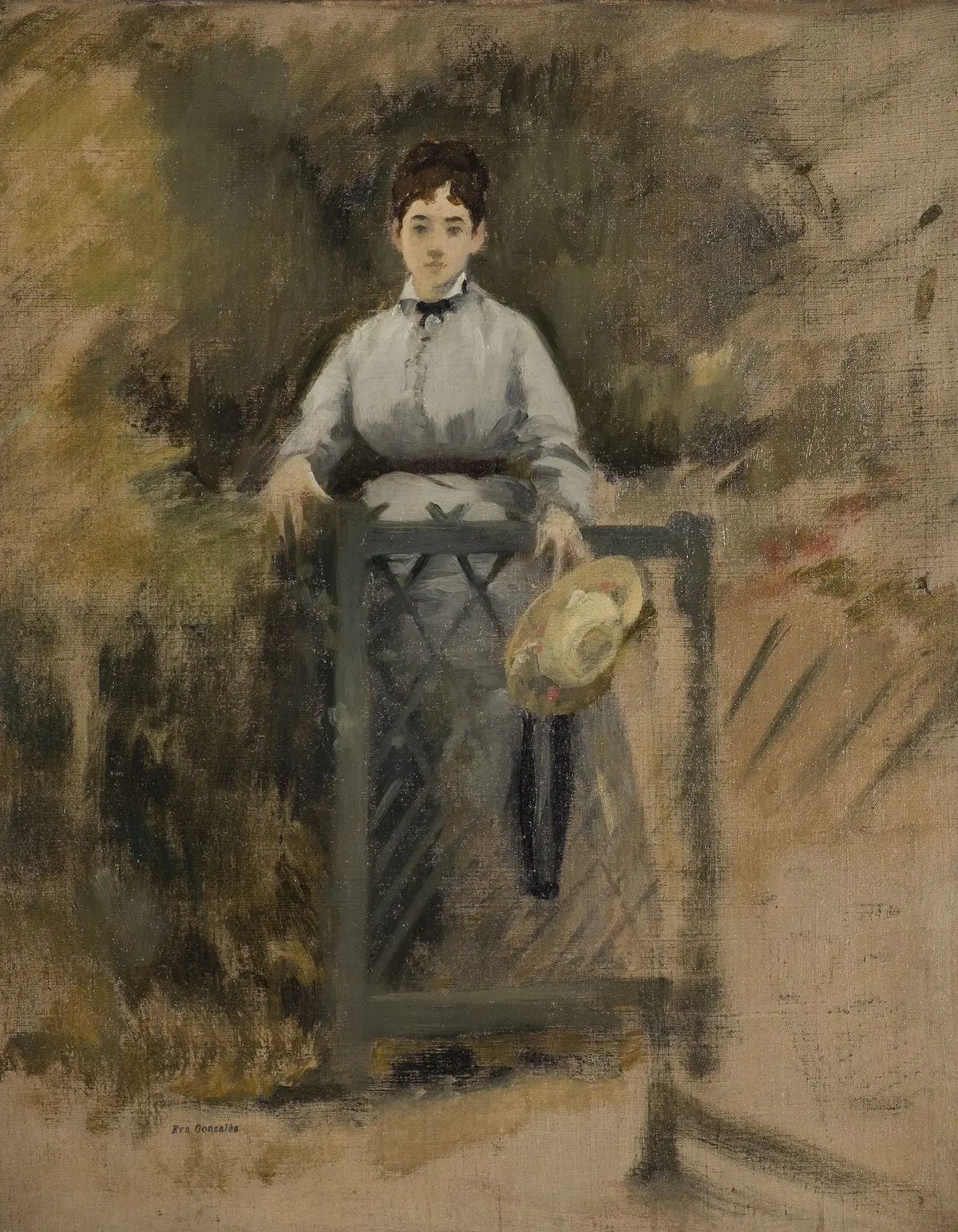
Second, French national museums held remarkably few of her works. Aside from La Matinée rose (1874), acquired by the French state in 1885, more than 135 years elapsed before the Petit Palais purchased an oil painting by her, acquiring La Servante ou À la barrière (ca. 1865–70) in 2021. The vast majority of her output remains scattered across private collections worldwide.
Nevertheless, this retrospective marks a watershed moment. By bringing together roughly 70 works—accounting for about two-thirds of her surviving corpus—the Petit Palais has reconstructed something approaching the scale of her 1885 posthumous exhibition.
Gonzalès has spent far too long being defined by her relationships—as someone’s daughter, someone’s model, or someone’s pupil. By stepping inside the Petit Palais exhibition, visitors are finally given the long-denied opportunity to evaluate her on her own terms: as an extraordinarily gifted, fiercely independent painter whose artistic flame, though burning far too briefly, illuminated a brilliant path of her own making.




Comments
Facebook App ID not configured. Please add it in the Customizer.