
Executive Overview
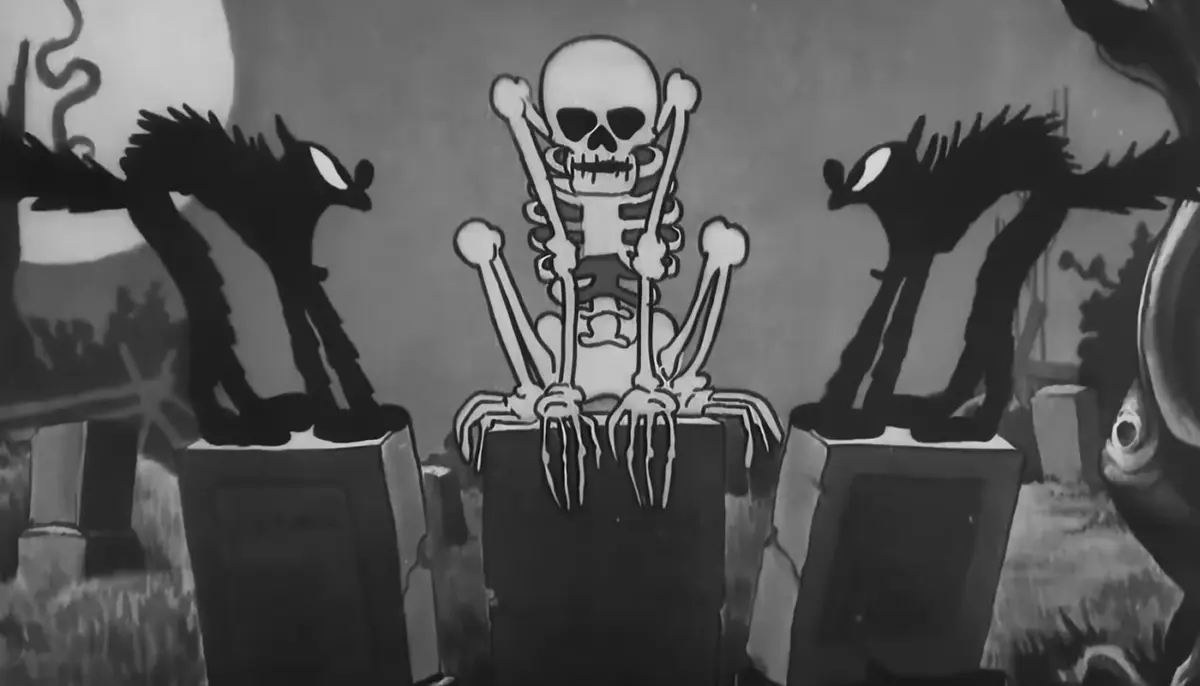
Nearly a century after its cinematic debut, Walt Disney’s The Skeleton Dance (1929) remains a foundational milestone in the history of animated film. As the inaugural entry in the celebrated Silly Symphonies series, this seven-minute black-and-white short established a symbiotic relationship between visual animation and musical scoring that forever transformed cinematic storytelling. Directed and animated by legendary pioneer Ub Iwerks, with a score curated and composed alongside Carl Stalling, the film broke technological barriers by deploying Pat Powers’ sound-on-film Cinephone process. This innovation allowed for absolute synchronization between on-screen action and auditory cue, creating a seamless ballet of the deceased that enchanted and unnerved audiences globally.
Beyond its technical triumphs, The Skeleton Dance represents a crucial nexus where early 20th-century entertainment traditions converge with the medieval European motif of the danse macabre. Far from an isolated novelty, Disney and Iwerks’ creation tapped into a centuries-old artistic lineage—from 14th-century plague-era frescoes and 19th-century magic lantern shows to late-Victorian stage spectacles. The short not only catapulted Walt Disney Productions into unprecedented cultural prominence, sparking historic second runs at major venues like New York’s Roxy Theatre, but also forged a permanent psychological imprint on generations of future filmmakers, animators, and artists. This investigative retrospective examines the technological genesis, cultural lineages, musical archaeology, and enduring legacy of an animation masterpiece that turned mortality into a high-kicking celebration.
Detailed Chronology: From Medieval Allegory to Celluloid Innovation
The Medieval Roots and the Danse Macabre
The philosophical DNA of The Skeleton Dance stretches far beyond the roaring twenties, plunging into the grim realities of 14th-century Europe. Emerging in the wake of the Black Death, the Great Famine, and the Hundred Years’ War, the danse macabre (or Totentanz) functioned as a visceral form of memento mori—a stark reminder that mortality spares no one, bridging the socioeconomic chasm between kings and peasants, popes and children. Painted on the interior walls of European churches and distributed via early printed pamphlets, these allegorical scenes featured skeletal figures leading the living toward their final resting place.
Read Also
While the institutional Church originally deployed these motifs to encourage spiritual repentance and pious reflection, the artistic subtext often suggested an inverse philosophy: a carpe diem imperative urging humanity to revel while breath remained. This subversive, joyful embrace of the afterlife migrated through global art history, surfacing in 19th-century Mexican broadsheets by José Guadalupe Posada, Japanese woodblock prints by Kawanabe Kyōsai, and Chinese imperial silk fans depicting skeletal puppetry.
The Stage Precursors and Vaudeville Spectacle
Before the advent of motion pictures, the trope of the dancing skeleton was a staple of physical theatre, magic shows, and vaudeville. By the late 19th century, stage productions like The Black Crook featured papier-mâché and wire-controlled skeletons performing intricate high kicks, limb dismemberments, and self-reassembly acts. Magic lantern shows and early optical toys, such as the Choreutoscope, relied heavily on skeletal choreography to captivate audiences.
By the 1920s, human performers, contortionists, and burlesque showgirls routinely donned phosphorescent or skeletal bodysuits to execute precision routines across American stages. It was this vibrant vaudevillian tradition that composer Carl Stalling recalled from his youth, planting the seed for what would become Disney’s groundbreaking animated short.
The 1929 Breakthrough and Cinematic Reception
In 1928, fresh off the cultural impact of Steamboat Willie and the dialogue-driven milestones of Mickey Mouse cartoons, Walt Disney and Ub Iwerks set out to redefine the parameters of animated synchronicity. Utilizing the sound-on-film Cinephone system—which bypassed the catastrophic sync slippages inherent in early phonograph-disc technologies like Vitaphone—Iwerks and Stalling meticulously matched every graphic movement to the cadence of the score.
Premiering in the summer of 1929 and distributed nationally by Columbia Pictures, The Skeleton Dance achieved an unprecedented theatrical triumph. Booked alongside a feature film at New York’s prestigious Roxy Theatre, the short generated such overwhelming public demand that management re-booked it for a second engagement—marking a historic first for any motion picture short or feature. Trade publications marveled at its structural precision, while high-profile audience members, including a young Joseph Barbera and Ray Bradbury, experienced foundational artistic awakenings that would shape their respective creative trajectories.
Supporting Context & Metrics
To fully comprehend the magnitude of The Skeleton Dance, one must evaluate the technological, financial, and cultural metrics that defined its production and release era:
- Release Date: August 22, 1929 (New York City premiere at the Roxy Theatre).
- Production Studio: Walt Disney Productions (Released under Celebrity Productions / Columbia Pictures distribution).
- Key Personnel: Produced and directed by Walt Disney; Chief Animator and Designer: Ub Iwerks; Musical Arranger and Composer: Carl Stalling.
- Technological Medium: Recorded using Pat Powers’ sound-on-film Cinephone process, ensuring frame-accurate synchronization between orchestral score and visual gags.
- Box Office / Theatrical Milestone: First film of any classification to secure a mandatory holdover and re-engagement at the 6,000-seat Roxy Theatre in New York.
- Artistic Lineage Traced: Spans 14th-century European danse macabre frescoes, 17th-century magic lantern projections (1659), 19th-century stage mechanizations (The Black Crook, 1893), and early motion picture precursors (American Mutoscope’s The Dancing Skeleton, 1897).
Official Statements and Archival Insights
The genesis and reception of The Skeleton Dance are well-documented through historical correspondence, trade reviews, and retrospective accounts from the medium’s foundational architects:
- Walt Disney, in a 1928 correspondence to his brother Roy Disney: Outlining the initial pitch provided by Carl Stalling, Walt recognized the profound commercial and artistic potential of the project, noting that a musically driven graveyard dance possessed "dandy possibilities."
- Carl Stalling, reflecting on his childhood inspirations: Explaining his lifelong fascination with skeletal performance, Stalling noted in historical interviews that "ever since I was a kid I had wanted to see real skeletons dancing," drawing direct inspiration from early mechanical toys and vaudeville novelty acts.
- Variety (August 1929 Review): Hailing the unprecedented technical execution of the short’s premiere, the trade publication praised the picture as "perfectly timed," though it famously appended a tongue-in-cheek advisory for family audiences: "Don’t bring your children."
- Ray Bradbury, writing in Bradbury Speaks: Describing the visceral, transformative impact the short had on him as an eight-year-old viewer, Bradbury characterized the film as "a five-minute lightning bolt that knocked the soul out of my eight-year-old body and vacuumed it back in, bright, clean, refurbished, hyperventilated, new."
- Joseph Barbera, co-founder of Hanna-Barbera: Recalling his experience in the audience at the Roxy Theatre, Barbera marveled at the technical choreography: "I saw these skeletons dancing in a row and in unison, and I asked myself: How do you do that? How do you make that happen?"
Future Outlook: The Indelible Blueprint of Animated Horror-Comedy
As The Skeleton Dance approaches its centenary, its status as a cornerstone of global visual culture remains unchallenged. The short effectively wrote the foundational grammar for the horror-comedy genre in animation, proving that terror and mirth are not mutually exclusive, but rather complementary facets of human storytelling. The technical demands pioneered by Ub Iwerks—demanding absolute, mathematically precise alignment between musical phrasing and graphic movement—set an uncompromising standard that elevated animation from a novelty trade into a high-art discipline.
In contemporary media, the DNA of The Skeleton Dance is unmistakable. From the intricate stop-motion skeletal ballets in Tim Burton’s The Nightmare Before Christmas and Corpse Bride to pop-culture mainstays like Saturday Night Live’s "David S. Pumpkins" sketches and countless digital iterations, creators continually return to the visual rhythm established in 1929. By stripping away mortal vanity and reframing the inevitable end of life as an excuse for an energetic, bone-rattling jazz routine, Disney and Iwerks achieved true cultural immortality. The Skeleton Dance endures because it reminds modern audiences of a timeless, liberating truth: even in the shadow of the grave, there is always time for a dance.

Comments
Facebook App ID not configured. Please add it in the Customizer.