
Executive Overview
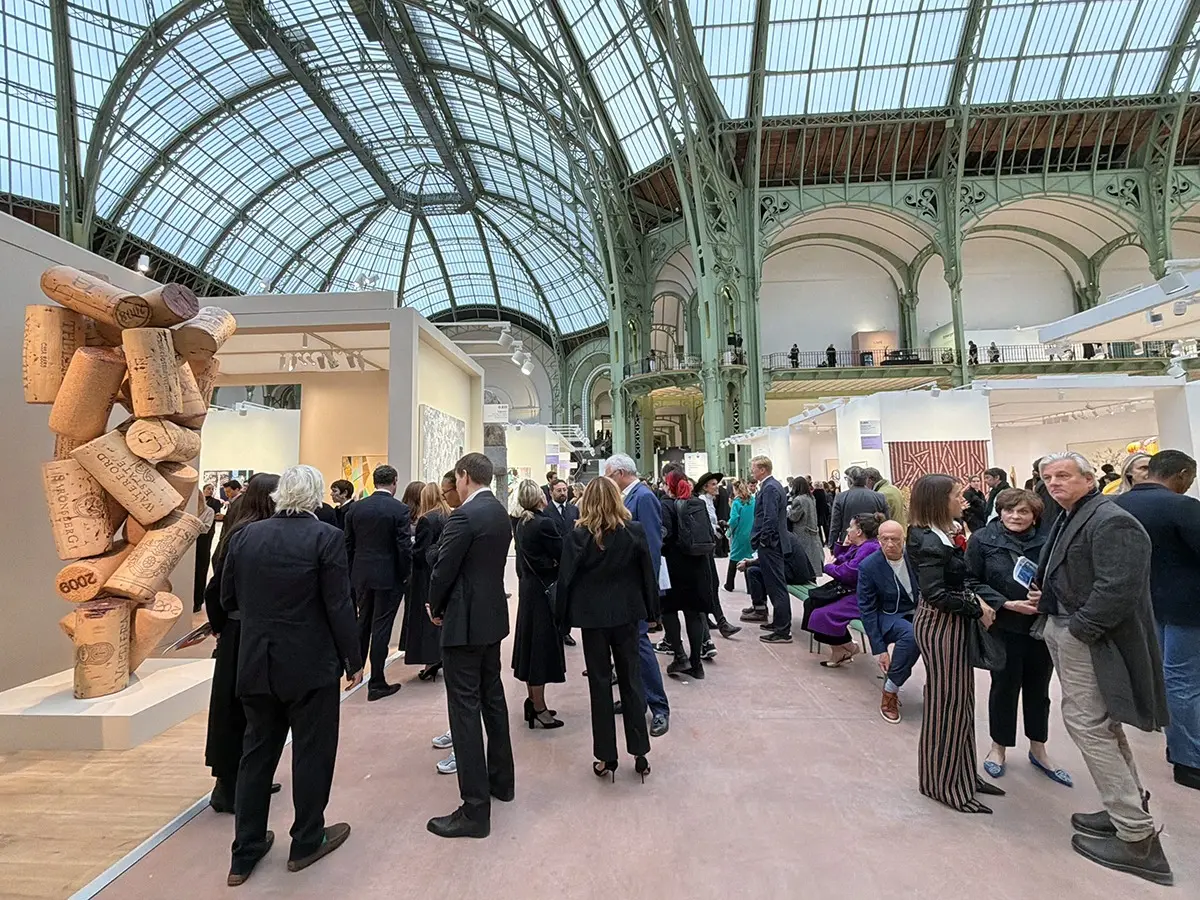
Parisian streets bore the physical reminders of weekend protests across multiple arrondissements, yet the international art market remained entirely unperturbed as Art Basel Paris launched its highly anticipated 2026 edition. Defying the logistical disruptions and lingering tensions of civil unrest, the global art community converged on the French capital, pressing forward with business as usual. The proceedings culminated sharply at 3:00 p.m. on Tuesday with the opening of the Avant Première—Art Basel Paris’s exclusive ultra-VIP preview event housed within the magnificent, light-filled vaults of the Grand Palais.
While the queues outside the architectural masterpiece were noticeably more restrained compared to the blockbuster debut of the Avant Première initiative the previous year, the subdued foot traffic proved to be a strategic filtering mechanism rather than a sign of waning interest. Aisles were comfortably navigable, and blue-chip booths hummed with serious transactional momentum. Galleries and fair organizers had evidently refined their invitation lists, curating an environment tailored strictly to high-net-worth buyers, seasoned connoisseurs, and institutional leaders.
Despite whispers of cautious collectors canceling travel plans due to local demonstrations, the anticipated absence of international heavyweights—particularly American patrons—failed to materialize. Instead, the Grand Palais boasted a dense constellation of top-tier global collectors, major museum directors, and prominent cultural figures. Amid a shifting macroeconomic climate and widespread market recalibration characterized by price skepticism, the opening hours proved that when exceptional works meet undeniable provenance, Paris continues to captivate, seduce, and command the highest echelons of global capital.
Read Also
Detailed Chronology: The Avant Première Unveiling
The rhythm of the opening day unfolded with a distinct cadence, shaped by the condensed timeline of the Avant Première. Unlike traditional multi-day public fairs that allow for gradual acclimatization, the ultra-VIP preview demanded immediate, decisive action from both dealers and collectors.
As the doors swung open at 3:00 p.m., the initial ambiance inside the Grand Palais was defined by focused intensity rather than chaotic fervor. Within the first hour, local and international galleries alike reported an immediate surge of positive energy. Mathieu Templon of Paris-based Galerie Templon noted the immediate sense of being in familiar territory, observing that the fair was "off to a great start." Templon quickly secured the gallery’s first major confirmed sale: Bilal Hamdad’s evocative 2026 canvas L’envers du soir, which traded for €65,000. Hamdad, who enjoyed a celebrated solo exhibition at the Petit Palais during the previous year’s iteration of Art Basel Paris, is currently experiencing an unprecedented wave of demand ahead of his highly anticipated solo show in March.
By late afternoon, the initial calm gave way to a brisk, high-stakes transactional pace. Because of the compressed format of the Avant Première, galleries were challenged to close transactions rapidly, leading to a shift away from the exhaustive, cumulative sales reports typically published at the close of standard opening days. Yet, the velocity of the deals executed within those initial four hours demonstrated that serious collectors came prepared to buy.
Major international galleries reported a steady stream of marquee acquisitions. Thaddaeus Ropac unveiled a staggering lineup, anchored by four historic Picassos dating from 1906 to 1938, a 1953 mixed-media work by Lucio Fontana commanding €1.8 million, and a striking 2019 painting by Georg Baselitz fetching €800,000. Ropac noted that while the stellar results were well within expectations, the underlying dynamic of the Parisian market favored speed and decisiveness.
Nearby, Hauser & Wirth executed a series of multi-million-dollar transactions that set a dizzying benchmark for the afternoon. In a surprise addition to their booth not featured in early previews, the gallery placed Gerhard Richter’s rare 1965 masterpiece Rokokotisch (Rococo Table) for a price in the region of $10 million. This was swiftly followed by the sale of Georg Baselitz’s 1965 canvas Der Hirte (The Shepherd), also fetching approximately $10 million. Additional high-profile placements included George Condo’s Woman with Designer Shirt (2026) for $2.9 million, Lucio Fontana’s 1961 Concetto spaziale for €1.7 million ($1.9 million), Philip Guston’s Untitled (1969) for $1.5 million, and Alexander Calder’s Four Dots and Brass Tail (ca. 1953) just shy of the $1 million threshold.

Supporting Context & Metrics: Navigating the Global Market
The robust opening figures arrive against the backdrop of a broader structural evolution within the international art market. For years, analysts have monitored a healthy rivalry between London and Paris as Europe’s premier cultural marketplace. Observing this dynamic, collector Will Paley—who divides his time between New York and São Paulo—offered a nuanced perspective on the complementary nature of the continent’s premier fairs.
"Frieze is primarily for young galleries, young artists, and young collectors with a more adventurous tone," Paley noted, contrasting it directly with Art Basel Paris, which operates at a significantly higher price point and caters to institutional-grade legacy acquisitions.
This structural divergence was further underscored by the strategic layout of Art Basel Paris 2026, which featured a record 12 shared booths representing 24 distinct galleries—the highest number in the event’s history. This collaborative approach highlighted how mid-sized and avant-garde galleries are pooling resources to maximize their market footprint during a period of ongoing economic adjustment.
A prime example of this cooperative model unfolded on the fair’s second floor, where Vienna-based Layr and Berlin/Munich-based Kraupa-Tuskany Zeidler shared a meticulously curated space. The joint presentation bridged historical and contemporary practices, pairing Franz West’s interactive 1983/1984 Passstück (prosthetic sculptures designed to alter human movement) with Anna Uddenberg’s dystopian 2026 sculpture White Noise (Soft Skills), featuring a faceless mannequin contorted around futuristic, ergonomic office contraptions.
Amadeo Kraupa-Tuskany confirmed that the collaborative risk yielded substantial rewards, noting that multiple works were successfully placed into prominent European collections, while Emanuel Layr emphasized successful placements with American institutional patrons. This spirit of creative partnership reflects a broader market reality: in an era of heightened buyer scrutiny, galleries must project transparency, research-backed authority, and dynamic presentation models.
Official Statements and Institutional Presence
Despite lingering anxieties regarding local transit disruptions and weekend demonstrations, the global cultural elite turned out in force, validating the unmatched drawing power of the French capital.
The floors of the Grand Palais were heavily populated by members of ARTnews’s Top 200 Collectors, including Allison Berg, Glenn Fuhrman, Pamela Joyner, Nancy A. Nasher, Bob Clark, Jason and Michelle Rubell, Anne-Cecilie Speyer, Jessica Seinfeld, and Adam Lindemann. Hollywood was likewise represented by actresses Katie Holmes and Natalie Portman.
Institutional leadership made an equally formidable showing. Museum directors and senior curators traversing the aisles included Michael Govan (Los Angeles County Museum of Art), Massimiliano Gioni (New Museum), Ruba Katrib (MoMA PS1), Giampaolo Bianconi (Art Institute of Chicago), and a robust delegation from the Metropolitan Museum of Art led by Director Max Hollein and Head of Modern and Contemporary Art David Breslin, who accompanied a large group of Met trustees to Paris.

Art adviser Ana Sokoloff praised the intentionality of the presentations, noting that the booths felt exceptionally well-researched and curated.
"This place is magical," Sokoloff remarked. "It is hard not to be seduced by the Grand Palais."
However, art world leaders also acknowledged the unique logistical hurdles posed by hosting a fair embedded deeply within a vibrant metropolis. Marc Payot, president of Hauser & Wirth, pointed out that while the density of top-tier collectors remains the fair’s greatest asset, it introduces distinct distractions.
"The problematic side is that you get distracted by the city," Payot explained. "People come here to see a thousand things."
Thaddaeus Ropac echoed this sentiment, observing that collectors in Paris frequently operate on an accelerated decision-making timeline because they are constantly dividing their attention between the fair, private gallery openings across the Marais and Saint-Germain-des-Prés, museum retrospectives, and cultural excursions.
Nevertheless, the pinnacle of the fair’s market offerings commanded undivided attention. Pace Di Donna Schrader delivered what was widely acknowledged as the most expensive museum-grade offering of the week: Amedeo Modigliani’s rare, striking 1917 reclining nude, Nu étendu (Lolotte), valued in excess of $100 million. Unseen in public for roughly a century, the canvas carries historic weight as part of Modigliani’s infamous 1917 exhibition at Galerie Berthe Weill—a show that ignited public outcry for indecency and remained the only solo exhibition held during the artist’s lifetime. Emmanuel Di Donna reported an overwhelming initial response, characterizing the overall sales velocity as akin to "drinking from a fire hose."
Additional major institutional-tier transactions highlighted the depth of the collector base:
- Gagosian declined to disclose exact pricing but confirmed the eight-figure private sale of a 1987 Willem de Kooning, alongside a major painting by Peter Doig.
- White Cube reported 16 total sales, anchored by two significant paintings by Julie Mehretu (dating from 2001 and 2018) which traded for $7.85 million each, alongside historical works on paper by Picasso (€150,000) and Léger (€65,000).
- Gladstone Gallery placed a Victor Man painting for $1.3 million and two collage works by Wangechi Mutu for $325,000 each.
- Xavier Hufkens recorded 10 sales, led by a Charline von Heyl painting at $475,000. Summing up the mood of resilience, Hufkens invoked the historic motto of the French capital: "Fluctuat nec mergitur [Tossed by the waves, but never sinks]. It feels particularly fitting this week."
- David Kordansky Gallery confirmed the conversion of multiple advance holds into confirmed sales, including a rare hard-edge abstraction by Sam Gilliam, Mycenaean Ode (1965), which fetched $300,000.
Future Outlook: A Calibrated Market Built on Trust
As Art Basel Paris transitions from its exclusive Avant Première into its broader public and VIP operational days, market analysts are utilizing the early data points to map the trajectory of the high-end art trade heading into the close of 2026.

Art adviser Nicolas Nahab, co-founder of NG Partners, offered a penetrating analysis of contemporary buyer psychology, pointing to a fundamental shift in how collectors approach acquisitions. According to Nahab, the art market is navigating a prolonged "period of adjustment," driven largely by lingering skepticism regarding inflated valuations for ultra-contemporary works.
"Collectors today don’t trust prices like they used to, and don’t take them at face value," Nahab explained. "This lack of trust makes them doubt and interrogate information given to them. They need reassurance, research, and a global understanding of an artist’s practice and market before making a decision, which is why the decision-making is so slow."
Yet, Nahab emphasized that this friction disappears when absolute transparency and institutional validation are present. "If trust is there," he noted, "then the decision is easy for collectors."
The resounding success of blue-chip offerings—ranging from million-dollar Calders and Richter masterpieces to historic Picassos and rare Modiglianis—suggests that capital has not retreated from the market; rather, it has become rigorously selective. Buyers are increasingly migrating toward historical weight, verified secondary-market pedigree, and museum-vetted blue-chip inventory where value retention is demonstrably secure.
Despite urban disruptions, shifting economic paradigms, and a more measured transactional pace, Art Basel Paris 2026 has successfully reinforced its status as an indispensable pillar of the global cultural calendar. By pairing architectural grandeur with elite institutional participation, the fair has proven that even when tested by the restless, contradictory energy of a capital city in motion, the international art market remains remarkably buoyant—anchored firmly by deep-pocketed connoisseurs who continue to seek out, invest in, and champion exceptional art.

Comments
Facebook App ID not configured. Please add it in the Customizer.