
Executive Overview
In the contemporary literary landscape, the genre of religious and spiritual autobiography has undergone a seismic shift. Publishers, academic press editors, and prominent literary agents agree that the days of the simple, anecdotal faith memoir—narratives sprinkled with tidy moral lessons and superficial spiritual takeaways—are effectively over. Today’s modern religious memoir must carry a heavier load: it requires an explicit purpose, a complex set of ideas to propound, urgent messages to deliver, and a profound capacity to challenge and inspire an increasingly skeptical readership.
Whether penned by high-profile political figures navigating the storm of hyper-partisan culture wars, everyday individuals breaking free from institutional dogma, or academics plumbing historical archives for forgotten blueprints of justice, the modern spiritual book operates on multiple levels. It pairs an irreproducible, deeply intimate human experience with a sweeping societal macro-lens. As publishers prepare their slates for late 2026 and 2027, the mandate for the religious and spiritual memoir is clear: it must speak directly to the stakes of a fractured public square, offering depth, dissent, and a fierce reclamation of faith as a force for public accountability.
Detailed Chronology: Upcoming Releases Shaping the Genre
The evolution of the modern spiritual memoir is best mapped across the forthcoming publishing seasons, where a diverse array of political, academic, and intensely personal narratives are set to hit shelves.
Read Also
Fall 2026: Politics, Autonomy, and Crisis
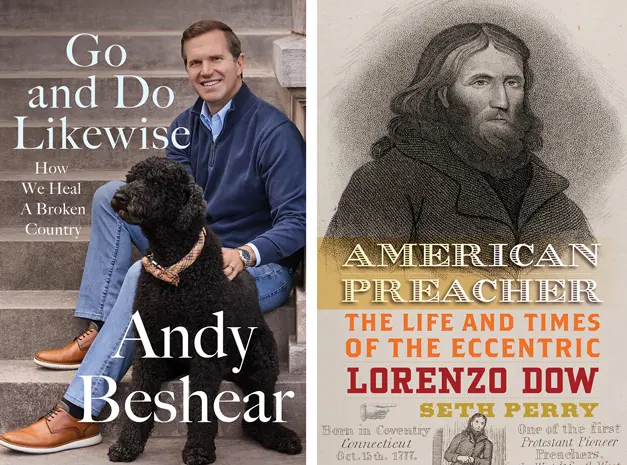
- September 2026 — Go and Do Likewise: How We Heal a Broken Country by Andy Beshear (St. Martin’s Press): Kentucky Governor and 2028 presidential hopeful Andy Beshear anchors his political manifesto in the biblical parable of the Good Samaritan. The publisher positions the book as an intentional effort to reclaim faith as a force for good against the backdrop of contemporary polarization.
- September 2026 — Thirsty for a Miracle: They Needed Clean Water. He Needed True Purpose by Greg Allgood (Tyndale Refresh): Shifting from high politics to grassroots altruism, this evangelically framed memoir chronicles Allgood’s spiritual calling to leave a lucrative corporate career behind to spearhead clean-water initiatives through the international relief organization World Vision.
- October 2026 — This Is What Happens When Women Read by Julianna Glasse (Spiegel & Grau): A raw account of personal deconstruction, Glasse’s memoir follows her life as a devout pastor’s daughter attempting to live as a biblically submissive wife. When her husband discovers her hidden cache of philosophy texts—Plato and Emerson—and denounces her with the titular line, the resulting marital fracture catalyzes her journey toward intellectual and spiritual autonomy.
- October 2026 — On Another Planet They Can Save Me by Lieke Marsman, translated by Sophie Collins (Catapult): Posthumously published, this memoir by the late Dutch poet laureate explores the spiritual awakenings of a lifelong secularist. Diagnosed with terminal bone cancer, Marsman turned to philosophy and theology, interrogating whether a purely rational worldview could survive the reality of mortality.
- November 2026 — Unapologetic: Clarity and Conviction in a World Gone Crazy by Sarah Huckabee Sanders (St. Martin’s Press): Arkansas Governor Sarah Huckabee Sanders reflects on her tenure in high-stakes public service and her personal battle with a cancer diagnosis, attributing her resilience to the bedrock of her Baptist faith.
- November 2026 — American Preacher: The Life and Times of the Eccentric Lorenzo Dow by Seth Perry (University of Pennsylvania Press): Stepping into early American history, Princeton religion professor Seth Perry examines the 19th-century itinerant preacher Lorenzo Dow, tracing how his brand of emotional, populist Protestantism laid the groundwork for modern American political and cultural rhetoric.
Winter and Spring 2027: Confronting Nationalism and Identity
- February 2027 — Rooting Out Injustice, First in Ourselves: The Faith and Practice of Bayard Rustin by Sarah Azaransky (Eerdmans): Union Theological Seminary professor Sarah Azaransky profiles civil rights luminary Bayard Rustin, demonstrating how his Quaker commitment to nonviolence directly shaped the tactical playbook of the mid-century civil rights and peace movements.
- February 2027 — Little Richard’s Witness: Liner Notes on Black Religion and Sexuality by Ahmad Greene-Hayes (Penguin Press): Harvard Divinity School professor Ahmad Greene-Hayes bridges memoir, cultural criticism, and music history. He explores his own queer Black Christian identity through the tumultuous life of rock-and-roll pioneer Little Richard, who spent his decades veering between flamboyant performance, secular stardom, and conservative religious self-loathing.
- April 2027 — A Voice in the Wilderness: The Principled Politics of Mark Hatfield by Randall Balmer (Eerdmans): Dartmouth religion professor Randall Balmer resurrects the political biography of the late Oregon Republican Senator Mark Hatfield, highlighting a political figure whose deep-seated faith routinely compelled him to cross party lines in service of his conscience.
- January 2027 — Notes from an Evangelical Reject: How America’s Largest Religious Movement Was Consumed by White Christian Nationalism by Jemar Tisby (Convergent): Historian Jemar Tisby blends memoir with sweeping sociological critique, examining his upbringing as a Black man in white evangelical institutions to dissect the insidious infiltration of white Christian nationalism into modern American religion.
Supporting Context & Metrics: The Skeptical Reader and the Digital Antidote
To understand why publishers are pivoting toward hard-hitting, issue-driven memoirs, one must examine the shifting psychological landscape of the contemporary book-buying public.
Today’s reader approaches religious and spiritual texts with a profound, pervasive skepticism. Decades of institutional scandals, hyper-partisan pulpit rhetoric, and the merging of religious identity with aggressive political tribalism have left the average consumer wary of superficial piety.
The Crisis of Public Witness
According to acquiring editors in the religion space, modern consumers constantly scan the public square asking a single, rigorous question: Which of the public figures claiming to be faith-driven are actually translating those principles into constructive, humane public action?
This skepticism is uniquely heightened during intense electoral cycles. With state, congressional, and presidential elections continually looming on the horizon, the market is flooded with autobiographical works by ambitious politicians eager to cite scripture as the catalyst for their political platforms. Yet, readers increasingly demand substance over signaling. They are looking past the political gloss to evaluate whether an author’s purported faith accounts for justice, mercy, and systemic reform—or if it merely serves as a rubber stamp for partisan ambition.
The Antidote to Algorithmic Fatigue
Beyond political disillusionment, publishers point to a growing cultural exhaustion with digital superficiality as a primary driver for the genre’s new direction. In an era where readers can query generative AI tools like ChatGPT for a tidy, five-point summary on how to improve their lives, or scroll endlessly through curated social media feeds of performative wellness, the traditional book must offer something fundamentally different.
Readers are turning to immersive memoirs not for quick fixes, but for deep, transformative encounters with human struggle. They want to be led through the crucible of a real life—complete with doubt, contradiction, and institutional resistance—offering a stark counterweight to the flattened, algorithmic answers dominating the internet.
Official Statements & Industry Perspectives
Industry leaders driving the religion and academic publishing sectors have articulated clear visions for where the genre is heading and what it demands of authors.
-
Derek Reed, VP and Editorial Director, Harmony and Convergent Imprints (Penguin Random House):
"A memoir needs to have a small story: the author’s unique experience that you know is irreplicable. And then it needs to have a big story: What does that experience illuminate about our lives individually, collectively? It has to address something that has stakes for readers."
-
Kimberley Benedict, Acquiring Editor, Eerdmans:
"The average person looks out on our public landscape today, and asks, which of the people who identify themselves as faith-driven or living by religious principles is translating that into constructive public action."
Speaking on the importance of biographical backstories in times of political distress, Benedict notes that looking backward helps readers "think how to move forward and not despair," citing figures like Senator Mark Hatfield whose conscience regularly superseded party lines.
-
Cindy Spiegel, Cofounder and Co-CEO, Spiegel & Grau:
"Memoirs can’t just be a great personal story with twists and turns unless you’re a celebrity and people are interested in you. Everyday people’s stories need to pack a powerful punch and touch upon wider truths."
-
Jon Farrar, Associate Publisher, Tyndale House:
"It’s an evangelical memoir. It’s here to tell you something about God and something about what you can do with God—about a transformative experience in life. People want to be immersed into a story. That’s why they turn to a book, not just scrolling online or going to ChatGPT and getting five points to make their life better."
-
Kendall Storey, Editor-in-Chief, Catapult:
Discussing Lieke Marsman’s terminal illness memoir, Storey observes: "Living for years with death challenged the limits of the rational, secular worldview she once trusted. All of this is an exploration of the possibility that meaning might lie outside the boundaries of what we know."
-
Helen Rouner, Acquisitions Editor (on Ahmad Greene-Hayes’s Little Richard’s Witness):
"Being caught between your faith and the way you are passionate about living or working may be something familiar to many people. [Greene-Hayes] was also brought up in a Black church tradition that did not make room for his queerness and that punished him for it."
Future Outlook: The Maturation of Spiritual Nonfiction
As the publishing industry charts its course through the late 2020s, the trajectory of religious and spiritual literature points toward a permanent maturation of the genre.
The successful spiritual memoir of the future will no longer rely on brand-name sentimentality or formulaic conversion arcs. Instead, it will be defined by its intellectual rigor, its emotional honesty, and its willingness to interrogate the dark corners where religious devotion intersects with politics, systemic injustice, and personal identity.
Editors are increasingly willing to commission and champion projects that complicate traditional narratives—whether by platforming secularists grappling with mortality (like Lieke Marsman), analyzing historical civil rights architects whose faith mandated radical nonviolence (like Bayard Rustin), or exposing the spiritual damage wrought by white Christian nationalism (like Jemar Tisby).
Ultimately, the publishers and academic presses surveyed by industry observers are proving that today’s religious and spiritual books do not shy away from controversy or complexity. By breaking boundaries in both form and substance, these works continue to fulfill their fundamental, enduring promise to the reading public: to inform, to enrich, to inspire, and, above all, to provoke a deeper reckoning with what it means to live a principled life in a fractured world.




Comments
Facebook App ID not configured. Please add it in the Customizer.