
Executive Overview
At approximately the one-third mark of the blockbuster fall exhibition at the Fondation Louis Vuitton (FLV) in Paris, visitors encounter a familiar yet profoundly startling apparition: Vincent van Gogh’s Self-Portrait with Bandaged Ear and Pipe (January 1889). Captured in rich, characteristic brushstrokes, "poor Vincent"—as the catalog affectionately dubs him—smokes a calming pipe against a vibrant collision of orange and red. His green jacket and matching green eyes gaze steadily outward, while a stark white dressing swathing his left ear reminds viewers of the tumultuous aftermath of a violent falling-out with Paul Gauguin.
Though immediately recognizable, this iconic canvas feels startlingly fresh. It is a sensation mirrored by dozens of masterworks throughout the exhibition. Few contemporary museumgoers have laid eyes on Self-Portrait with Bandaged Ear and Pipe in decades; its reclusive owners, members of the Greek shipping billionaire Niarchos family, last lent the canvas to a public institution in 1990.
This van Gogh masterpiece is merely one crown jewel in "Gustave Fayet, Collector-Designer: Icons of Modern Art," a landmark survey running through March 8. The exhibition is explicitly dedicated to resurrecting Gustave Fayet, an influential yet nearly forgotten French art collector and designer whose avant-garde network at the dawn of the 20th century permanently altered the global trajectory of modernism.
Read Also
Fayet was among a brave and critical handful of patrons who championed van Gogh, Gauguin, and Odilon Redon when mainstream French society rejected their radical aesthetics. By successfully gathering more than 250 artworks from Fayet’s dispersed collection—spanning Post-Impressionism, the Nabis, and early abstraction—the Fondation Louis Vuitton has staged a museum-wide triumph that rectifies decades of art-historical amnesia.
Detailed Chronology & Historical Trajectory
The Making of a Visionary: Heritage and Eye
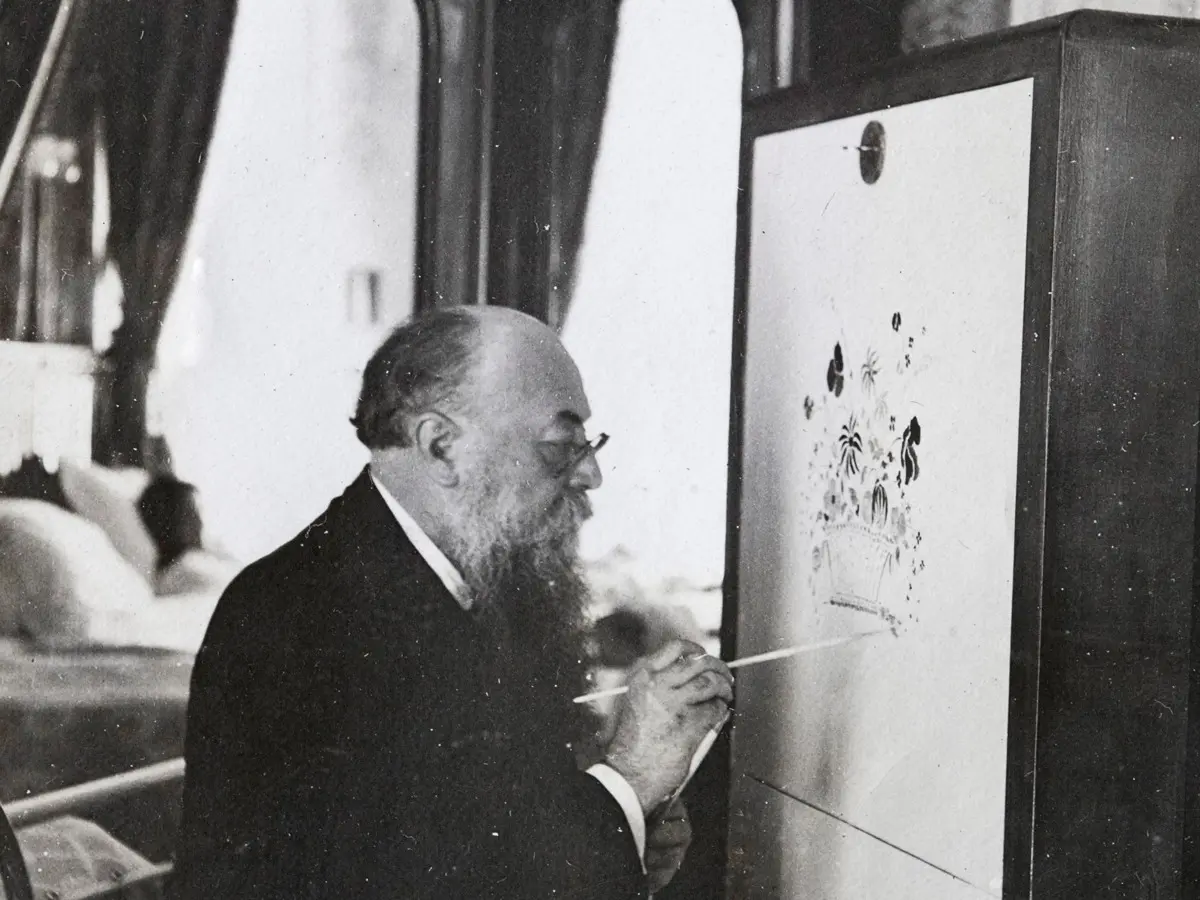
Born into a wealthy family of southern French winegrowers, Gustave Fayet inherited both considerable financial security and a deeply embedded appreciation for the arts. His father and uncle were passionate amateur painters who worked in the nature-inspired realist style of the Barbizon School. Immersed in this creative environment from youth, Fayet developed a perceptive eye that later guided his adventurous collecting philosophy.

Though Fayet occasionally tried his hand at painting—producing naturalist landscapes and later color-rich, stylized experiments clearly influenced by his inner circle—his true genius lay in his curatorial audacity. He possessed what co-curator Angeline Scherf describes as a "particular sensitivity" toward art that elevated color, tapped into nature, and championed fantasy and mysticism over rigid academic realism.
The Turn-of-the-Century Mecca: Abbeys, Homes, and Avant-Garde Luminaries
By the turn of the 20th century, Fayet had achieved legendary status in Parisian art circles for housing what contemporaries colloquially referred to as his private "Gauguin museum"—an astonishing holding of roughly 200 works across multiple mediums—alongside a dedicated room for his van Gogh holdings. At a time when public institutions in France routinely shunned these radical painters, private sanctuaries like Fayet’s estates were the sole places to engage with their work.
His lavish residences became magnets for an illustrious roster of thinkers and creators. Visitors to Fayet’s homes included artists such as:
- Pierre Bonnard
- Maurice Denis
- André Lhote
- Henri Matisse
- Pablo Picasso
- Édouard Vuillard
They were joined by prominent literary figures like Edith Wharton, André Suarés, and Colette, as well as fellow pioneering collectors Sergei Shchukin and the Morozov brothers—whose own legendary collections have also been celebrated in past FLV exhibitions.
The Restoration of Fontfroide Abbey
Fayet’s vision reached its physical zenith when he acquired the medieval Fontfroide Abbey in southwest France. He painstakingly restored the architectural landmark, transforming it into a personal Gesamtkunstwerk (total artwork).

The exhibition’s climactic final rooms pay homage to this endeavor with a chapel-like scenography. This space features vibrant, color-bursting stained glass designed by Richard Burgsthal, whom Fayet commissioned for the abbey. Furthermore, the exhibition showcases a monumental Symbolist suite commissioned by Fayet in 1908 from Odilon Redon for the abbey’s library. Comprising the triptych Day, Night, and Silence, these works beautifully bridge Redon’s early, monochromatic "Noirs" (dreamlike charcoal drawings and lithographs dominated by floating eyeballs) with his explosive transition into luminous color, abstraction, and floral motifs.
Supporting Context & Metrics: The Anatomy of a Dispersed Collection
During his lifetime, Fayet is estimated to have held roughly 750 artworks at any given moment. However, his collection was defined by constant flux. Rather than maintaining a static vault, Fayet frequently traded, bartered, and sold pieces, occasionally capitalizing on resale profits.
Total Estimated Peak Holdings: ~750 Artworks
Key Collection Tally Featured in the FLV Exhibition:
- Odilon Redon: 86 works
- Paul Gauguin: 78 works
- Vincent van Gogh: 10 works
- Paul Cézanne, Edgar Degas, Henri de Toulouse-Lautrec,
  Pierre-Auguste Renoir, Berthe Morisot, Paul Signac,
  Pierre Bonnard, Edouard Vuillard, Henri Matisse: Multiple works
Despite the sheer scale and historical importance of these holdings, Fayet’s legacy nearly vanished from public consciousness. After his death, his family did not actively preserve his collection or archive, and Fayet himself donated only two paintings (both by 19th-century artist Adolphe Monticelli) to the Louvre during his lifetime.
Networks of Influence: Advisers and Collaborators
Fayet was not a solitary tastemaker operating in a vacuum. Instead, he relied heavily on a trusted network of artist-friends who possessed exceptional radar for new talent:
- Emile Schuffenecker and George Daniel de Monfreid were instrumental in steering Fayet’s attention toward van Gogh and Gauguin.
- Maurice Fabre, Fayet’s childhood friend, art critic, and fellow collector, acted as his primary guide into the heart of the French art world.
Interestingly, Fayet’s eye was not infallible. While he once declared Paul Cézanne "as great a painter as Rembrandt," he harbored periodic doubts about Cézanne’s market longevity, leading him to resell several Cézanne canvases that today rank among art history’s most coveted treasures.

Official Statements & Curator Insights
Speaking exclusively to ARTnews, exhibition co-curator Sylvie Patry underscored the profound historical value of Fayet’s early conversions:
"[Fayet] was important, because he was one of the first in France to understand van Gogh, Gauguin, and to support Odilon Redon. He was adventurous in a really positive sense, and had a form of audacity in his choices."
Addressing Fayet’s complex reputation as both an aesthetic visionary and a pragmatic buyer, Patry noted:
"He made a few nice deals with some Gauguins, but if he was really collecting in order to speculate, he’d have done it more systematically. Instead, when the opportunity presented itself, he sometimes jumped. He didn’t like losing money and tended to come out even in the end."
FLV Artistic Director Suzanne Pagé contextualized the museum’s bold decision to dedicate an entire fall season to a relatively obscure historical figure rather than a universally recognized household name:

"Exhibitions on subjects that haven’t been addressed fall squarely within our remit. Especially when it offers an opportunity to present major works of modernity that have never been shown in France."
Pagé further reflected on the fierce resistance the French avant-garde faced at the dawn of the 20th century:
"The masses in France were completely against this kind of French avant-garde art at the time, because the most important artists break the rules. It’s first and foremost through other artists that other [avant-garde creators] are discovered."
Future Outlook & Museum Significance
The Fondation Louis Vuitton’s "Gustave Fayet, Collector-Designer: Icons of Modern Art" does far more than dust off forgotten canvases; it rewrites the mechanics of how artistic canons are forged. By reuniting historic milestones—such as a rare trio of Christ-themed Gauguins (Self-Portrait with the Yellow Christ, Le Calvaire Breton, and The Yellow Christ, the latter serving as a manifesto of Synthetism) that have never before been exhibited together in France—the exhibition offers a masterclass in contextual curation.
At the same time, the exhibition thoughtfully addresses the darker, more complex dimensions of its subjects. Wall texts confronting Gauguin’s exploitation during his time in Tahiti—where he lived with underage local girls while simultaneously pioneering a shift toward viewing Polynesian forms through an aesthetic rather than ethnographic lens—demonstrate a modern, rigorous art-historical transparency.

As museums globally grapple with how to present historical collections through contemporary frameworks, the FLV’s resurrection of Gustave Fayet stands as an inspiring benchmark. It reminds us that behind every monumental shift in art history lies a daring patron willing to bet his fortune, his homes, and his reputation on the rule-breakers of tomorrow.
“Gustave Fayet, Collector-Designer: Icons of Modern Art” remains on view at the Fondation Louis Vuitton in Paris through March 8.

Comments
Facebook App ID not configured. Please add it in the Customizer.