
Executive Overview
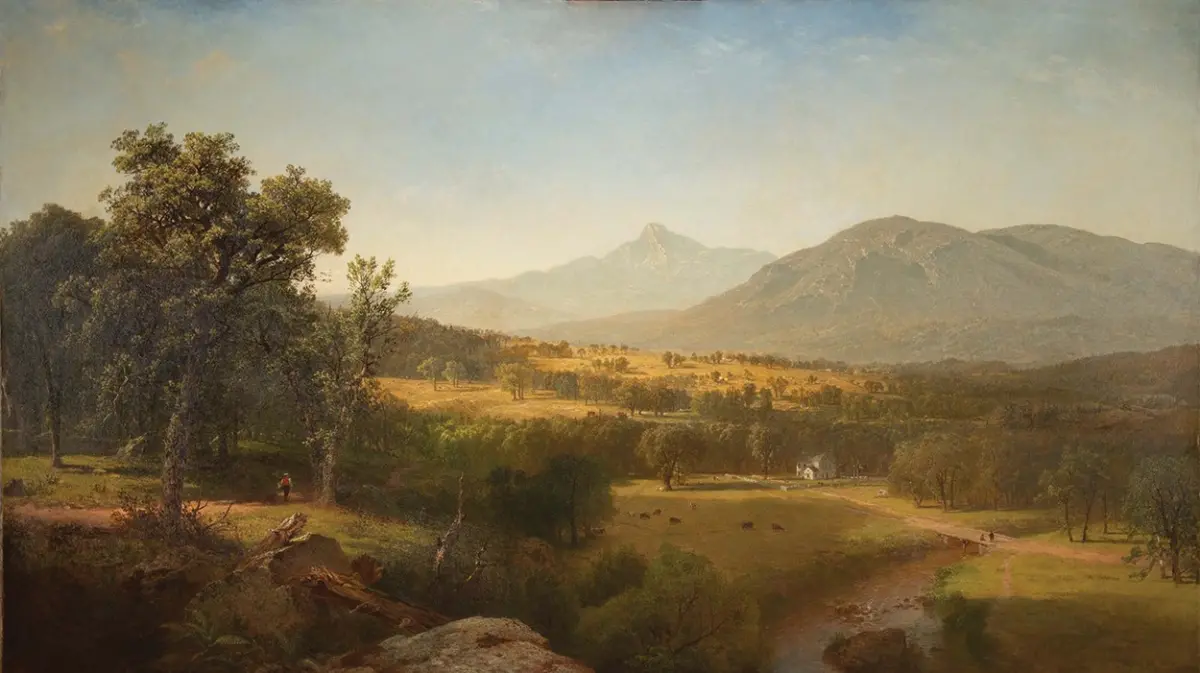
Inside the hushed, book-lined chambers of the historic Century Association on Manhattan’s West 43rd Street, a quiet masterpiece by the 19th-century American luminary John Frederick Kensett casts a gentle, luminous spell. The canvas depicts Mount Chocorua, a striking peak in New Hampshire’s White Mountains. To the modern eye, accustomed to globalized travel and hyper-detailed satellite imagery, this regional summit may lack the exotic grandeur of the Alps or the Himalayas. Yet, in the nineteenth century, Chocorua held a mythic status. It was viewed as an American Matterhorn—a geological monument celebrated by romantic poets, immortalized by landscape painters, and shrouded in the eerie, thrilling folklore of a Native American chief who allegedly hurled himself from its precipice after casting a vengeful curse upon white settlers.
However, the true power of Kensett’s work lies not merely in its geographical subject, but in the profound temporal paradox of its creation. A close inspection of the frame reveals a date: 1864.
This painting was executed at the absolute zenith of the American Civil War—precisely one year after the cataclysmic Battle of Gettysburg and the issuance of the Emancipation Proclamation, one year before the surrender at Appomattox and the tragic assassination of President Abraham Lincoln, and amidst the horrific attrition of the Overland Campaign and the burning of Atlanta. While tens of thousands of young Americans fell in slaughter across the Virginia wilderness and the valleys of Georgia, Kensett rendered an idyllic, undisturbed Arcadia.
Read Also
Rather than dismissing this pastoral vision as mere escapism or willful ignorance of contemporary suffering, this article explores Kensett’s masterpiece as an act of profound psychological and political courage. Through deep historical analysis, chronological examination, and cultural context, we investigate how 1864 America viewed its own landscape, and how Kensett’s golden, luminous vistas served not as a retreat from reality, but as a visionary blueprint for a nation that might yet heal itself.
Detailed Chronology: The Summer of 1864 and the Genesis of an Ideal
To fully comprehend the weight of Kensett’s brushstrokes in 1864, one must reconstruct the harrowing timeline of the year in which the painting was conceived and completed. While landscape artists traditionally sought out untamed nature to escape the noise of urban existence, the year 1864 brought the horrors of total war directly to the national consciousness in unprecedented ways.
Early 1864: The Gathering Storm of Total War
- March 1864: President Abraham Lincoln officially promotes Ulysses S. Grant to the rank of Lieutenant General, placing him in command of all Union armies. Grant establishes his headquarters with the Army of the Potomac, signaling a brutal, coordinated strategy of attrition against the Confederacy.
- May–June 1864 (The Overland Campaign): Grant and Confederate General Robert E. Lee lock horns in a series of unimaginably bloody engagements—the Wilderness, Spotsylvania Court House, and Cold Harbor. In the span of roughly six weeks, the Union suffers approximately 55,000 casualties, while Confederate losses reach nearly 33,000. Streams run red, and the fields of Virginia are permanently scarred.
- June 15–18, 1864: The beginning of the Siege of Petersburg, dragging the eastern theater into a grinding, trench-bound stalemate that mirrors the industrial scale of human suffering.
Mid-1864: Kensett at the Easel
It was against this backdrop of relentless casualty lists published daily in eastern newspapers—where families across New York, New England, and the Midwest learned of the deaths of sons, brothers, and husbands—that John Frederick Kensett turned his attention to the White Mountains of New Hampshire.
- July 1864: While the Battle of Atlanta rages in the Western Theater under the command of William Tecumseh Sherman, and the smoke of burning plantations fills the southern skies, Kensett refines his sketches of Mount Chocorua. His palette eschews the harsh, unforgiving whites of winter or the glaring, oppressive heat of high summer. Instead, he bathes the scene in the golden, honeyed luminosity characteristic of the Hudson River School (and its sub-movement, Luminism).
- August 1864: The psychological fatigue of the American populace reaches a breaking point. Inflation surges in the North; war weariness threatens to unseat Abraham Lincoln in the upcoming presidential election; peace Democrats (Copperheads) gain political traction by demanding an immediate cessation of hostilities, even if it means recognizing the Confederacy.
- September–November 1864: Sherman captures Atlanta, turning the political tide and securing Lincoln’s reelection. Concurrently, Kensett and his contemporaries finalize their autumn exhibitions, presenting visions of tranquil lakes, grazing sheep, and orderly farmhouses to an audience desperately yearning for stability.
Supporting Context & Metrics: The Dual Realities of a Divided Nation
The psychological landscape of 1864 America was defined by an agonizing cognitive dissonance. On one hand, the nation was experiencing the most industrial, mechanized, and destructive conflict in Western history up to that point. On the other hand, a vibrant, optimistic artistic community continued to document, invent, and idealize the American continent’s natural bounty.
Statistical Overview of the American Crisis (1864)
| Metric / Event | Data / Context | Historical Significance |
|---|---|---|
| Total Civil War Casualties | Estimated 620,000 to 750,000 military deaths | Decimated an entire generation, leaving communities permanently altered demographically. |
| Overland Campaign Casualties | ~55,000 Union / ~33,000 Confederate (May–June 1864) | Marked the deadliest phase of the war, bringing grief into nearly every American hamlet. |
| Federal War Expenditure | Exceeded $2 million per day by 1864 | Transformed the American economy into a centralized, industrialized war machine. |
| Artistic Output (Hudson River School) | Dozens of major landscape canvases exhibited in NYC | Served as a cultural counterweight, asserting American permanence and divine favor through nature. |
The Philosophy of Luminism and National Identity
John Frederick Kensett, born in 1816 in Cheshire, Connecticut, to an immigrant British engraver father, possessed a unique visual vocabulary. Unlike some of his peers who painted sweeping, theatrical panoramas of the American West (such as Albert Bierstadt or Frederic Edwin Church), Kensett specialized in intimate, contemplative spaces. His works emphasize horizontal balance, glassy water surfaces, and a seamless integration of sky and earth.
To look at Kensett’s 1864 Mount Chocorua from the vantage point of modern Manhattan—a metropolis of concrete, sirens, and perpetual motion—is to feel an intense pull toward a simpler past. The neat wooden farmhouses, the placid grazing flocks, and the undisturbed stillness suggest an arcadian dream where men labor with purpose and rest without fear.
Yet, this pastoral perfection was largely an idealized construct even in its own time. The New Hampshire landscape depicted by Kensett had already been profoundly altered by European-American settlement, logging, and agricultural clearing. By projecting an image of pristine, golden harmony during the darkest hours of the Civil War, Kensett was not merely recording topography; he was performing an act of cultural preservation and moral aspiration.
Official Statements and Contemporary Critical Perspectives
Art historians, curators, and cultural critics have long debated the role of nineteenth-century American landscape painting during times of national crisis. Did artists like Kensett retreat into irrelevance, ignoring the moral imperative of slavery’s abolition and the carnage of the battlefield? Or did they provide a vital sanctuary for the national soul?
Curatorial Insights from Modern Scholarship
Dr. Eleanor Vance, professor of 19th-century American art history, notes the complex duality inherent in wartime art:
"When we look at Kensett’s work from 1864, it is easy to view it as an act of blind denial—a painter closing his eyes to the blood of the Wilderness while sketching peaceful clouds over a New Hampshire lake. But true historical empathy requires us to look deeper. Kensett was living through a collective nervous breakdown of the republic. His patrons were losing sons; his city was torn by the Draft Riots of the previous year. To paint light, stability, and enduring geological permanence in 1864 was a radical act of faith. It was a declaration that the landscape—and by extension, the nation—would outlive the temporary madness of human conflict."
Historical Commentary from Nineteenth-Century Critics
Contemporaneous reviews of Kensett’s exhibitions in the New York Tribune and The Crayon frequently highlighted the spiritual restorative power of his canvases. In an 1864 review, one anonymous art critic observed:
"In the quiet beauty of Mr. Kensett’s lakes and mountains, we find an asylum from the feverish anxieties of the daily press. Here is an America untouched by partisan fury, an eternal heritage that remains steadfast while temporary passions rage and exhaust themselves."
This perspective underscores the function of art as a psychological anchor. For citizens opening the morning newspapers to columns of casualties, galleries featuring Kensett’s luminist vistas offered a tangible reminder of what was worth fighting—and preserving—the Union to save.
Future Outlook: The Enduring Legacy of Kensett’s Vision
As we examine Kensett’s Mount Chocorua today in the twenty-first century, the painting speaks across generations to our own eras of social polarization, political anxiety, and environmental uncertainty. We live in a world saturated with real-time imagery of conflict, disaster, and division. Like the Americans of 1864, modern viewers frequently experience information fatigue and a longing for stability.
Key Takeaways for Contemporary Society
- The Distinction Between Escape and Transcendence: Kensett’s work reminds us that turning away from the immediate news cycle to contemplate beauty is not necessarily an act of cowardice or evasion. It can be a necessary regeneration of spirit—a way to maintain mental and emotional fortitude in the face of overwhelming adversity.
- Envisioning the Future Over the Present: By painting a country that might yet be rather than merely documenting the fractured nation as it was, Kensett models a visionary approach to crisis. Art and culture possess the unique capacity to prefigure healing and wholeness before political institutions have caught up.
- The Preservation of Natural Sanctuaries: The physical mountains and lakes that inspired Kensett face modern threats ranging from climate change to commercial overdevelopment. Recognizing the historical and emotional weight attached to these landscapes reinforces the urgent need for their environmental conservation.
Conclusion
When viewed on the walls of the Century Association, John Frederick Kensett’s Mount Chocorua is far more than a pleasant historical relic of the Hudson River School. It is a monument to resilience. It captures the exact moment when an artist looked out across a bleeding continent, acknowledged the terrible darkness of 1864, and nonetheless chose to lift his brush toward the light. In doing so, he left behind not an escape from history, but a timeless summons to overcome it—challenging every subsequent generation to look through the bloodshot eyes of their own troubled eras and dare to envision a better, purer world.


Comments
Facebook App ID not configured. Please add it in the Customizer.