
Executive Overview
In a significant branding and structural pivot, Amazon has officially phased out its long-running Kindle Unlimited moniker, transitioning the flagship e-reading and subscription service to Kindle+. This marks the very first time the technology giant has fundamentally overhauled the naming convention of its premier reading subscription ecosystem since its inception. Designed to signal a broader, more integrated multimedia subscription model, Kindle+ aims to unify text-based reading with audio content under a single umbrella.
However, the rollout has been far from seamless. The transition has exposed a web of systemic bugs, inventory mapping errors, and broken checkout pathways across international storefronts in the United States, United Kingdom, and Canada. Adding fuel to the fire, the architectural backbone of the new Kindle+ service heavily incorporates automated artificial intelligence.
By leveraging its proprietary "Virtual Voice" text-to-speech technology, Amazon is rapidly scaling its audiobook catalog, making AI-narrated titles available automatically to Kindle+ subscribers via Kindle Direct Publishing (KDP) Select integration. While this move massively expands the platform’s content library overnight, it has ignited a fierce debate among consumers, industry analysts, and purists regarding the degradation of quality, the displacement of professional voice actors, and the future value proposition of digital subscriptions.
Read Also
Detailed Chronology: The Rough Launch of Kindle+
The transition from Kindle Unlimited to Kindle+ began rolling out quietly behind the scenes before making its public debut across Amazon’s global web infrastructure. What was intended to be a streamlined rebrand quickly spiraled into a logistical and user-interface nightmare.
The Immediate Post-Launch Disconnect
Within hours of the Kindle+ designation going live, users navigating Amazon’s digital storefront encountered a confusing patchwork of legacy branding and broken pathways. Because Amazon’s inventory management systems failed to update synchronously, consumers attempting to purchase hardware—such as the upcoming, highly anticipated Kindle Colorsoft Signature Edition—were still greeted by legacy references to "Kindle Unlimited."
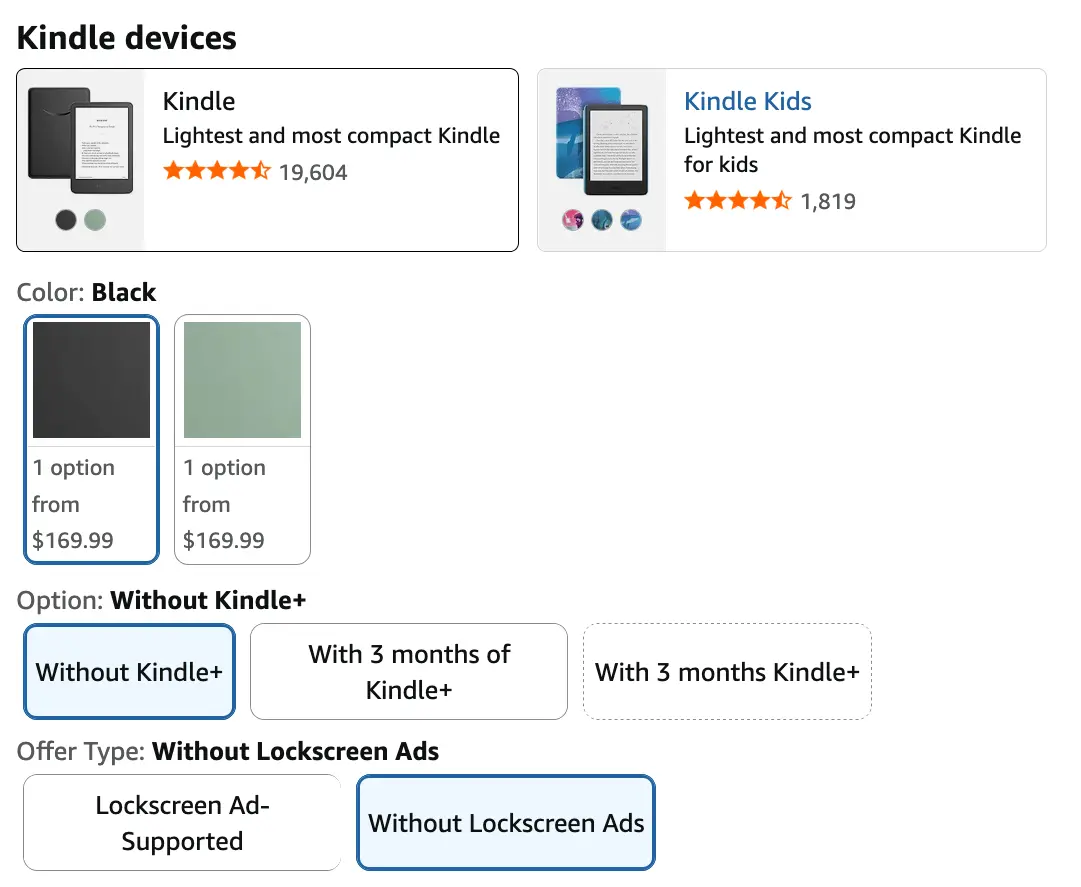
Conversely, customers purchasing standard 11th-generation Kindles in black or matcha colorways faced conflicting product options. The checkout page featured a perplexing layout: one variant explicitly stated "without Kindle+," sitting directly adjacent to mismatched text boxes of varying dimensions that haphazardly declared "With Kindle+."
Hardware-Specific Omissions
The deployment errors extended beyond mere text mismatches. Certain newly introduced hardware iterations, including the fresh line of Kindles featuring premium aluminum backplates, inexplicably failed to offer any option to bundle or enroll in the newly minted Kindle+ service at checkout. Rather than presenting a unified upgrade path, the hardware purchase flow became an obstacle course of missing toggles and unlinked SKUs.
International Fall-Out
While initial reports of these bugs surfaced on the primary United States portal, international consumers in the United Kingdom and Canada quickly reported identical interface anomalies. International storefronts displayed a chaotic mix of legacy branding banners, broken promotional links, and conflicting subscription terms, prompting widespread confusion across reader forums and digital communities.
Supporting Context & Metrics: The AI Audiobook Expansion
At the heart of the Kindle+ transition lies a strategic ambition: transforming a traditional e-book subscription library into an all-encompassing media ecosystem. The primary vehicle for this transformation is the aggressive integration of audiobooks. However, rather than commissioning traditional studio recordings at scale, Amazon is relying almost entirely on generative AI to populate its expanding catalog.
The Mechanism of Virtual Voice
Amazon’s "Virtual Voice" technology allows independent authors participating in Kindle Direct Publishing (KDP) to convert their written texts into spoken-word audiobooks at zero upfront cost. Under the rules governing KDP Select, once an e-book is enrolled in the program, its newly minted AI-generated companion audiobook is automatically injected directly into the global Kindle+ subscriber catalog.

This frictionless pipeline has allowed Amazon to scale its audiobook inventory exponentially within a matter of weeks—a feat that would have taken decades using traditional human recording methods.
Market Dynamics and the Scaling Imperative
- The Content Gap: Traditional audiobooks require casting actors, renting professional recording studios, hiring audio engineers, and undergoing rigorous post-production editing. This limits the speed at which niche independent titles can receive audio adaptations.
- The AI Shortcut: By automating the process, Amazon bridges the gap for millions of long-tail indie titles, making virtually every book on the platform "listenable."
- Geographic Rollout: The integrated audiobook feature—complete with its controversial AI Virtual Voices—is initially deploying to US-based subscribers and authors, with a staggered international rollout planned for the UK, Canada, and secondary markets over the coming quarters.
Expert Analysis: The Quality Conundrum and Subscriber Backlash
The shift toward AI-generated narration within a paid subscription tier has triggered sharp criticism from industry veterans and longtime consumers alike.
The Decline of Production Standards
Professional narration is an art form. Trained voice actors utilize pacing, emotional inflection, distinct character voices, and subtle nuances to breathe life into text—a process executed in acoustically treated environments under the guidance of professional directors and sound engineers.
In contrast, automated Virtual Voice technology, while rapidly improving, frequently struggles with complex emotional beats, mispronounced foreign or invented fantasy terms, flat cadence shifts, and unnatural pauses. For avid listeners who view audiobooks as a high-end artistic medium, the sudden influx of unvetted AI narration into a premium subscription service feels like a severe downgrade in quality.
The "Subscriber’s Gamble"
Subscribing to Kindle+ exclusively for audio content has effectively become a high-stakes gamble. Navigating the catalog no longer guarantees a professionally produced performance. Instead, users are forced to manually sift through thousands of titles, hunting for the increasingly scarce marker of a human narrator amidst a sea of algorithmic conversions.
Industry analysts point out two inevitable paths for this trend:
- Mass Churn: Frustrated subscribers, weary of playing audio roulette, may begin canceling their Kindle+ renewals en masse, viewing the expanded audiobook catalog as bloated with low-quality filler.
- Catalog Segregation: Amazon may be forced to bow to consumer pressure by introducing strict categorization filters—segregating human-narrated works from AI-generated Virtual Voices, much like the ongoing debates surrounding AI-generated e-books and cover art.
Future Outlook: Where Goes Kindle+?
The rebranding of Kindle Unlimited to Kindle+ represents a pivotal moment for Amazon’s digital reading division. By attempting to marry unlimited e-book access with an infinitely scalable AI audiobook repository, Amazon is betting that volume and convenience will outweigh traditional standards of artistic craftsmanship.
Moving forward, the success of Kindle+ will hinge entirely on how Amazon manages user expectations and curation tools. If the platform fails to introduce transparent labeling and robust filtering options that allow users to cleanly separate professional studio recordings from automated synthetic voices, the service risks alienating its most loyal base of readers and listeners.
As international rollouts proceed and software engineers scramble to patch the persistent UI bugs plaguing the storefront, Amazon must decide whether Kindle+ will stand as a beacon of innovative multimedia integration or a cautionary tale of algorithmic overreach in the creative economy.





Comments
Facebook App ID not configured. Please add it in the Customizer.